

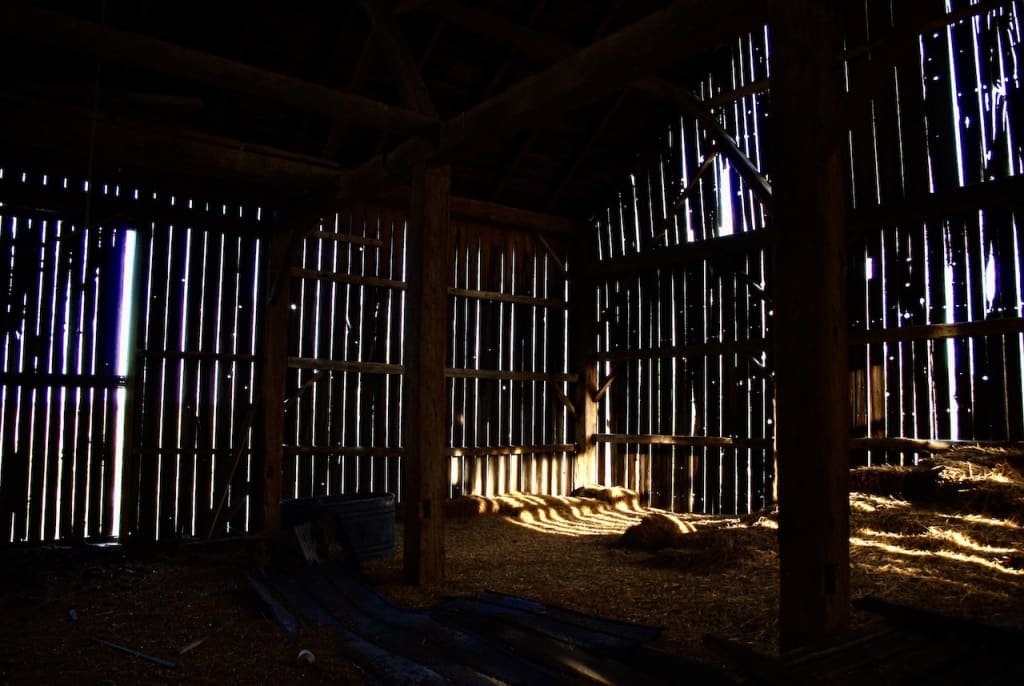
I step into the barn, and the smell ignites flames of old memories. Musty and old, but far from unpleasant, the barn is dark and cool and familiar.
It’s been years since I was last in here. I may have changed, but aside from a few extra broken boards, this barn hasn’t. I know where to step, and I still look for the old names written in the cement: Tom & Mary Michaels, 1899. This farm has been in my family for over a century.
My parents weren’t farmers. Like me, my father left for the city to pursue any career that wasn’t farming. He was the younger brother and glad of it; the farm went to my Uncle Todd. He died young, though, and Dad found himself back here with his new wife and baby: me. My parents rented out the land, the barn stopped being used, and as much as Dad resented the place growing up, he couldn’t bring himself to sell it. So, rather than make the decision himself, he put it on me. He and mom were finally moving after all these years. If I wanted the farm, I could have it, and if not, they would sell it for me.
I always thought I would sell it when I was young. I was surrounded by farmers, and in teenage naiveté and desperation to be different, I vowed that I would move to the city and never live here like the generations before me. And when I got the call from my parents, I echoed those sentiments; I told them they could sell.
But when I hung up the phone, I felt a dull pang in my chest. It was the lonely ache of nostalgia, not without some regret for the way I had dismissed the place for so many years, and for the people I had left behind. I sat with my thoughts and the ache all night, and the next morning, I called my parents back.
“Not yet,” I told them.
———
I step over soft, mouldering straw, avoiding old boards studded with even older nails. Eventually I get to the bottom of the ladder leading up to the loft, and climb up to the top.
It’s brighter up here. Light streams through the cracks between the boards, illuminating the barn with a golden glow. Most of the straw had been cleared from up here years ago, though some still sits in the corner and all the old planks are covered with a dusting of it. Some of the older boards that make up the walls have broken off over the years, and the higher ones lend a view to the sky and the tops of nearby pine trees. Although the sky is blue now, I know what it’s like to lie in here at night, on pillows and blankets sneaked out of my parents’ house, looking through those broken pieces to see stars twinkling and the moon shining.
I turn, and walking away, I trip over the head of a nail sticking up out of the floor. Cursing at it, I bend down, and examine it. A torn, red piece of cloth is attached to it, and I know exactly what it’s from. The quilt it’s torn from lies in my childhood bedroom.
I leave the thread where it is, preserving the memory.
I’m not sure why I’m in here, to be honest. I’ve visited my parents countless times over the years since moving out, and I haven’t stepped foot in this old barn once. There was no reason to, I suppose. We spend time on the patio, on the front porch, and going for walks in the bush behind the barn, but not going in the barn itself. I don’t think my parents ever come in here either, judging by its state of disuse.
I walk to the other side of the barn and stare down through a gap where a board has broken and fallen off. Next to the barn lies my parents’ vegetable garden, thriving with peppers, tomatoes, cucumbers, and peas. Squash flowers bloom bright orange in the thick of green. I make a mental note to pick the ripe vegetables before I go back into the house.
“Your mom said you’d be in here,” says a voice behind me, making me jump.
“Cam,” I say, knowing the voice immediately despite not hearing it for years. It’s engrained in my memory, etched into brain like my best friend’s birthday, the taste of my mother’s chicken soup, the layout of this barn. I turn around to face him. “How did you know I was here?”
“Just said. Your mom told me,” he said, looking bemused.
“Not here in this barn. Here,” I gesture widely. “Home.”
“I didn’t. Came by to drop off a bundle of corn for your mom and dad, and your mom told me you were out here,” he shrugged, then added: “I was as surprised as you are.”
He steps into the loft and trips over the same nail, and I laugh before catching myself. Cursing more mildly than I had, he looks down and laughs too.
“Oh, wow. That’s where you—” he breaks off as I hold up my hand to show the scar. “That did not heal well,” he says.
“I think the doctor was drunk,” I say.
“We were drunk, I know that. I thought you were going to die.”
“I thought there was so much blood, and then I realized it was mostly wine,” I say, reliving the memory.
It was the summer before I left for university. I had woken up to twigs and pebbles hitting my window, and at Cam’s signal to come downstairs, I grabbed pillows and blankets from my bed and quietly snuck out the back door of my parents house. Cam was waiting for me outside with a bottle of wine and two glasses.
“Let’s celebrate,” he says. End of high school, starting postsecondary, summertime—I’m not sure what we were celebrating. But we went up to the loft of the barn like we had hundreds of times before, since we were old enough to climb the ladder.
We had always loved each other. Living just one farm over from each other, we used to ride our bikes to each other’s houses. I was just six months old when we moved here; we were practically born friends. It changed as we got older, as most people predicted it would. We had always vowed it would never change, that we would always be just friends. We were wrong, though, and eventually we knew we were more than that. It wasn’t dramatic. We had always been on the same page about nearly everything, and how we felt about each other was no different. The only thing we weren’t on the same page about was the future, which turned out to be a very big thing.
“I was so mad your parents wouldn’t let me go to the hospital with you,” said Cam, breaking me out of the past.
“I know. It was the only time I’d ever seen you cry.”
He looks sheepish. “I’d had a lot of wine.”
“Do you still cry when you’ve had a lot of wine?” I tease. It’s always like this when we see each other. It’s awkward for all of two seconds until we naturally fall back into being friends.
“I’ve avoided wine since that night, actually,” he replies. “So, no.”
“I can’t say the same, unfortunately.” We’re closer now, a friendly distance apart instead of standing near opposite sides of the barn.
“Do you still fall down and cut your hands open when you’ve had a lot of wine?” More teasing.
“Not for 13 years, now.”
We had brought a candle up to the barn with us for some light. It wasn’t the smartest thing to do, but nothing bad had come of it. We made a makeshift bed out of the blankets and pillows and poured ourselves healthy servings of wine. We both hated it, so we drank it quickly to get it over with. At the end of the hour, we had nearly finished the bottle.
I stood up, holding my half-full glass of wine, proclaiming that I was going to sneak another bottle out of the house. With the red quilt wrapped around me, I took a step toward the door, and the quilt caught on that one nail. Already having a hard time with balance thanks to the wine, I pitched forward toward the floor, landing with my hand still holding the now shattered wine glass.
Panic ensued, followed by a fairly alarming flow of blood from my wound down my arm. Cam ran to the side of the barn to open up the massive doors that led to the top of the hill. They groaned open, not having been used in over 15 years. Scooping me up, he ran back to the house, carried me inside, and woke my parents up in a drunken panic.
They drove me to the hospital, I got ten stitches, and shortly after that, I went away to university.
———
“My parents are moving out west,” I tell him abruptly.
He’s quiet for a moment before he speaks. “Finally. They’ve wanted to move since they got here.”
“I know,” I reply, looking down. “I think I never thought they actually would, you know? They talked about it for so long that it just seemed like crying wolf.”
We sit for a few more moments in silence. Eventually Cam walks over to the side of the barn, much calmer than he was years ago, and opens up the barn doors. Light pours in. It’s nearing sunset, and the sky is streaked pink and blue and gold. He sits down on the dusty planks and watches the sun slowly dip behind the trees that separate his property and ours. I sit by him, but not too close.
“So they’re selling then?” He asks the inevitable.
I pause before answering, not knowing what my answer is. “I don’t know,” I say truthfully.
He looks at me, one eyebrow raised. “So they’ve left it up to you.” It’s not a question.
“Yeah, they have.” I kind of laugh, but it comes out more as a huff. “I don’t know what to do, Cam. I never wanted to be a farmer. I never wanted this place, and I always thought they should sell it. But now that that might be a reality, I don’t want to lose it.” I finally look over at him, and he’s looking back at me. Whereas I know my face is worried, uncertain, his is one of resolve.
“Then don’t, Megs,” he says simply.
I look back out over the hill. The sun has almost sunk behind the trees now, and just a sliver of its electric orange glow remains. The light sifts through the trees in rays, landing on the grass and bushes and flowers. The side of the barn, though grey in its old age, is awash in deep golden light. It’s beautiful. I finally shift my gaze back to Cam, who hasn’t looked away from me. I look into his eyes, more familiar to me than anyone else’s.
“I won’t,” I say quietly, and we both look back out the doors as the sun dips out of sight. I hear him shifting, and then he’s next to me, his fingers touching mine. I lean my head on his shoulder, and we sit like that until the sun sets.
About the Creator
Alana S. Leonard
A long-time lover of reading and writing.
Keep reading
More stories from Alana S. Leonard and writers in Fiction and other communities.
Solace
I can’t stand another day out here. I’m exhausted. I’m feel like I'm losing my mind. There is no reprieve from the unbearable heat, but if I concentrate, I can almost remember the crisp air of nighttime. Stars shining above me, a cool breeze, the smell of rain. It all feels like a lifetime ago.
By Alana S. Leonard5 years ago in Fiction
Lightning Never Strikes Twice
The distant rumble, the sudden deluge, the crescendo of sound, the flash of light, the explosive energy — it never gets old. I became an amateur storm chaser about two years ago. My wife, Cindy suggested it. Sort of. She said, "Alex, you know this cancer is killing me. I've come to terms with that, but you're smothering me. Go join a band, write a book, or become a storm chaser, for all I care. I love you, but you need a hobby."
By Julie Lacksonen6 days ago in Fiction
Who is your "Person"?
It's important to recognize that you cannot go through life as easily on your own. My name is Elizabeth and I'm a survivor of child abuse and horrific trauma. Healing from trauma is not a quick fix and recognizing that it will take time, is part of the struggle.
By Elizabeth Woods4 days ago in Psyche



Comments
There are no comments for this story
Be the first to respond and start the conversation.