
Charlotte's Cobweb
Footnotes in the Rafters

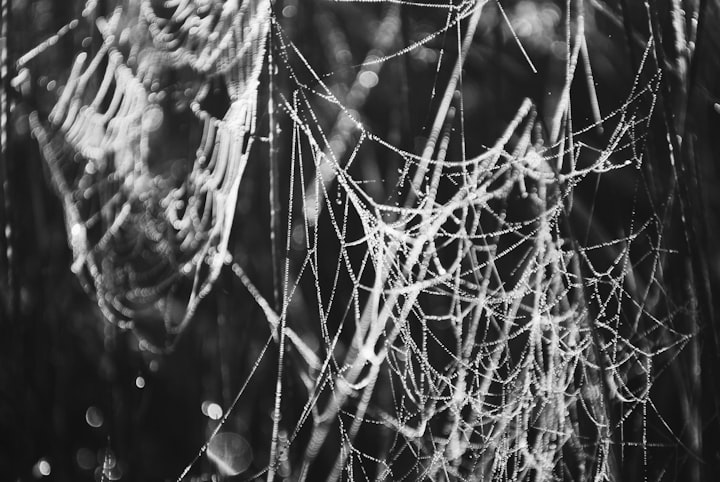
The Zuckerman farm in Maine had seen better days. The large barn’s original color had long faded into the streaked, bland hues to which all pigments under the sun succumb, even if one summer at a time. Three barn spiders each had set up webs, occupying three corners, with the fourth corner of the edifice left alone, sacrosanct. The three spiders never spoke to each other, instead going about their business of ensnaring, confining, and eating. Their victims came and fell into oblivion, as if never having even been, except for the meals they provided.
Because each page falls out as soon as it is turned, the book of oblivion is very thin, although its footnotes could fill volumes. Perhaps one day the footnotes and asides will see a proper typeface or be written into the text proper. The three spiders knew they would one day become their own footnotes, but life is for the reading, not for rereading irrelevant and impossibly small fonts at the bottom of a page.
The Zuckerman barn had once peaked with the goings-on of animal husbandry. The cacophony of the species that cohabitated here, once annoying, was now extinct. A once-productive pear tree stood twisted in putrefied and strandy obstinance to gravity, although gravity would soon win. So long had the pear tree sat unrealized, that it had long forgotten what fruit it made.
Life and death scenarios had played out at the pleasure of Homer Zuckerman himself, punctuated by periodic harvesting of pears from the tree. He would pick the pear he wanted to eat first, because it was his right as the farmer; the hired hands could gather the rest that were ripe.
Some pigs, like pears, were worth eating, too. Others, he learned, were worth keeping, and again they were his from which to pick and choose. One of the pigs, a humble one named Wilbur, had long since provided his own story—not in inconspicuous notes at the bottom of a page already fallen from its book’s spine—but in proper text and formatting. It stood on its own. Homer Zuckerman himself remained as only a footnote to Wilbur’s story, relegating him to the bottom of the page with the rest of the pears which just as well had never been. In the SEO of life, Wilbur outranked Homer.
In contrast, Wilbur had his own paragraph. He merited standalone prose, for this was "some pig," as some would say. He was noteworthy. His was a story worth telling.
Today what was left of that story hung in shreds of spidery threads in one corner of the dilapidated Zuckerman barn, a gossamer remnant of the deproteinated webbing from five generations ago, never blown away via the barn’s own weather system, its eddies and swirls engendered by spaces that indicated the long-removed doors and windows.
Below Charlotte’s corner was an old, rusty rat trap, its landed hammer fused to the bones of a once-fat, gluttonous rat; with the emotionless decision of an inanimate spring, his greed and selfishness died with him.
The once-peaceful smell of the barn had by now turned fetid, for other animals had chosen this retreat to die and become footnotes of all existence. The sweat breath of the cows had expired decades ago; the manure from healthy digestive systems was now part of the barn’s foundational strata.
One of the spiders, a female named Charlaine, had been a direct descendant of a lexicographic spider who, after helping that remarkable pig, had relied upon him for her legacy when he graciously had carried her egg sac back to the barn. The other two spiders, males, were strangers and unrelated to her or that ancient sac.
Of the three, Charlaine had been there the longest. She knew every bit of this barn and had even explored its periphery beyond the walls. She even once climbed the pear tree, only to return to her web disappointed in its lifelessness. She wondered how many lives on Earth were nurtured by the fruit it provided, seemingly unending in their blossoming into new stories that would add to the footnotes. The other spiders had never left their webs, but dutifully put them up and tore them down each and every day.
They did not share the reverence for that holy fourth corner of the barn that Charlaine had, so when they suggested that all three go to it and consume what was left of its silk as a biochemical recycling obligation to the natural world which they instinctively felt, only Charlotte’s descendant saw it as unnatural.
“Cannibals!” Charlaine shouted at them.
“It’s just old silk,” said Mumbo, one of the males. “Many spiders even eat their mates,” he said. “It’s only natural.”
“Like to do it myself,” said the other male, Jumbo, and cast an avaricious look at Charlaine with most of his eight eyes.
“Naturally,” said Mumbo. “It really is just webbing, after all,” he added.” Charlaine met Jumbo’s stare, but there was to be no blinking here. Eye lock between spiders usually ends in a death battle. While Mumbo held her in his locked gaze, however, Jumbo descended, making his move—declaring. Thus, it was afoot.
The barn was not a perfect square but rectangular. Charlaine’s own web was the one next to the Charlotte Memorial corner, so she figured she could intercept Jumbo in his scramble from his cater-cornered web if she got the angle right. But she was larger, so she was slower.
From the floor Charlaine could see the remnant of the old and bear pear tree. She thought about the continuity of life--one thing interweaving its story with all of the other things that walked, crawled, slithered, swam, and flew. Now the tree reached out only impotently to the world, its contributions timely spent.
Mumbo perched on a strand of his web, inert, watching them. He called out to both.
“Only one of you can prevail.” Then he laughed, adding, “And I hope you beat him senseless, sweetie, because I want to mate with you. It’s only natural.”
The running male, Jumbo, called out to Charlaine. “You think you’re gonna catch me, don’t you? Well, I’m going to mate with you. Me!” Then he called out to the stationary Mumbo, “What do you think of that, Mumbo? Gonna be me. Not you—me!”
Mumbo sang back,
“Jumbo and Charlaine, struggling on the floor
Making baby spiders ‘cause can always use some more
First he takes her on and then he makes her wife
Then he better disavow and better run for his life!”
Charlaine stopped to laugh. Jumbo didn’t get the joke. “Why don’t both of you mate with me?” she asked. There was considered silence from both males.
Now the running male, Jumbo, stopped all of his eight legs. Mumbo, who had remained on his web, now descended down a silky strand, intrigued. They both approached her from two directions. When they stopped, equidistant from her, they regarded each other.
“Both of us mate with you? Yes!” agreed Mumbo, “but me first.”
“No, me first,” said Jumbo.
“Boys, boys,” she said. “You can both go first.” The males unlocked their gazes at each other; something more important had come up than ending eye contact with battle.
“How do you figure that?” asked Mumbo.
“Yea, how can we both go first?” asked Jumbo.
“Simple,” she explained. “There are two holes in the floorboard in that old, unused corner. By the rat trap. Each of you go down one of the holes. I’ll drop into each hole, and you can mate with me.”
They eyed each other again, sixteen eyes sweeping back and forth. “How,” asked Mumbo, “will I know I was the first?”
“Or me?” asked Jumbo.
“Does it matter?” she answered. “Neither of you will know. So, it kind of works, don’t you see.”
“It does,” said Mumbo, who stood motionless in thought.
“Yes, I suppose it really does,” said Jumbo.
Sixteen eyes eyed two holes in the one barn. They made it a race to see who would get to his hole first, thinking it might influence Charlaine on whom to visit first. She even climbed up the ol' pear tree to watch their race, provoking more fuel for their speculation.
She had to laugh, because she envisioned, after returning to her web, spelling out on it, “Stupid men.” She considered which hole first, then she agreed with herself, “Does it matter? Ha! I think not.” She didn't even stay on the tree to see who took his hole first. She ran her legs across the threshold of the barn and then across its floor toward the holes, where her suitors waited in earnest.
She dropped down one of the holes. “You win,” she said to Mumbo, “you’re first.” He was ecstatic--one of his life's primary ecstasies. They mated and then she did what many female spiders did after mating: she ate him.
She crawled out of the hole, a little bigger and a little slower than she was before. She sauntered to the other side of the rat trap and then dropped into the second hole. “You win,” she said to Jumbo in his hole. “Yessiree, congratulations, you’re first.” He was ecstatic--one of his life's primary ecstasies. And after the obligatory mating, she ate him, too. Then, to herself she said, “it’s time I took back over the family homestead.”
She crawled out of the second hole, bigger and slower, up the wall to the corner her great-great-great-great-great-grandmother had occupied. She smiled. Peace at last. She gazed at the ancient pear tree and again waxed philosophical on the interactions of life that bump and grind into long lives, early deaths, or near-misses.
In a reverence for the old web the two males could never appreciate, she ate the remaining ancestral strands and gave them time to break down into the proteins she would need for her project. She would build a magnificent web and, like her great-great-great-great-great-grandmother had done, deliver a message in silk to the world like had been written when there were pigs and spiders and rats and farmers and pears.
Charlaine’s tenuous footnote in the friable book of life on Earth, were anyone to care to look for it, would likely read,
“I didn’t do much in my short, little life. I was born. I lived. I navigated death-defying obstacles. Like everything else that lived, I did both good and bad. I experienced abundance and want. I impacted others’ lives, even if I ate them sometimes. I reproduced and put forth many young into this wonderful world, just so it would keep turning, and it turned just a little different because of me. I took nutrition from others and then it was my turn to give it back, so I died, having accrued my little life-passages day-by-day, until the end. I mattered.”
These were all the things she wanted to say before her message would mix with the otherwise gibberish of life past, as only an unread footnote, in a forgotten book that falls apart in the wind as quickly as it is written.
She reconsidered her new corner of the barn, rightfully hers by posterity; but it just wouldn't do for her memorandum to the world. Dark and out of sight, her historical family corner was only illuminated for a few minutes each day when the rising sun shined through the eastside missing window just right. Hardly a place for the magnificent web and the important announcement she intended.
She had a better idea. She took down her day's web and planned all night.
The next morning she floated down from her great-great-great-great-great-grandmother's corner on an umbilical cord of glistening silk. She began her descent just as the corner glistened in its daily sunrise radiance. She landed on the barn floor simultaneously with the traveling sunrise spot which honored her by escorting her along her entire procession toward the missing barn door.
She looked up with two superior eyes while the other six surveilled the environment horizontally. There it stood, once mighty with fruit but now a tombstone riddled with ants. This is where she and her spotlight separated. She began her methodical climb up the old pear tree until she reached an interspace between two gnarly branches that were separated perfectly for the geometry she envisioned.
Thanks to the extra nutrition she had garnered from those two incidental, eight-legged footnotes in the history of life on our Earth, she was able to spit out silk like nobody’s business. She finished by midmorning and it was truly magnificent, scalloped jewelry radiating from a perfect center. She rehearsed in her mind what she would write on it for all to see, but there was only so much room on a page, footnotes and all.
The ants on the tree scurried away for their little ant lives; this web was meant for shouting, not for appetizers. She wrote what she could fit, were there ever to be anyone to see it. She then vibrated against her web as long as she could, until she fell, lifeless, to the ground below.
Brandished across her work of art--her opus--four letters, two words, one footnote:
I WAS
It was a love letter.
About the Creator
Gerard DiLeo
Retired, not tired. Hippocampus, behave!
Make me rich! https://www.amazon.com/Gerard-DiLeo/e/B00JE6LL2W/
My substrack at https://substack.com/@drdileo
Keep reading
More stories from Gerard DiLeo and writers in Fiction and other communities.
Meow and Then
She lived alone with her cats, which is as alone as a person could get. She didn’t even have any worries living with her, like most folks do. Her mortgage had been paid off and she had no bills, so she never received anything in her mailbox that wasn’t junk mail. Her special needs trust was managed by a trustee who took care of the mundane costs of living, such as her utilities and phone bill, so the trustee, besides making sure the property taxes and phone were paid, didn’t do very much to earn his $800 each month.
By Gerard DiLeo5 years ago in Fiction
Veil of Subconscious Awakening
Images slide behind my eyelids like film cadres, bursting with meanings. In one moment, I’m speeding down the highway, making the speedometer swing wildly like a frantic pendulum. The next moment, I’m plunging from a falling plane, slowly crashing earthward. At home, I meet black cat’s green, googly eyes staring at me from the cavernous hollowness of the kitchen. When I turn for a moment, it disappears, and all I can see is a pair of blue suede shoes set up against the wall. I pick them up and put them on. When I glimpse at them again, they’ve become black as night, making me blink and flinch.
By Moon Desert7 days ago in Fiction
Tatt~Master
— Assembly Line Tatt Machine ~ Impressions to Impress — As I begin to understand more about the Tattoo Phenomenon. I've written silly, yet verbatim, dating site anecdotes in 'Frazzled.' So let me ask you: Would you be More attracted to someone slathered with tattoos, or Less?
By Jay Kantorabout 8 hours ago in Humor


Comments
There are no comments for this story
Be the first to respond and start the conversation.