
"Chandrayaan-3: India's Quest for the Moon"
"Chandrayaan-3: India's Triumphant Return to the Moon"

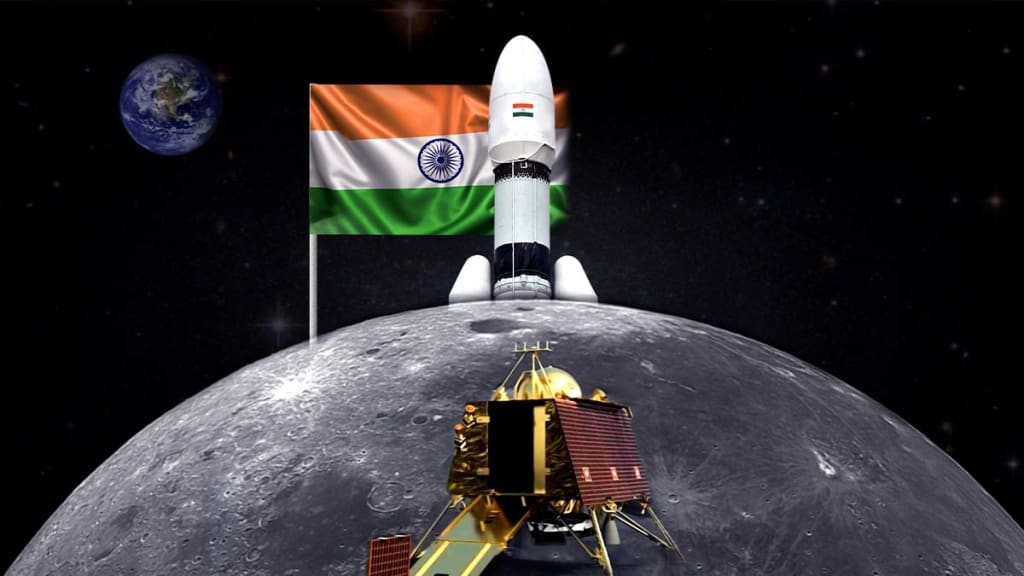
Once upon a time in the bustling city of Bangalore, India, a team of brilliant scientists and engineers at the Indian Space Research Organization (ISRO) was hard at work, preparing for a historic mission to the Moon. Their mission was called Chandrayaan-3, the third installment in India's lunar exploration program.
Chandrayaan-3 was born out of the success and lessons learned from its predecessors, Chandrayaan-1 and Chandrayaan-2. While Chandrayaan-1 had discovered water molecules on the lunar surface and Chandrayaan-2 had aimed to land a rover on the Moon's south polar region, Chandrayaan-3 had a different goal in mind – to perfect the art of lunar landing.
The previous mission, Chandrayaan-2, had faced a setback during its attempted landing. The Vikram lander had lost communication with Earth just moments before touchdown. This time, the ISRO team was determined to succeed.
The Chandrayaan-3 spacecraft was a technological marvel. It consisted of a lander and a rover, both equipped with state-of-the-art instruments to study the Moon's surface and geology. The scientists had also incorporated lessons from the past, making the spacecraft more robust and resilient.
As the launch date approached, the excitement and anticipation in India were palpable. People from all walks of life were glued to their televisions and smartphones, eagerly awaiting the liftoff of Chandrayaan-3. The mission was not just a scientific endeavor; it was a source of national pride.
Finally, the day arrived. Under a clear night sky, the powerful GSLV Mark III rocket roared to life at the Satish Dhawan Space Centre. A collective cheer erupted across the nation as the spacecraft embarked on its journey to the Moon.
The journey to the Moon was long and challenging. The spacecraft had to traverse vast distances through the cold vacuum of space. The ISRO team monitored every aspect of the mission with utmost precision.
After several days of travel, Chandrayaan-3 entered lunar orbit. It performed a series of complex maneuvers to position itself for the descent. The tension in the mission control room was palpable as the team meticulously followed each step of the descent.
Then, the moment of truth arrived. The lander separated from the orbiter and began its descent towards the lunar surface. The entire nation held its breath as the lander approached the designated landing site.
As the lander descended, the heart rates of the scientists and engineers increased. They remembered the challenges faced during Chandrayaan-2, but this time, they were determined to overcome them. The lander's descent was smooth and precise. It touched down gently on the Moon's surface, sending a resounding cheer through the mission control room.
The rover, named "Indra," rolled out of the lander and started its mission. It began exploring the lunar landscape, collecting valuable data about the Moon's geology, atmosphere, and history. The Chandrayaan-3 mission was an overwhelming success, and India rejoiced in its achievement.
The data sent back by Indra provided a wealth of information about the Moon, contributing to our understanding of our celestial neighbor. It also laid the groundwork for future lunar missions and possible human exploration.
Chandrayaan-3 became a symbol of India's scientific prowess and determination. It demonstrated that setbacks could be overcome with dedication and perseverance. As the spacecraft continued its mission, it reminded the world that the pursuit of knowledge knows no bounds.
And so, Chandrayaan-3 continued to explore the Moon, unlocking its secrets one discovery at a time, and inspiring future generations to reach for the stars.
About the Creator
Pelzang T
Hi! 👋 I'm a trader 📊 and writer ✍️ who simplifies complex trading ideas into clear insights. I love sharing tips on VIP indicators, market trends, and mindset. Let’s grow together through trading and storytelling! 🚀📚
Bomb Scare
It was 2027, and the world never thought it would happen. A missle hit the United States, but it wasn't where they had anticipated. A little town in the northeast was hit by a missile strike, they didn't know why, and they didn't know exactly where it hit, but they did know it was a coastal community, somewhere between Maine and Delaware.
By Gregory Payton7 days ago in Fiction
Chosen Ones
*From the writings of Brother Pavel, whilst serving his sentence of Solitude. Clergy eyes only. "When the sky turns wrong, and the ground quakes and splits, and Fate and Fortune feel their strength slip, seven there shall be who step forward. A Noble, with hair of gold. A Priest, with mission sacred. A Bard, with singing strings. An Archer, green eyes so keen. A Soldier, with painful past. A Thief, his family lost. And a Farmhand, born on a moonless night."
By Malcolm Roach6 days ago in Fiction
Hottest in the Office
Dear Rafi, You’re very distracting to work around. For the first second I saw you the other day, I thought you were some type of executive. It took a moment to realize no, you were just the new guy, dressed up for the job he wants. Be still, my heart.
By Gabriel Shames2 days ago in Pride




Comments (1)
Kelsang, Will we all one day walk on our neighbor, the moon?