
Carried Across the Dust
She had no milk. He had no mother. Still, they crossed the miles — together.

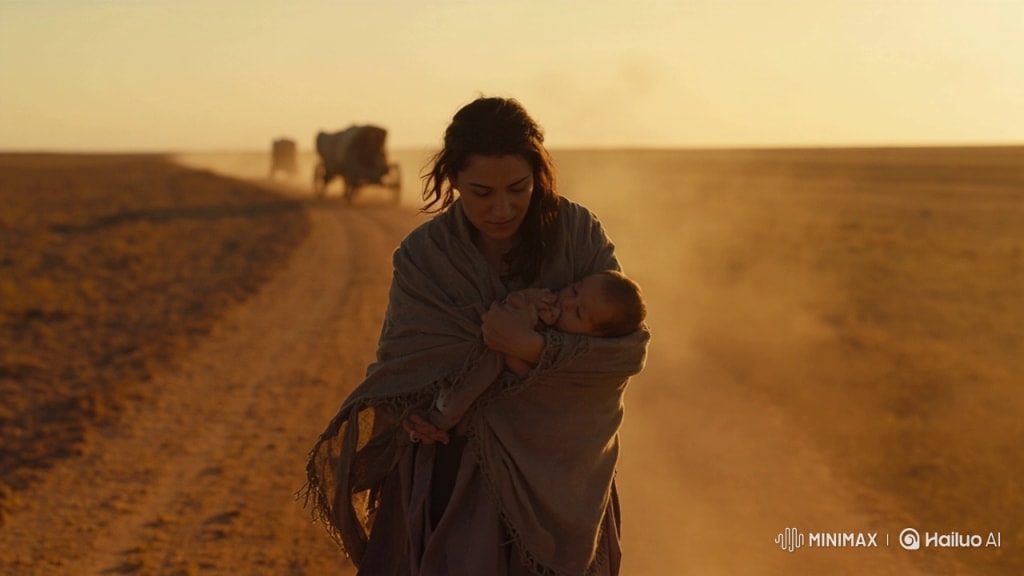
The child was heavier today.
Wrapped tight against her chest, his warmth seeped into her bones, already damp with sweat under the worn shawl. He slept the way he always did on the trail—mouth slightly open, fists curled near his chin, breath warm against her collarbone. The scent of him hung in the folds of her clothing. Thick with milk, slightly sour now, mingling with dust, sweat, and the faint smoke of last night’s fires.
She didn’t mind it anymore. It was the only thing in her life now that felt familiar.
They had been walking for weeks. Maybe longer. Maggie had stopped counting after the first few hundred miles. The wagon train rolled forward every morning and scattered every evening to make camp. Dust was their only constant companion.
The baby had no name. Or none that Maggie had been told. His mother had died two nights before Maggie found him, bundled loosely in rough cloth, squalling and red-faced in the arms of a distracted old man who had no idea what to do with an infant. The others in the wagon said it was only a matter of time. Motherless babes didn’t last long out here.
But Maggie hadn’t been able to look away.
Maybe it was the weight of the journey settling in her bones. Maybe it was the memory of her own empty arms. Whatever it was, she reached for him—and never let go.
Now he slept against her heart, unaware of the world’s hunger and cruelty. Unaware of his own luck.
“It’s alright for some,” she muttered under her breath.
Her feet ached with every step, the worn soles of her boots barely cushioning the bite of sharp stones. Every muscle screamed for rest, but stopping wasn’t an option—not here, not now. She glanced down at his small face, the curve of his cheek soft as butter, lashes dark against pale skin.
Four hundred miles. Maybe more by now. And still they walked.
The caravan was both danger and salvation. Maggie knew better than to trust everyone who traveled in it. She avoided the wagons with only men, kept to herself when she could, and slept with her small knife hidden in the folds of her skirts. But at night, when the fires were lit and the children cried for their mothers, she found them. The women. The mothers.
Each evening was the same.
As the wagons circled and camp took shape, Maggie would scan the spaces between canvas and wheel. Looking for the women who still nursed their own. They were easy to find—babies fussing at their breasts, mothers with that heavy look of exhaustion in their eyes, shoulders sagging with the weight of life and hunger.
Maggie would approach carefully. A polite greeting. A deferential nod of her head. And then the words she repeated like a prayer.
“Ma’am, your little one—does he still take the breast? Only, he’s got no mother, you see. And I’ve got no milk.”
Some women looked at her sharply at first, suspicion flaring behind tired eyes. But none ever refused. Not once.
“Come on then,” they’d sigh, adjusting their shawls and holding out their arms. “Poor little thing.”
And the boy would go to them eagerly, rooting and wriggling, as though the universe itself owed him that meal. And maybe it did.
Maggie always stood by, close enough to take him back if needed, watching carefully for any roughness or impatience. But most of the women held him as they would their own, stroking his hair, whispering soft things, rocking on their heels as they hummed quiet lullabies. The songs were sometimes in languages Maggie didn’t recognize, but the melody was always the same.
Comfort. Survival. Love.
Night after night, a different fire, a different hand, a different voice—and yet always the same mercy.
The women might not have had much to give, but they shared what they could, even when it left them emptier.
And the boy thrived.
Fat cheeks. Soft skin. Tiny fists always ready to fight the air.
It was more than many others had on this trail. More than Maggie herself had.
As darkness gathered and another fire hissed in the distance, the baby stirred. A little grunt, a wrinkle of the nose, the first signs of hunger returning.
“Alright,” she murmured softly, pressing a kiss to his warm forehead. “Let’s go find you a mother.”
---
Thank you for reading.
Inspired by the true words of Margaret Inman, 1852: “I carried a little motherless babe five hundred miles, whose mother had died, and when we would camp I would go from camp to camp in search of some good, kind motherly women to let it nurse, and no one ever refused.”
About the Creator
Waqif Khan
i'm creating history from old people
Keep reading
More stories from Waqif Khan and writers in Fiction and other communities.
📢 Raise Your Voice Thread: 01/22/2026
Our “Raise Your Voice Threads” are hosted most alternating Thursdays at 12PM ET to offer creators more avenues to uncover exceptional stories on Vocal. As we are continuously searching for fresh creators and inspiring stories, this thread provides an opportunity to exchange and discuss the stories that have moved and motivated us on Vocal.
By Raise Your Voice by Vocala day ago in Resources



Comments
There are no comments for this story
Be the first to respond and start the conversation.