

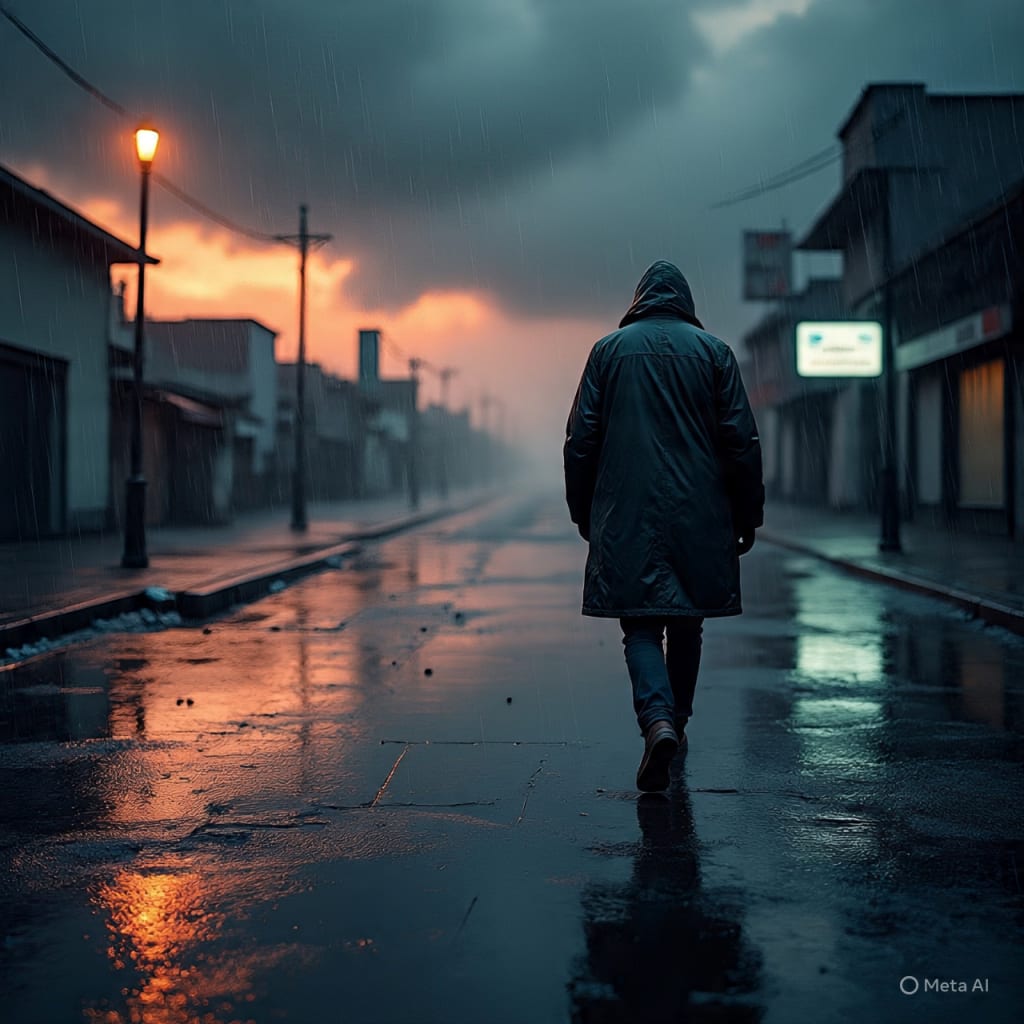
At first, no one noticed. The sun still rose, but it felt… thinner, as though someone had turned down the brightness. A pale gold at dawn, it never quite made it to white at noon. People blamed the season, or pollution, or their own tired eyes. I did too—until the day it didn’t rise at all.
The night before had been warm, heavy with summer humidity. I was lying awake, listening to the far-off hum of the city, when the air changed—thicker, heavier, as if the atmosphere had been replaced with water. Then came the silence. No traffic, no crickets, no hum of transformers. Just the slow, suffocating stillness.
When I woke, the window was black. I thought maybe the power was out, the streetlights gone. But then I realized—this wasn’t night. It was something else.
I checked the clock. 7:12 a.m. The sun should’ve been blazing in the sky. Instead, the world looked like the moments before a storm—except the clouds were wrong. They weren’t drifting. They were still, a jagged wall of dark, stretching from one horizon to the other.
That was the first day.
By the third day, people stopped going to work. By the fifth, the power grid failed. And by the seventh, we understood: the darkness wasn’t weather. It was alive.
They called it the Veil. It swallowed light the way a black hole swallows stars. Flashlights sputtered after a few seconds, candles burned low and died without smoke, and even fires seemed to choke on the air. You could only see a few feet ahead before the black swallowed everything.
Some people fled the cities, hoping the countryside would be brighter. I heard rumors about “safe zones” where the sun still shone, but no one I knew ever came back from trying to find them.
I stayed. I told myself it was because I knew the streets, because I could scavenge and survive here. But deep down, I think it was because I didn’t want to risk finding out there was no light anywhere.
It was on the 14th day that I saw them for the first time.
I had been moving through an abandoned grocery store, taking what I could carry. As I turned down an aisle, the dark seemed to move. Not just the normal ebb and flow of shadow, but something shifting inside it—fluid, deliberate. I froze.
Two shapes emerged—long, jointed limbs, bodies thin as wire, their outlines just visible in the dim grey. No eyes, no face, but somehow I felt their attention lock on me.
I ran.
From then on, I wasn’t just hiding from the dark. I was hiding from what lived in it.
The days bled together. Food ran low. My radio picked up only static. I found myself talking to the shadows sometimes, just to hear a voice. Maybe it was madness. Maybe it was the Veil whispering back.
One night, as I lay awake in my barricaded apartment, I saw a flicker—faint, but real. Light.
I went to the window. Across the street, in the building opposite mine, a single candle burned in a high window.
It was impossible. Candles didn’t last here.
I didn’t think. I just moved. Down the stairs, across the empty street, into the cracked lobby. I climbed by touch, my hand sliding along the rusting rail, until I reached the 12th floor.
The door to the apartment was open.
Inside, the light was blinding compared to the darkness outside. A small table, a single chair. And sitting in that chair, a woman. Her skin was pale, her hair white as frost, her eyes the color of winter sky.
“You made it,” she said, as though she’d been expecting me.
I stammered something about the candle, how it hadn’t gone out.
“It’s not the candle,” she said, smiling faintly. “It’s me. The dark can’t touch me.”
She told me the Veil wasn’t a storm, or a plague, or a curse. It was hunger. It fed on light, on warmth, on life itself. And it had been feeding for a long time, quietly, until it finally decided to take it all at once.
“But you—” I began.
“I am what it can’t eat,” she said. “And so are you.”
It took me a moment to understand. All the days I’d survived without freezing, without starving completely. All the times I’d escaped the shapes in the dark.
“You came because you felt it,” she said. “Because the light in you was still burning.”
She leaned forward, the candlelight flickering between us. “We can stop it. But we’ll have to go where it’s thickest.”
I thought of the shadows that moved, the way the Veil swallowed even fire. I thought of the endless, starless sky.
And then I thought of what it would mean if we didn’t try.
I nodded.
She blew out the candle.
For the first time in weeks, the darkness didn’t move.
About the Creator
Masih Ullah
I’m Masih Ullah—a bold voice in storytelling. I write to inspire, challenge, and spark thought. No filters, no fluff—just real stories with purpose. Follow me for powerful words that provoke emotion and leave a lasting impact.
Keep reading
More stories from Masih Ullah and writers in Fiction and other communities.
Threads of Forever
My dearest love As I sit here tonight, with the soft hum of the clock in the background and the scent of your favorite tea drifting through the room, I find myself holding a pen, wanting to tell you all the things I’ve carried in my heart for years. We have shared a lifetime together — but I realize there are feelings I have never fully put into words.
By Masih Ullah7 months ago in Fiction
Becca
"Everything is so... flat." Denille said stupidly as she looked around her new neighborhood. She looked around at the muted desert where even the smallest sign of life seemed to have given up. The plant life was shrubs that were half cooked by the heat and where there should have been a lawn, a mess of white rocks laid glistening in the sun. Even the sky looked stretched thin, like the sun had ironed it smooth. She’d moved from Riverside, where at least there were hills, but here in Barstow, everything felt baked and brittle.
By Sara Wilson6 days ago in Fiction
Notes in the Margins of Happily Ever After
The first thing every girl receives in the kingdom where I was born is a book. I am writing in mine now. The leather cover is still white, though the edges are darkened with smoke and forest dirt. Some of the pages curl slightly, as if the book has already survived a small fire. The gold lettering has almost rubbed away, but if you tilt it toward the firelight you can still read the title pressed into the skin:
By Stacey Mataxis Whitlow (SMW)about 6 hours ago in Fiction
A More Human Vocal
When we launched Vocal nearly a decade ago, the world was a very different place. LLMs did not exist, and stories were created one at a time by people sitting down to write, revise, and share something personal. Many of our assumptions about publishing, trust, and participation were built for a world where effort and output were inseparable.
By Justin @ Vocal6 days ago in Resources




Comments
There are no comments for this story
Be the first to respond and start the conversation.