
Beneath the Flooded Sky
How a Village Faced the Rising Waters
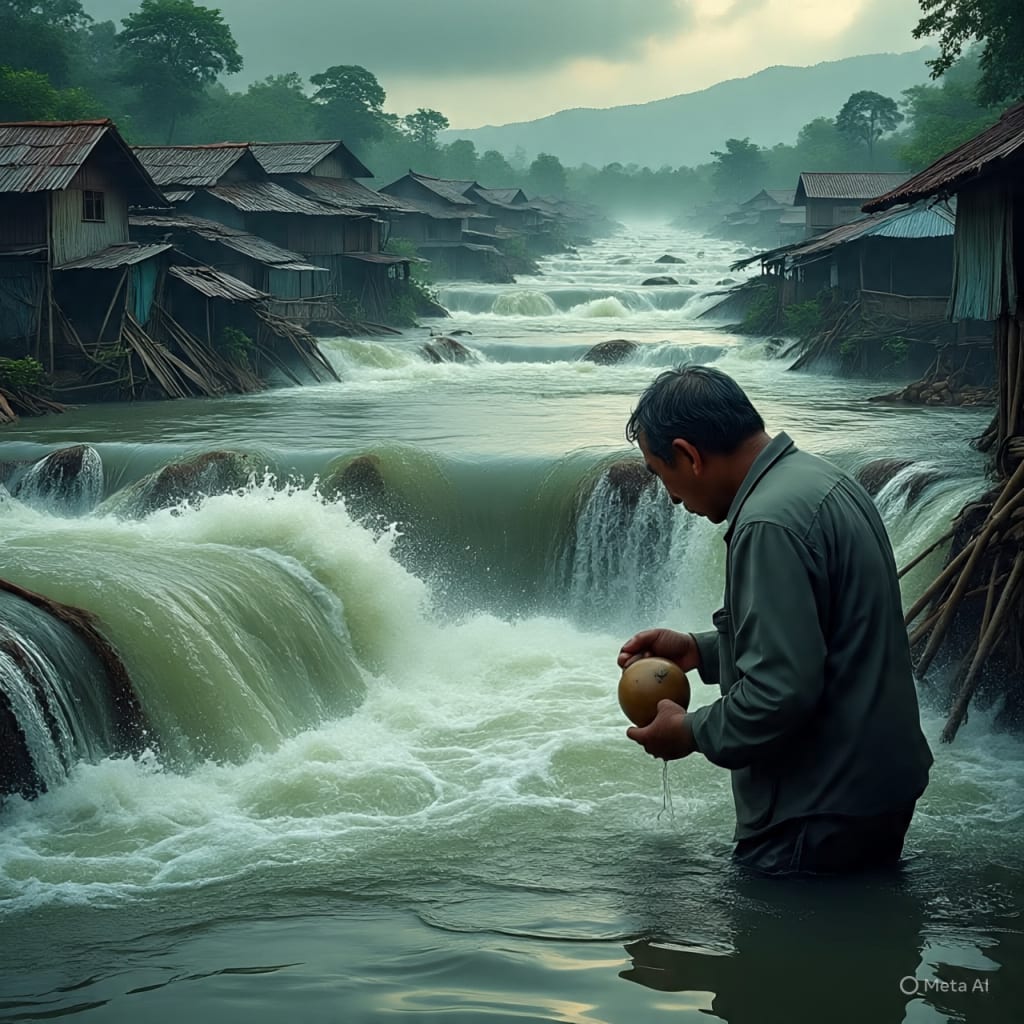
The rain began as a whisper against the rooftops, soft enough that no one gave it much thought. In the village of Kalindar, people were used to storms. The river had always fed them, watered their crops, and given them fish. It had flooded before, but always receded, like a wild animal that roared and then retreated to its den.
But this time, the rain did not stop.
By the second day, the river had grown restless. Its surface churned with branches and debris, swollen with mud washed down from the mountains. The villagers exchanged uneasy glances while continuing their chores. “It will pass,” the elders said. Yet each night, the rain hammered harder, and each morning the river’s voice grew louder.
Mira, a young woman of twenty, stood at her doorway on the third evening, her little sister clinging to her arm. She watched the road disappear under sheets of water. The mango tree in front of their home shivered in the wind, its roots already sinking into mud. Mira’s father had tied their goat to the porch, but the animal bleated with panic as the water lapped at its legs.
“Take her to the hill,” her father ordered, his voice tight. He meant both the goat and her sister. Mira hesitated, staring at him as the river surged closer. “Go now,” he barked. “I’ll come with the boat.”
The hill was the highest point in Kalindar, crowned with an old stone temple that had stood for centuries. Mira took her sister’s hand and pulled her along, struggling through knee-deep water. The goat fought against its rope until Mira cut it free, urging it to follow. Behind them, thunder cracked like a whip, and lightning illuminated the entire valley in ghostly blue.
They reached the hilltop, soaked and trembling, where other families had already gathered. Children cried in their mothers’ arms, and men looked back helplessly toward the drowned village. Fires sputtered in the rain as people tried to keep warm. The temple bell, long unused, swung in the wind, tolling a hollow note that seemed to mourn with them.
Below, the river showed no mercy. Roofs vanished beneath its waves. Fields where rice once stood bowed under torrents of brown water. The marketplace, once busy with traders, dissolved into floating wreckage. A wooden cart spun past like a toy, then smashed against a tree with a sound that made everyone flinch.
By morning, Kalindar was gone.
Mira’s father had not returned. She sat with her sister wrapped in a blanket, her eyes fixed on the horizon, searching for the small fishing boat he had promised to bring. Every branch, every shadow in the floodwaters made her heart leap, but the boat never came. She did not cry. She felt her sister trembling against her and knew she had to be strong.
The days that followed were long and heavy. The rain eased at last, but the flood remained, an endless mirror stretching across the valley. People shared what little food they had carried to the hill—bags of rice, jars of pickles, a handful of dried fish. Mira helped distribute water, climbing down to collect it in battered pots from the cleaner streams that trickled along the slope.
At night, huddled under the temple roof, the villagers spoke in low voices. Some said the river was angry, that the gods had been forgotten too long. Others blamed the new dam upstream, claiming it had burst. No one knew for sure. But everyone knew the truth that hurt most: their homes were gone, and nothing would be the same again.
Mira’s sister, Leela, would sometimes ask, “When can we go back?” Mira would smooth her wet hair and whisper, “Soon.” But in her heart, she wondered if there would even be a village to return to.
On the seventh day, the waters began to recede. Slowly, rooftops reemerged, black with mud. Trees leaned at odd angles, their roots half-exposed. A silence fell over the survivors as they descended the hill for the first time. Every step squelched in the thick sludge that coated the earth.
Mira walked to where her house had stood. The walls were cracked and leaning, the porch swept away. The mango tree still stood, stripped of leaves but alive. She touched its trunk with muddy fingers, as if greeting an old friend. Her father’s boat was nowhere to be seen.
The villagers began the painful work of salvage. They pulled debris from the mud—blankets, tools, the broken remains of furniture. Mira found her mother’s cooking pot wedged beneath a collapsed wall. She cleaned it carefully, as though restoring a piece of her family’s soul.
That night, as the sun dipped low, the villagers lit small fires among the ruins. For the first time since the flood, laughter bubbled in fragments—children chasing each other through puddles, men joking grimly about rebuilding walls. The river still flowed wide and dark, but it had quieted, as though satisfied with its feast.
About the Creator
Keep reading
More stories from Princess Ladly and writers in Fiction and other communities.
The Story in Our Hair
Maya sat in front of the mirror, her fingers twirling the same stubborn lock of hair that always slipped loose no matter how she styled it. Tomorrow was her cousin’s wedding, and the thought of walking into the venue with hundreds of eyes on her filled her with a strange mix of dread and anticipation. She’d spent the past week scrolling through endless photos of updos, braids, and sleek ponytails, but every style seemed to carry its own story—stories she wasn’t sure she could wear.
By Princess Ladly7 months ago in Fiction
Someone's Father or Uncle
Amy stepped of the train as the Broad Street Subway let her off at Philadelphia's City Hall stop and mixed her way into the more than 100 other people who were all moving like a flood to the steps. While most moved down the interchange concourse that lead to the “L” train, she moved towards the escalator in the other direction, along with a small handful of other people that took her out into the City Hall courtyard.
By Timothy E Jones3 days ago in Fiction
Cassie and Johnny
I’m the kind of dame you notice. I’m no femme fatale, but you can’t ignore me, at least not until I warn you about what’s coming, then everybody ignores me. Hell, they usually blame me afterwards and give Johnny all the credit for saving the day, but my Johnny couldn’t save a seat at the movies without my help. Sure, he’s brawny, but brainy? Not so much. Like that time I asked him to spot me five bucks, and he said he didn’t see it anywhere on me, and believe you me, he looked but good.
By Harper Lewis6 days ago in Critique



Comments
There are no comments for this story
Be the first to respond and start the conversation.