
Being Here
"You can’t get away from yourself by moving from one place to another." - The Sun Also Rises
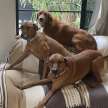

It is not often that you ride in a limo driven by a bull. But as the bull explained, driving for a living was not his first choice. Initially, he had planned on an agricultural career in Cyprus, his native country. But things often do not go as planned. In his youth, living on a large farm, he had been happy. But after he reached adulthood, circumstances changed, and he emigrated to America.
I learned this as the bull and I had quite an opportunity to chat. He was driving me from my office in Midtown Manhattan to catch a flight at JFK. And as anyone who has driven in New York knows, that particular trip is ‘stop and go’, with more stop than go. Some people hate the thought of having a chatty Cathy as a driver. I am usually one of them. But today I was in the mood for conversation, and the bull spoke English well. Although he had enough of an accent that occasionally I had to request he repeat himself.
I asked him if his family were here. He sighed and said they were not. His wives were all still in Cyprus. I asked how many wives he had. He said he didn’t know, as the situation was fluid. Some days a van would stop by his farm and take several of his wives away. And he would never see them again. On other days, the boss would release a few heifers into his care. As a result, most of his marriages were short.
As for his children, while he was proud of them, they were always mama’s boys and girls. And soon, they too left home. I asked if he ever heard from them. He shook his head sadly. No, he said. But he added that he did not mind so much, as the young were always curious about the world, and they had their own lives to lead and could not spend time worrying about the past.
This seemed ineffably sad to me. Like many people, who now claim New York City as their hometown, I was born elsewhere - Dubuque, Iowa, in my case. So I had a certain empathy for - and I realized that I didn’t know my driver’s name. So I asked him. And he said it was Kamel - so I had a certain empathy for Kamel and his long journey from the place of his birth.
Unlike Kamel, I still kept in close contact with my family. I would video call my mother on Saturday mornings. She and my father were descended from German immigrants. And there was a Teutonic directness to her. She would tell me I wasn’t eating enough. Demand to know if I was keeping warm. And ask if I had ‘met anyone?’ - which was code for ‘did I have a girlfriend?’ Not that she was pressuring me - but 31 is not young - and the clock is ticking.
My father was rarely on camera, and he didn’t say much. To this day, I don’t know if it was because he was taciturn or because my mother wouldn’t stop talking. Occasionally, he would demand, “Louise, let the boy be. He’s a grown man. He’ll do what he’ll do when he does it.” If my mother valued this solid piece of Midwestern common sense, she gave no sign, as she slipped around his observation much as Walter Payton once eluded linebackers.
And then there were my siblings. A brother, John, and a sister Amy, still in Dubuque, married with children, who my mother showered with affection. Another sister, Rebecca, lived in LA with her fiancée, Lauren, an entertainment lawyer. My parents loved Lauren, but still told some of their neighbors she was only a roommate. Dubuque was a progressive town, but in some quarters there was an unspoken agreement about observing the traditional niceties.
I had another sister, Emily, who played jazz trumpet in New Orleans. She was very happily married to the artist Marcel Jefferson. Who was being noticed by the right people. He had even exhibited in a Soho gallery in my adopted city. Marcel was a man of the world - literally - his DNA was a braided cord of African, Asian, and Mediterranean ethnicities, with a dab of the Northern European evidenced by the hazel hair that framed his mocha face. This olive-skinned Manet was a hit with the Iowa ladies whenever he and Emily visited my parents at Thanksgiving.
And then there was the black sheep of the family. My younger brother Justin. He had grown up an average, carefree, devil-may-care kid. But something had gone wrong. And now he was a fire and brimstone, bible-thumping pastor of a local evangelical church, the Living Waters Worship Center. He insisted on saying grace at the Thanksgiving table. And would pointedly ignore Lauren and Rebecca and speak with stiff formality to Marcel. I felt for his wife, Abigail, a quiet woman. Although Rebecca claimed she was a laugh-riot if you got her alone. And she should know, as, after the meal, they would sneak down to the barn with a purloined bottle of wine and smoke some weed.
But Kamel had none of that. He was a bull alone in New York. I asked him if there weren’t other Cypriot ex-pats he could befriend. He explained that there were, but they were all Greeks. And he was Turkish. Cyprus, he explained, was a divided Island. Although it was officially Greek, and the majority of Cypriots were ethnically Greek, the northern part of the Island was a de facto autonomous region under the rule of Turkish Cypriots.
The Island was divided by language, culture, and religion. Unlike the Greeks, who were Orthodox Christians, Kamel was a Sunni Muslim. And those two groups might as well have been oil and water. Kamel did allow how he knew some people in the Turkish community, but they considered him a rube and a hick. It seemed that the mainland Turks don’t think highly of the Turkish Cypriots. But isn’t that the way it always is - even among your own kind, you can still be the outsider - no?
I asked Kamel what his plans were. He said he was working hard and saving money. He estimated that, within a few years, he would have enough to buy his own car. And then he would drive a 12-hour shift, and he would hire another driver to drive it the other 12 hours. He figured if he could do that six days a week - being a Muslim, his Fridays were dedicated to prayer - he could earn enough to buy a house, perhaps in Islandia, an enclave in Nassau County, and home to many Turkish-Americans. He expressed hope that, as a property owner, his community might be more welcoming.
A lull came over the conversation as we inched along the Long Island Expressway past the Calvary, Mt. Olive, and Mt. Zion cemeteries. These necropolises illuminate a fact of life and death in New York City. While Manhattan is a place many want to live - and where quite a few die - hardly anyone could be buried there anymore. At last count, there were two plots available for $350,000 apiece in the New Marble Cemetery. Other than that, you could become the pastor at Trinity Church in Wall Street and find eternal rest in the church’s graveyard. Or you could claw your way up the Roman Catholic corporate ladder and become a Cardinal in the Archdiocese of New York, which grants you a spot, in due time, under the altar in St. Patrick’s Cathedral.
But I didn’t know that, and I am reasonably sure Kamel didn’t either.
The cemeteries seemed to have prompted a memory in Kamel. Out of nowhere, he said it was fear that brought him to America. Fear of what, I asked. Death, he told me. Back in Cyprus, it wasn’t just his family that kept disappearing, but many other bulls and cows, heifers, and bullocks from across his neighborhood. Adding to the misery, there were rumors of horrible surgeries on young males, too awful to contemplate. And the heifers were rounded up and locked in huge facilities - labor camps if truth be told - and forced to work producing milk. Which was then confiscated.
It is cruel to be forced to labor and then have the result of that labor taken without recompense. When a brave soul would ask someone in authority what was going on, they received no answer. Silence and dismissal greeted these inquires. There was both the monotony of sameness and the nagging fear of something evil over the horizon. It was this uncertainty that had finally convinced Kamel he had to leave.
He had gathered together everything he owned and told his family his plan. They were concerned. But they knew there was little they could say that would dissuade him. Once Kamel had it in mind to do something, the wheels turned inexorably. "The mills of God grind slowly, but they grind exceedingly small,” he was fond of saying. And his family knew what he meant even if they didn’t understand what he said.
He had found passage in steerage on a rusted tub of a boat transporting olive oil to Port Newark. From the port, he took a train to the city. And the subway to an address in Queens where an old Turkish woman rented rooms by the month. Fortunately, the New York DMV had a ‘don’t ask, don’t tell’ citizenship policy on issuing drivers' licenses. And he was soon able to get a driving job at a black-car company that didn't waste a lot of time checking documents.
And that had been his life for the last five years.
We had just turned onto the Van Wyck Expressway, the last highway before JFK, when I saw Kamel’s eyes glisten, and he appeared to suppress a tremor in his shoulders. I said nothing, as I knew enough not to intrude on the inner thoughts of a bull. And that’s when he told me he knew he would never see any of his family again. He had already lost too many when he lived in Cyprus. It was unlikely any survived five years later. Perhaps a few of those that had been very young when he left would still be alive, but they wouldn’t remember him.
When we reached the terminal, a thought occurred to me - I should invite Kamel to my parent’s house for Thanksgiving. He could meet my family and perhaps some of the neighbors. Wouldn't it be agreeable for him to feel camaraderie and intimacy? But almost as soon as the thought occurred, I dismissed it. He was, after all, a stranger. What did I really know about him? Just a few words exchanged in a car, driving to an airport.
So when he handed me my bag, I merely thanked him for the conversation. Gave him a generous tip. And wished him well. In turn, he thanked me. Said he had enjoyed our conversation. And wished me well. I shook his hand, which I had never done with a limo driver before. Then I turned to the terminal to check in. And steeled myself to deal with the petty annoyances of bad signing, interminable security checks, and over-priced food and drink at the theme restaurants near the departure gate. I suppose Kamel drove back to Manhattan, although I would never know. And I never thought of him again.
About the Creator
Pitt Griffin
Once upon a midnight dreary, while I pondered, weak and weary, it occurred to me I should write things down. It allows you to live wherever you want - at least for awhile.
Keep reading
More stories from Pitt Griffin and writers in Fiction and other communities.
Time's Thread.
As a girl, whenever Maria got the sniffles, grippe, headache, or an upset tummy, her bisabuela would dose her with an aromatic tea made from the flowers of the cempoalxóchitl plant - which the English, hard-pressed to replicate the subtitles and nuance of the indigenous language, had named 'Mexican marigold'. To this day, its tart, sweet taste of anise reminded Maria of her great-grandmother, Colel, with her flaming red hair, unusual in a Mexican. She was a ‘roja’, a ‘red’, and her hair was a testament to the European adventurers who came to make their fortune harvesting henequen in the Yucatán.
By Pitt Griffin5 years ago in Fiction
Lightning Never Strikes Twice
The distant rumble, the sudden deluge, the crescendo of sound, the flash of light, the explosive energy — it never gets old. I became an amateur storm chaser about two years ago. My wife, Cindy suggested it. Sort of. She said, "Alex, you know this cancer is killing me. I've come to terms with that, but you're smothering me. Go join a band, write a book, or become a storm chaser, for all I care. I love you, but you need a hobby."
By Julie Lacksonen5 days ago in Fiction
me, me, me
when i read back my poetry it screams “me, me, me” on my screen in bold letters and i can’t shut it up — most days, i cannot make any other words out; i want to throttle a thousand versions of the me gone by, i want to throw myself from a figurative balcony, i want to sink a sword into every pen i’ve held
By angela hepworth7 days ago in Poets



Comments
There are no comments for this story
Be the first to respond and start the conversation.