
At 2:14, the Earth Listens
A Midnight Offering, and the Price of Being Kept

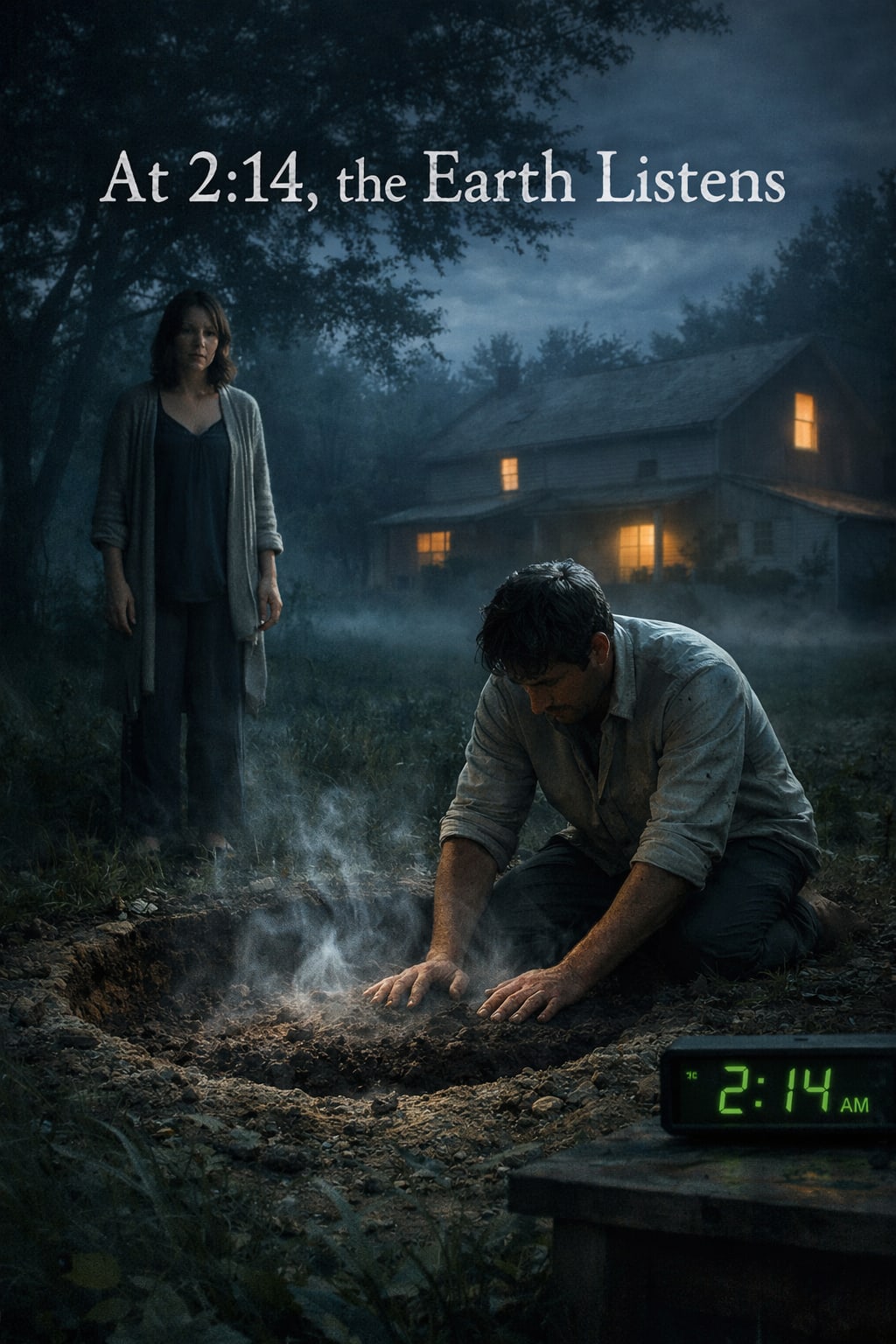
The first time Mara noticed the hour, she assumed it was coincidence.
2:14 a.m.
The clock on her bedside table glowed that soft, watery green that feels almost alive in a dark room. She had rolled over half-asleep, arm searching for Elias out of habit, and instead of warm skin she found cold sheets and the faint dip of where his body had been moments before.
She lay there listening.
At first, just the house: the settling of old beams, the distant hum of traffic on the highway miles away, the soft tick of the clock.
Then, the faint sound of movement downstairs.
Not footsteps. Not exactly.
Something lighter. More deliberate. Like someone placing their feet with care, as if trying to remember how walking worked.
Mara sat up, the comforter sliding down to her waist. Her eyes adjusted to the dark, tracing the familiar shapes of their bedroom — the leaning bookshelf crammed with paperbacks, the chair piled with laundry, the framed photo of the two of them at the lake the summer before they moved here.
She listened again.
A creak. A pause. Another creak.
She swung her legs over the side of the bed, the wooden floor cool beneath her feet. For a moment she considered calling out, but she didn’t. Something in the rhythm of the sounds made her hesitate.
Downstairs, a light flickered on.
A thin, warm glow seeped up through the crack beneath the bedroom door.
Mara stood, padded across the room, and opened the door just enough to peer into the hallway. The light from below spilled up the stairs in a narrow rectangle.
She descended slowly.
The stairs in this house were old, too — a farmhouse that had been added onto and altered so many times it no longer knew what it wanted to be. Every step had its own particular protest. Mara knew which ones to avoid, which ones to favor, but in her fatigue she misjudged and one stair gave a sharp, betraying squeal.
Downstairs, the movement stopped.
“Mara?” Elias’s voice drifted up, calm, ordinary. “You’re awake.”
She let out a breath she hadn’t realized she’d been holding. “You woke me.”
“I didn’t mean to,” he said. “I lost track of time.”
She reached the bottom of the stairs and found him in the kitchen.
He stood at the counter with his back to her, sleeves rolled up, forearms dusted with flour. The overhead light was on, the one they usually avoided at night because it was too bright, too clinical. On the counter lay a circle of dough, already shaped into a neat ring.
Elias had always been a baker, even before they met. It was how they’d found each other, in fact — her wandering into his small neighborhood bakery on a rainy afternoon, him handing her a warm croissant wrapped in paper, their fingers brushing.
Now, in their own home, the ritual of baking had become one of their shared languages.
But this was new.
“It’s two in the morning,” Mara said.
“I know,” he replied without turning. His voice had that distant quality it sometimes took on when he was concentrating. “I couldn’t sleep.”
She stepped closer, peering over his shoulder. The dough was different from his usual loaves — no braid, no score marks, no rustic flour dusting. Just a smooth, perfect circle, like something molded rather than kneaded.
“What is it?” she asked.
He hesitated, just for a beat. Then: “Bread.”
She gave a small, skeptical huff. “That doesn’t look like any bread you’ve ever made.”
He finally turned to look at her, a faint smile tugging at the corner of his mouth. His face, in the harsh kitchen light, looked slightly too pale, his eyes a little too bright.
“It’s a new recipe,” he said. “I want to try something different.”
Mara studied him, taking in the flour on his hands, the careful placement of tools around the counter, the way he had already set out the baking stone in the oven.
“When did you start?” she asked.
“Just now,” he said, though there was flour in his hair that suggested otherwise.
She glanced at the clock above the stove. 2:14.
The number felt sticky in her mind, like something she was meant to remember.
“Come back to bed,” she said softly. “You can bake in the morning.”
Elias looked at the dough again, then back at her. Something flickered across his face — hesitation, maybe. Or something like longing.
“Five more minutes,” he said.
She considered arguing, but exhaustion weighed heavy in her bones. She leaned against the counter, watching him work, letting the quiet hum of the house wrap around them.
He began to press his palms into the dough, not kneading so much as… coaxing. His movements were slow, almost reverent. Every so often he paused, closed his eyes, and breathed deeply, as if listening to something Mara couldn’t hear.
At exactly 2:19, he stopped.
Without a word, he lifted the dough ring and placed it carefully onto the hot stone in the oven. The instant contact made a soft sizzle.
He closed the oven door.
Then he turned, wiped his hands on a towel, and took Mara’s face in his flour-dusted palms.
“Come,” he said.
They went back upstairs together.
—
It happened again the next night.
And the next.
Always at 2:14.
Always the same: Mara waking to empty sheets, the soft creak of stairs, the glow of the kitchen light, Elias standing at the counter shaping that strange, perfect circle of dough.
By the third night, she stopped being startled. By the fifth, she stopped asking questions.
The ritual settled into their lives the way habits do — quietly, almost invisibly.
During the day, Elias was himself. He laughed at breakfast, teased Mara about her coffee addiction, told her about a new sandwich idea he had for the bakery he dreamed of opening one day. He went to work at the café downtown, came home with flour still clinging to his shirt cuffs.
But at night, something else took hold.
Mara began to stay downstairs with him.
She would sit at the small kitchen table, wrapped in a blanket, watching as he worked. The clock would glow. The oven would hum. The dough would take shape beneath his hands.
She noticed things she hadn’t before.
The way he never glanced at the clock.
The way his breath seemed to sync with the faint ticking of something she couldn’t identify.
The way the dough always ended up the same size, the same thickness, no matter how much flour or water he started with.
One night, she asked, “Where did you get this recipe?”
Elias didn’t look at her. His hands moved with that same careful rhythm.
“It came to me,” he said simply.
“From where?”
He paused, fingers hovering above the dough. For a moment, the room felt too quiet.
“From here,” he said finally, tapping his temple lightly. “From… somewhere deeper.”
Mara frowned. “That’s not really an answer.”
He smiled, but it didn’t reach his eyes. “Maybe not.”
At 2:19, he placed the ring in the oven, closed the door, and turned to her. This time, instead of going upstairs immediately, he pulled out the chair across from her and sat.
They sat in silence as the bread baked.
Mara found herself watching the oven door, as if expecting something to happen — smoke, fire, a voice, anything.
Nothing did.
At exactly 2:34, the timer beeped.
Elias rose, opened the oven, and removed the bread. It was golden brown, flawless, its surface smooth and unbroken. He set it on a cooling rack between them.
Steam curled up in delicate ribbons.
They didn’t touch it.
“Do you ever eat it?” Mara asked.
He shook his head. “No.”
“So what do you do with it?”
He looked at the bread, and for the first time since this began, his expression shifted into something like discomfort.
“It goes where it needs to go,” he said.
Before she could ask what that meant, he stood, took her hand, and led her upstairs.
—
On the tenth night, Mara followed him after he placed the bread in the oven.
Instead of going upstairs, Elias slipped out the back door into the yard.
Mara hesitated, then grabbed her sweater and followed.
The night air was cool, smelling of damp earth and distant rain. Their backyard sloped gently down toward a line of trees that bordered the old property. Beyond that lay fields Mara had never bothered to explore.
Elias walked barefoot across the grass, carrying the cooling bread in his hands like an offering.
Mara’s heart thudded uncomfortably in her chest.
At the edge of the trees, he stopped.
The ground here was softer, darker, as if it held onto moisture even in dry weather. A shallow depression lay before them, almost like a bowl carved into the earth.
Elias knelt.
Mara stayed where she was, arms wrapped around herself.
He placed the bread gently in the center of the depression.
For a long moment, nothing happened.
Then the ground… moved.
Not violently. Not dramatically. Just a subtle, almost imperceptible shift, like the slow inhale of a sleeping creature.
The bread sank.
Not into a hole — there was no opening — but into the soil itself, as if the earth simply… accepted it.
Mara felt a chill crawl up her spine.
Elias remained kneeling, head bowed, hands resting on his knees.
“Elias,” she whispered.
He looked back at her, face pale in the starlight.
“Do you see now?” he asked.
She swallowed. “See what?”
He stood, brushing dirt from his knees, and came back to her. His hands were warm when he took hers.
“It keeps us,” he said.
The words landed heavy and strange between them.
“Keeps us how?” Mara asked.
He guided her back toward the house, not answering until they reached the back porch.
“This land,” he said, glancing out over the dark yard. “It remembers everything that has happened here. Every joy. Every loss. Every life.”
Mara frowned. “All land does, Elias.”
He smiled faintly. “Not like this.”
That night, she didn’t sleep.
She lay in bed listening to Elias breathe beside her, staring at the faint glow of the clock.
2:14 would come again.
—
In the days that followed, Mara began to notice small things.
The house felt… steadier. The old boards creaked less. The drafts that used to snake through the hallways seemed to have vanished.
Her own dreams grew calmer, less frantic.
Elias, too, seemed lighter — less haunted by whatever restlessness had driven him to bake in the dark.
And yet, the ritual did not stop.
Every night at 2:14, he rose.
Every night, he shaped the ring of dough.
Every night, the earth accepted it.
Mara tried to rationalize it. A strange coping mechanism. A sleepwalking habit. A harmless eccentricity born of too many late shifts and too much stress.
But there was a feeling — a persistent, prickling unease — that refused to settle.
One night, she stayed outside with him after he placed the bread in the depression.
She knelt beside him, pressed her palm to the cool soil.
It felt alive beneath her skin.
Not warm, not cold — just aware.
“Does it take anything else?” she asked quietly.
Elias didn’t look at her.
“It takes what is given,” he said.
Her gaze flicked to the bread as it disappeared. “And what have you given?”
Silence stretched between them.
When he finally spoke, his voice was barely above a whisper.
“Time.”
Mara’s breath caught. “What do you mean?”
He turned to her, eyes shining in the darkness.
“I wake at 2:14 because that’s when it asks,” he said. “Not earlier. Not later. Just enough.”
“Enough for what?”
He reached out and cupped her cheek, thumb brushing beneath her eye where she suddenly realized tears had gathered.
“Enough to stay,” he said.
—
Weeks passed.
Mara stopped asking questions. She stopped trying to fight the pull of the ritual. In some quiet part of herself, she even began to understand it.
They were not meant to be visitors here, she realized — not renters of space, not temporary occupants. The house, the land, the air itself wanted something from them in exchange for shelter.
Elias provided it.
At least, she thought he did.
Then came the night when she woke and the bed was empty, but the clock read 3:02.
Her heart jolted.
She sat up, pulse quickening, listening.
Silence.
No creaking stairs. No kitchen light. No soft sizzle of dough on stone.
She scrambled from bed and rushed downstairs, bare feet flying over the steps she no longer bothered to avoid.
The kitchen was dark.
Cold.
The counter was clean. No flour. No tools. No ring of dough waiting to be shaped.
Mara’s chest tightened.
She ran to the back door and flung it open, cold air biting at her skin.
The yard lay quiet beneath a thin wash of moonlight.
At the edge of the trees, she saw him.
Elias stood at the depression, hands empty at his sides, staring down at the dark soil.
She hurried across the grass to him.
“You missed it,” she said, breathless. “It’s past 2:14.”
He turned slowly, and the look on his face made her stop in her tracks.
Something was gone from his eyes — that gentle, distant focus she had grown used to. In its place was something raw, almost frightened.
“It didn’t ask,” he said.
A cold dread unfurled in Mara’s stomach. “What do you mean?”
He gestured to the ground.
The depression was still there, but the soil looked… different. Flatter. Emptier.
“Maybe it doesn’t need us anymore,” Mara offered weakly.
Elias let out a hollow laugh. “Or maybe it needs more.”
The wind shifted through the trees, carrying with it a low, almost imperceptible sound — not a voice, not a breath, but something in between.
Mara felt it in her bones.
She reached for Elias’s hand, but he was already moving, stepping closer to the edge of the depression.
“Elias,” she said sharply. “Don’t.”
He hesitated.
For a long moment, they stood there together, the house behind them, the waiting earth before them, and the space between devotion and disturbance stretched thin as a wire.
Then, slowly, Elias knelt.
Mara’s heart hammered as he pressed both palms flat against the soil.
The ground did not move.
It simply… listened.
And somewhere in that stillness, Mara understood — with a clarity that was both terrible and tender — that rituals, once begun, rarely end the way we imagine.
They end the way the world decides they must.
About the Creator
Lawrence Lease
Alaska born and bred, Washington DC is my home. I'm also a freelance writer. Love politics and history.
Keep reading
More stories from Lawrence Lease and writers in Fiction and other communities.
Trouble at the Tea Leafing Café
The rain had started right around the time that Annie was buttering her second thick slice of homemade toast for breakfast, and hadn’t paused since. Not that anyone could tell. The windows of the café were fogged over, and with every seat filled with happy customers munching on fresh baked pastries or steaming bowls of the delicious soup of the day, it was hardly surprising. Annie looked around the room, finally taking a moment to breathe after the lunch time rush. Her old life already felt like a bad memory, a part of her history, always, but just that. History.
By Hannah Moore5 days ago in Fiction
Bridges
In preparation, my shadow crossed that bridge. A mission, a reconnaissance in a way. It was just a moment in time I could never forget; I mean who could and soon it will be in the distance. I mean it is life changing, life is always changing. Of all the things we have weaved and engineered in life as humans you would think we would have found a way to control the weather, disease, and each other by now. The snow piling up and the wind was strong blowing off the frozen fields. Across the street I watched from my bed the tombstones bracing the wind for days as the snow drifted in front of them, as if the bodies were under all that snow still waiting on the grounds first thaw. That gap between breath and silence briefly on hold, waiting peacefully for the storm to pass. I am sure the dead have somewhere to be, but what is the hurry now?
By Gerry Thibeault5 days ago in Fiction


Comments
There are no comments for this story
Be the first to respond and start the conversation.