

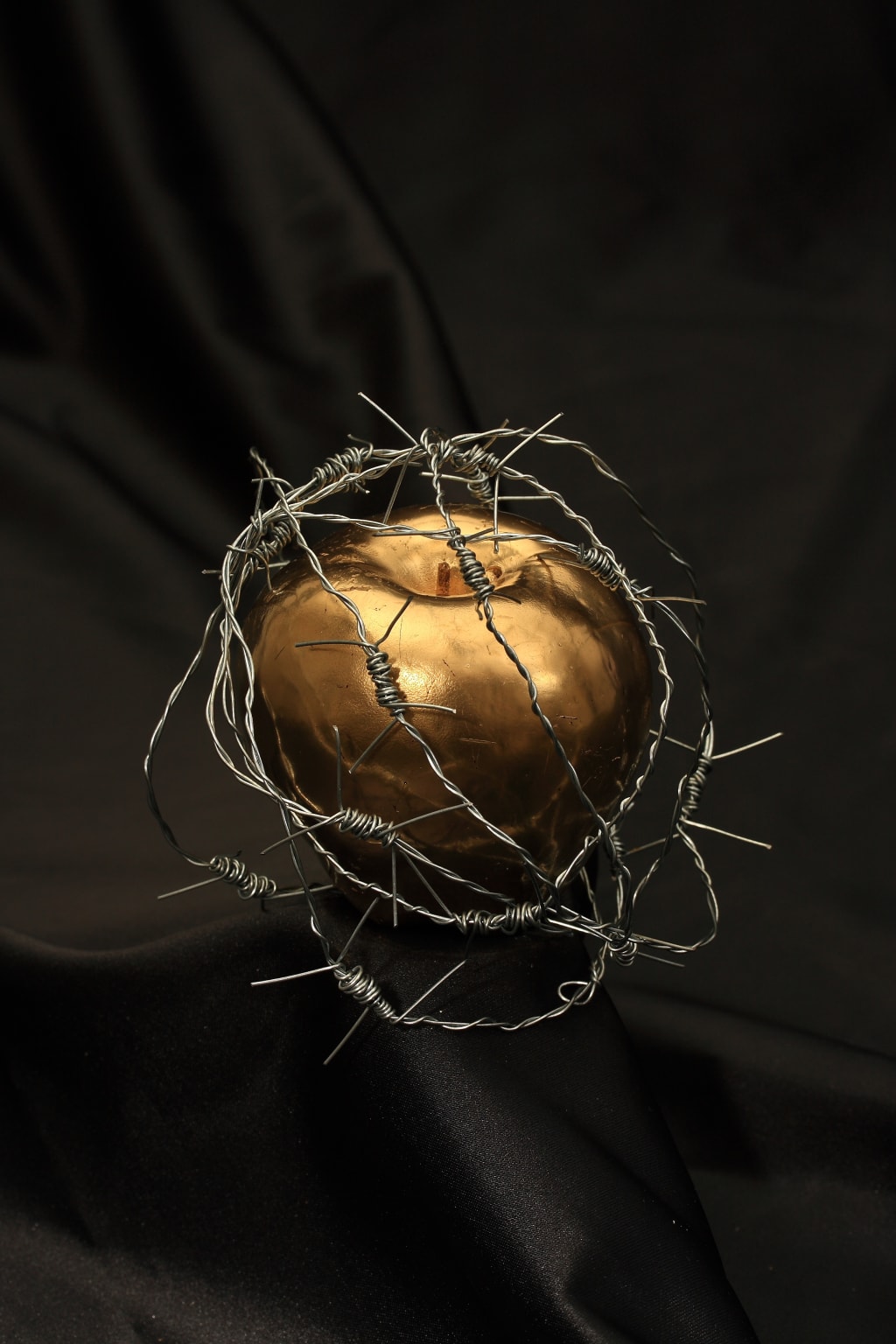
The brother was born on Friday the thirteenth, six minutes after midnight struck. His sister had arrived half an hour earlier, when it was still Thursday the twelfth, an incredibly beautiful, healthy baby, on the clear night of what had been the sunniest day of the year. As soon as he popped out, however, a pucker-faced runt who began wailing as soon as he hit air, the starry sky clouded over, sheets of rain began assaulting the hospital roof, bringing the gutter down with an awful crash, and thunder boomed ominously in the distance, starting a forest fire up on the mountains.
The doctor, a psychic with the power to see the futures of people he touched, held the newborn boy for all of five seconds and then flung him away into the arms of a nurse, refusing to come close enough to cut the umbilical cord.
“You need to get rid of that one,” he said, shaking from head to toe. “It will only bring destruction. Destruction and ruin, wherever it goes.”
The mother, perfectly calm and remarkably unbothered after just pushing two screaming infants from her loins, studied her son in a wholly un-motherlike, calculating way.
“Excellent,” she said, and severed the umbilical cord herself.
The girl took after their father, a man blessed by the gods of luck. Her good fortune shone around her like a halo, gifting her a light step and a face like the breath of spring. As she grew she won at games, bets, and races, excelled in school without picking up a book, received praise from the people who flocked to her, flies clinging to a lightbulb. She was the kind of person whose success was guaranteed from birth, who others descended upon and crowded in masses, hoping for some of the splendor to rub off.
The boy was more his mother’s child; from her he had inherited the gift of chaos, of bad luck. Chaos, she told him, is power in the hands of one who can control it, disaster in those who cannot. She had hoped the son who inherited a talent for mayhem even greater than her own would become her ultimate triumph, had wanted him to harness the raw maelstrom that raged beneath his surface. But he was small and weak; instead, it made a puppet of him. Rather than wreaking turmoil on others, it was reflected uncontrollably back on himself. Cracks appeared unbidden in the pavement beneath his feet. When he met his own eyes in a mirror, it shattered into splinters. People avoided him like a leper, whispering about house fires and car crashes that seemed to follow in his wake. He was little more than an instrument of disorder’s whim—rather than wielding it as a weapon, he himself was the tool to be used. When his mother discovered this her love for him froze over, a flash storm that moved in overnight. If by some accident her eyes cast over him they would turn cold and displeased. She looked at him not like a son, but an unfortunate stain on the tablecloth, a failure made more disgraceful because she could not be rid of it, but instead had to live with its tarnish.
Luck warped how people behaved towards each twin, for better or worse, so that only they saw each other for who they truly were. In a different world they might have found this comforting, might have loved one another and stayed by each other’s side. But their mother saw to it that this did not happen. She still hoped they could be bent into more useful shapes, and weapons must grate against one another to grow sharp.
When they were nine years old, she brought them before a magnificent marble pedestal upon which rested a golden orb with silver leaf and stem, encased in a cage of glass. They had never wanted anything in their lives with such a fierce, soul-consuming hunger.
“This apple takes the form of a person’s strongest desires. Anyone who wields it controls whoever they please, as no one is able to resist its thrall. When you turn eighteen, one of you shall claim it as your prize. Until then, you will do everything in your power to impress me.”
For nine long years they competed in weightlifting, swordplay, footraces. The girl crushed her brother to dust in every arena. She relished in holding her victories above his head. So sure was she that the apple was hers, she would lick her lips and grin, swearing she could already taste it.
Once as they raced under the unrelenting sun she hung back to taunt him, breezily keeping pace while his limbs strained and his lungs burned themselves to ash.
“Wish Mother had abandoned you at birth,” she said, sticking out the tip of her tongue at him from between her small, sharp teeth.
“Wish I ate you in the womb,” he grumbled back, moving to elbow her in the rib. She hopped nimbly out of the way, his momentum making him stumble and lose his footing. He knelt clutching his skinned knees, palms slippery with blood. From the ground, he watched her cross the finish line and leap into their father’s outstretched arms while their mother’s lidded gaze rested on him, a stormcloud of disapproval.
The night before their eighteenth birthdays, their mother named their final test. Tomorrow at first light they would outfit themselves with their most deadly weapons and slaughter an ogre. The child who landed the death blow would reign victorious. There was no rule that the other had to survive.
At dawn they awoke to find the girl missing from her bed, all the precious heirlooms robbed from their home and the golden apple thieved from its impenetrable pedestal, the unbreakable glass case hanging open on its hinge.
Their mother looked underwhelmed and disappointed, standing in her bathrobe with her bare feet against the cold marble floor.
“She lost.” Said the father, stunned with disbelief. He returned his son’s questioning look with a withering stare, so used to being let down that he knew the boy hadn’t figured it out, even then. “The test isn’t about who wins the apple.
“It’s about who resists it.”
It had been a decade with not so much as a word from the twin with whom he once shared a womb.
All of those years they had spent competing, the miles stretching wider between them. His was a struggle that could have never come to any fruition—it had never been the apple that he was fighting for. But things like love and acknowledgement were nothing to his sister, so she had nothing to hold her back and nothing to lose. That was why she always won. Life was a game for her, rigged perpetually in her favor. When everything always goes your way and victory is always within your grasp, waking up begins to lose its spark.
He’d heard rumors she ran among bad company now, the leader of a band of petty thieves. He doubted she was satisfied with that kind of life. When he closed his eyes he pictured her lying awake at night, back against the wall and one eye on the door, apple clutched in her fists, the envy of all kinds of criminals who would gladly kill to taste it, and wishing to god she had never laid hands on the one thing that made life so easy she could not see the point in holding on anymore.
In the end, that apple had its way with the both of them.
About the Creator
The Dead Princess's Mercy
General Wei stared at the pool of black water beneath his feet. In its reflection, he didn’t see his own battle scared face, but the faces of the three thousand men he had burned alive at the Siege of Yan. Their skin was translucent and their mouths were stitched shut with what looked like rusted wire.
By Carolyn Patton4 days ago in Fiction



Comments
There are no comments for this story
Be the first to respond and start the conversation.