
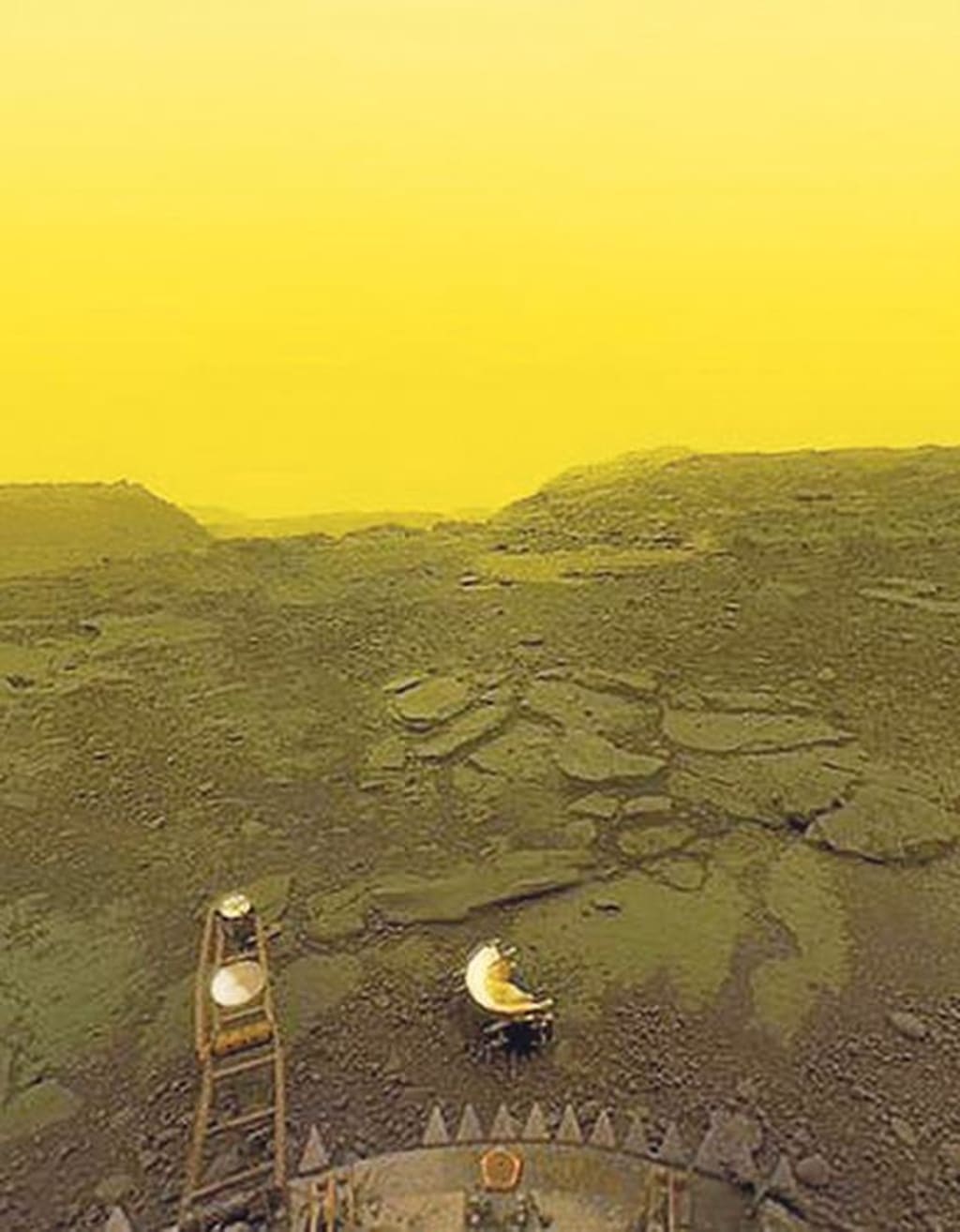
I took Jonathan completely by surprise just when his life was about to change forever. I attribute it to the embers in the breeze and perfect sunset at the party where he laid eyes on me. That evening we talked until the morning without even holding hands. Later, he thought that what drew us together was something immutable and ephemeral, more than the sum of my parts. I guess we mingled enough that night to trade approaches. The poet sought environmental explanations, while the engineer looked no further than his heart. Humans usually mate in pairs, and often trade souls a little along the way. We call it ‘being in love.’
That autumn was a delightful daze. Neither of us had been in love before, and Jonathan’s work suffered. He was only a postdoc. A tenured position would depend on a successful proof-of-concept in his ambitious project to transform Venus toward human habitability. He didn’t care a whit about tenure, prestige, or money – I considered him wonderfully humble – but everyone else in his life was worried.
We organize productivity around what we call ‘merit,’ which is usually eagerness to do as we’re told, but occasionally the opposite of that. Merit is rewarded with ‘status,’ a system of social signals that can modulate pleasure and pain in our primate brains’ hierarchical egos. There’s more to it. I’ve left an encyclopedia encoded in an electric semiconductor device within this memorial, but I have no idea whether you’ll be able to read it, or even realize that it contains knowledge.
Jonathan’s struggles at work came to a sudden end one day. He burst into his apartment, not surprised to find me already there.
“Simone! Simone! This is how you’ll see me for ten months.” He always announced his conclusions to initiate conversation. Had we lived longer, it might have grown irritating, but it was endearing at the time.
He held a large heart-shaped locket in the palms of both hands. It was open, and held a hi-def screen and a webcam. It was wrapped in a lavender satin ribbon, which I liked because he got it because he thought I liked that sort of thing.
“I’m going to Venus! Not just my bots – I’m going too! This is for us to talk while I’m in space. Don’t worry, you can use the bigscreen instead sometimes if you want.” His voice crackled with that curious glee of a scientist, and there was probably a hint of primate-brain status pleasure in there too. He was thoroughly buzzed with this news, brainstem to cortex.
He didn’t even look me in the eye, but he kissed me triumphantly and spun me around, his air debonaire and a shade misogynistic, I the damsel ornamenting his pride. I let it slide and used the camera in the locket to snap a photo of his bright and proud smile, eyes shining, cheeks flushed, framed by long brown hair. A man whose face shows he’s standing ten feet tall inside.
“The launch window opens soon and we can’t reschedule. There’s no way to deal with the radio lag in transmissions to the bot swarms and blimps by then – ,“ he paused, a little guiltily, “so we have to send along a technician! Someone who could correct the code and implement any Earth-based instructions….me!” he finished with a bright and embarrassed smile. He had been rewarded for his own mistakes, and knew it. Merit is weird.
We talked all night again, but it was different. He wanted to go, but first he wanted a baby.
“I could die on the mission, without leaving anyone behind…” he trailed off, glancing at the cross on a chain around my neck. “We can get married first, if you want.” He added this with a blush, totally misunderstanding the pain on my face.
Though we’d never more than kissed, somewhere along the line I started believing we’d be together forever. Now, over pizza and beer at midnight in his living room, I suddenly shivered with doubt. You want me to have your baby in case you die?
I was fighting double for tenure, in ancient mythology and modern verse. A cross-disciplinary position. (Merit is confusing.) Have your baby in case you die?
No terraformer can lack a central arrogance, I suddenly realized. A tingle went down my spine. I’m with the sort of man who would whimsically rebuild a planet, or my life. Jonathan had hidden his center from me, and I prided myself on reading people. Make that no person can lack a central arrogance.
We saw less of each other in the next few weeks. He was spending more time in the control room, and I was changing course. Still, I attended the launch: A golden flame of him crossing a crisp blue sky.
We talked over the locket sometimes. He explained his mission concept: how nanotechnology might make Venus habitable faster than any other proposal. “Venus is closer to the Sun, but that’s not why it’s overheated. It has a lot of carbon dioxide and a greenhouse effect, but that’s not why either. The main problem is the pressure from all that CO2. PV=nRT!” Jonathan thought that since I taught humanities I couldn’t know any science. Like so much else, it was cute until it wasn’t.
“Yes,” I drawled, “I think someone doodled that on a whiteboard while I was at MIT.”
He stiffened. “You’re right. Let me start over. Our solution is old-school, maybe two parts Carl Sagan and one part Geoffrey Landis, with a splash of Grey Goo over ice. The nanobots are so tiny and flexible they can swim through Venus’ mantle at low Reynold’s Number. I’ll IM you a paper that goes through the Navier-Stokes’ equations and the deformations that work depending on viscosity, in case you’re interested. Our lander drills through the crust and releases the bot swarm. The bots cut a series of microfissures through additional points on the crust, just large enough for assisted gas transfer. The blimps provide wifi coverage and onboard computing to optimize CO2 sequestration in real-time using a neural net. Unsupervised, obviously.” He chuckled. “But the main thing is to keep the crust stable at a macroscopic level, because quakes could shut down the whole system. If we’re successful, we could lock as much as 0.01% of the atmospheric CO2 into the mantle this trip. That would prove our overall plan is feasible within only hundreds of years. It would be a breakthrough.”
I checked my IM. Jonathan had sent a physics paper from 1976 called Life at Low Reynold’s Number by someone named E.M. Purcell. There were more papers on nanotechnology at extreme temperatures.
“Unsupervised because you don’t have training data,” I said slowly, half to myself.
“Yes. But…is anyone with you?”
“I’m alone.” Boy am I.
“Well, I’ll let you in on something, just between you and yours truly.” Suddenly he had that same proud smile. “Nobody knows about this. I’ll be supervising.” He drew his hair back to reveal a shaved area over his ear with a nasty looking scar. “I know that’s not what it means, but you can see what I mean. You’re smart. I don’t want to say more on the air.”
“You’re smart,” he repeated. Then he cut the transmission, as if spooked.
Now at least I know why you thought you might die.
We grew distant as he flew away. I toyed with the idea of ending our relationship, but decided to wait until he got back to discuss it. We were famous, and he didn’t need the distraction now, I thought. Months passed. Blimps were deployed across simmering, sulfurous cloudscapes. The lander survived the crushing descent to Venus’ dutch-oven surface and lasted hundreds of times longer than any of the Venera probes. Finally, it drilled through and released Jonathan’s payload.
I took a walk along the beach early the next morning to see the Morning Star. She was just how Tennyson described her:
For a breeze of morning moves,
And the planet of Love is on high,
Beginning to faint in the light that she loves
On a bed of daffodil sky
To faint in the light of the sun she loves,
To faint in his light, and to die.
I decided I wasn’t jealous.
The last time we spoke, he was already almost home.
“We finally confirmed elements from the mantle can be sent to the atmosphere too! It’s reversible. No easy grok.” He brushed his hair back again. He was agitated, and he smiled, but with sharp edges. “You know, it would work on Earth too. Like a thousand volcanoes at once. Poof! Reset the whole planet. Some people think that would be heroic, by the way. Smart people. I think you’re leaving me.” Now he looked straight into the camera. Somehow, over the millions of miles and despite the time lag, he caught my eye, or maybe my spirit, and we both knew it was true.
And there, it seems, what was left of his brittle self gave in.
“There were voices.” He looked away from the camera. “For a long time there were voices and the bot swarm had a life of its own. They never did much to the mantle. I fudged the uplink, just to give myself more time to correct things...Listen, Simone, something down there gave me a lot of ideas like that, and somehow we got all those bots back into my ship. You know, they’ve never come up with a good way to stop an astronaut from landing...I still care for you, but there aren’t voices anymore, there’s just a voice. I can't argue with it anymore. Goodbye.”
We still don’t know exactly what was in the modified escape pod that splashed down in the Pacific, but we know that since then the weather keeps getting warmer, cloudier, murkier. Even now, the pressure is rising. Even now, animals are choking on dense smog. Many plants will last a little longer. Perhaps this also happened on Venus, eons ago. PV=nRT! Some geologists are frantically trying to create earthquakes, hoping to save some of us. All I can contribute is this memorial. The engineers say it will keep transmitting up to 500 bars of pressure.
Jonathan never loved anyone in particular except me or anything in particular except the thrill of the experiment. Both turned out deservedly unrequited. There's a reality which forms us as much as we form clay and nanobots and music: when you poke cornered life, it will fight to the death. Why did we assume Venus would just fade into our new day? The first and last humans are poets, peering between the clouds and hoping someone understands. The first and last humans are doomed, taking our treasures to be dust with us. We knew better, in a way that could never matter. If it hadn't been Jonathan, it would have been another one of us. Merit and status.
I wonder what that voice, or whatever it is, went through, waiting there on Venus all those ages. I wonder if it started out as someone more like us, more like me. The ship is still in in orbit. It’s been completely redesigned, and nobody can shoot it down, and I’m afraid. They say the oceans will boil in about ten years, but I’m not afraid of them. I’m afraid that thing really did start out as someone like me.
That locket keeps ringing. I’m afraid he, or it, still wants a baby.
About the Creator
Keep reading
More stories from Nathan Hall and writers in Fiction and other communities.
Unrequited Aphrodite
I took Jonathan completely by surprise just when his life was about to change forever. I attribute it to the embers in the breeze and perfect sunset at the party where he laid eyes on me. That evening we talked until the morning without even holding hands. Later, he thought that what drew us together was something immutable and ephemeral, more than the sum of my parts. I guess we mingled enough that night to trade approaches. The poet sought environmental explanations, while the engineer looked no further than his heart. Humans usually mate in pairs, and often trade souls a little along the way. We call it ‘being in love.’
By Nathan Hall5 years ago in Fiction
One Hard Thing
Stop me if you’ve heard this one before: You have the number, you know your schedule- you’ve even picked out the perfect day and time to make this appointment. Shoot, you’ve even picked out alternative days and times just in case their schedules can’t accommodate you!
By Taylor Rigsby3 days ago in Motivation


Comments
There are no comments for this story
Be the first to respond and start the conversation.