
Animal Farm (George Orwell) - Chapter- 9 (Novel)
A Fairy Story

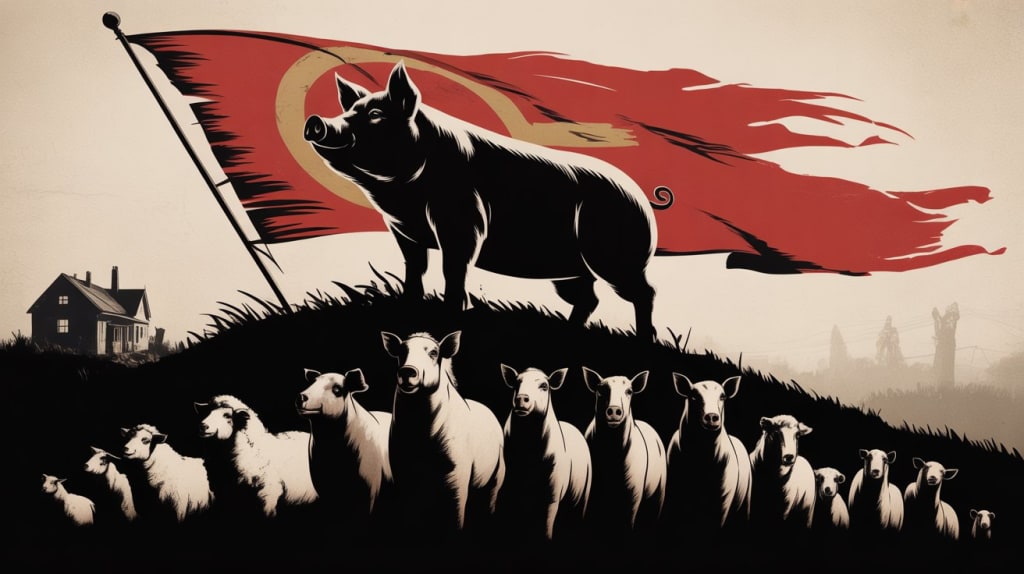
As the harsh winter passes and spring arrives on Animal Farm, the animals' hardships intensify, yet their hope struggles to survive. The animals, especially the hardworking ones like Boxer and Clover, work tirelessly to rebuild the windmill, which was destroyed in the brutal Battle of the Windmill. Despite their exhaustion and lack of food, they press forward with faith in the promise of a better future.
Boxer, always dedicated to the cause, pushes himself to the point of physical exhaustion, repeating his maxims, "I will work harder," and "Napoleon is always right." His immense strength and perseverance have long been the backbone of the farm's productivity, but now even that is beginning to show signs of wear.
The animals' rations are meager, and the food they receive is often poor or spoiled. Nevertheless, Napoleon and the other pigs live comfortably, enjoying the best food and comforts. The inequality on the farm has never been more severe, but the other animals accept it with little protest. Squealer's propaganda convinces them that the pigs' privileges are essential to the farm's survival.
Tragedy strikes when Boxer falls while working on the windmill. Unable to continue, he suffers a serious injury. The animals, deeply concerned, hope that he will receive care and comfort. However, Napoleon announces that Boxer will be sent to a veterinary hospital in a nearby town. The animals' initial relief turns to horror when they discover that Boxer has been sold to a Knickerbocker, a glow-boiler, to be slaughtered for profit. The proceeds from the sale are used to buy whiskey for the pigs.
Squealer explains this deception to the animals by lying that Boxer died peacefully in the hospital and that Napoleon acted in Boxer's best interests. The animals are heartbroken but lack the strength to challenge the deception.
Meanwhile, life on the farm becomes increasingly difficult for the other animals. They toil relentlessly in increasingly poor conditions. The lack of food, the harsh cold, and the relentless work sap their strength and spirit. The animals begin to question their memories of their rebellion, feeling trapped in a cycle of suffering that seems no better than under Mr. Jones.
The Seven Commandments have now been completely changed or erased. The rules have been changed to justify the pigs' privileges and harsh treatment of the other animals. The original ideals of the farm have been reduced to empty slogans.
Napoleon's leadership is becoming increasingly authoritarian. He uses fear, violence, and propaganda to maintain control. Dogs patrol the farm, punishing any dissent, while Squealer spreads lies to confuse and calm the animals.
Despite the darkness, some animals still hold onto hopes for justice and equality. Clover and Benjamin, the donkey, remain suspicious but silent. Benjamin, in particular, understands the full extent of the corruption but feels powerless to change anything.
The chapter ends with a chilling reflection on the cost of the revolution. The animals have lost everything they fought for: freedom, equality, and dignity. Instead, they live under a new tyranny that is as cruel as the one they overthrew.
Orwell’s narrative in Chapter 9 highlights the tragic fate of the working class and the dangers of totalitarianism. The betrayal of Boxer, the most loyal and hardworking animal, symbolizes the exploitation and sacrifice of the masses under corrupt governments.
About the Creator
Echoes of Life
I’m a storyteller and lifelong learner who writes about history, human experiences, animals, and motivational lessons that spark change. Through true stories, thoughtful advice, and reflections on life.
Keep reading
More stories from Echoes of Life and writers in Fiction and other communities.
Animal Farm (George Orwell) - Chapter- 8 (Novel)
As Animal Farm enters its fourth year of independence, the gap between the pigs and the other animals is growing rapidly. Napoleon, with the help of his ferocious dogs and the persuasive Squealer, has consolidated his control. The animals are struggling to survive, but their memories of the past are dim, and they cling desperately to hope.
By Echoes of Life8 months ago in Fiction
Bomb Scare
It was 2027, and the world never thought it would happen. A missle hit the United States, but it wasn't where they had anticipated. A little town in the northeast was hit by a missile strike, they didn't know why, and they didn't know exactly where it hit, but they did know it was a coastal community, somewhere between Maine and Delaware.
By Gregory Payton7 days ago in Fiction
Group-think, However Sanctimonious...
Excerpt from Iceman Xavier Rickles Today, I found, at the moonshiners’ old place, something glowing in the muddy ashes where the still once sat. It had been harshly secured as my first sight of That Brochure. I let Gwen know where I was and took the ladder down to the moonshine shrine, a couple of cots, and a workstation. Amongst it was a cash stash of $234,650, 3 crates of shine, a change of clothes per cot, wallet of the deceased. Plus 500 more dollars. Behind the cot, which was the first thing to your left, I found a dart. Maybe the board was once near the large metal cylinder inside a steel tub, shedding rust into the dark dirt. The tip of the dart had been caked in clay, or like I said, that rusted equipment, but also matched that of the D.C.S. Atrium. I searched the wall for the former target spread, spotting a darkness in there that made my flashlight fail like a whimpering torch, feeding off the fresh batteries to an aggravation level almost making my legs wobble. Could have been the unseeable depth and the absence of reference of where the light was truly halting. Stopped five or so feet ahead, but there's more to go...again? The dark makes this hovel feel physically unknowable. I caught a glimpse, however, above the workbench. I moved it for a closer look to find what I thought was bothering me so much, and kept looking even after the motivation in me left. It was trail.
By Willem Indigo4 days ago in Fiction
Worth the Wait: Puerto Viejo, Costa Rica
Beach bumming in a small Caribbean beach town sounded like a perfect way to end our 6-month trip through Mexico and Central America. Or so we thought. The foul, fishy stench of rotten seaweed hit our nostrils as we stepped from the cramped bus and looked out at a rather depressing, empty, and underwhelming black sand beach. It was pouring with rain, and we had to quickly fish out our ponchos. We thought, this couldn’t be it, could it?
By Sh*t Happens - Lost Girl Travel7 days ago in Wander


Comments
There are no comments for this story
Be the first to respond and start the conversation.