
Animal Farm (George Orwell) - Chapter- 1 (Novel)
A Fairy Story

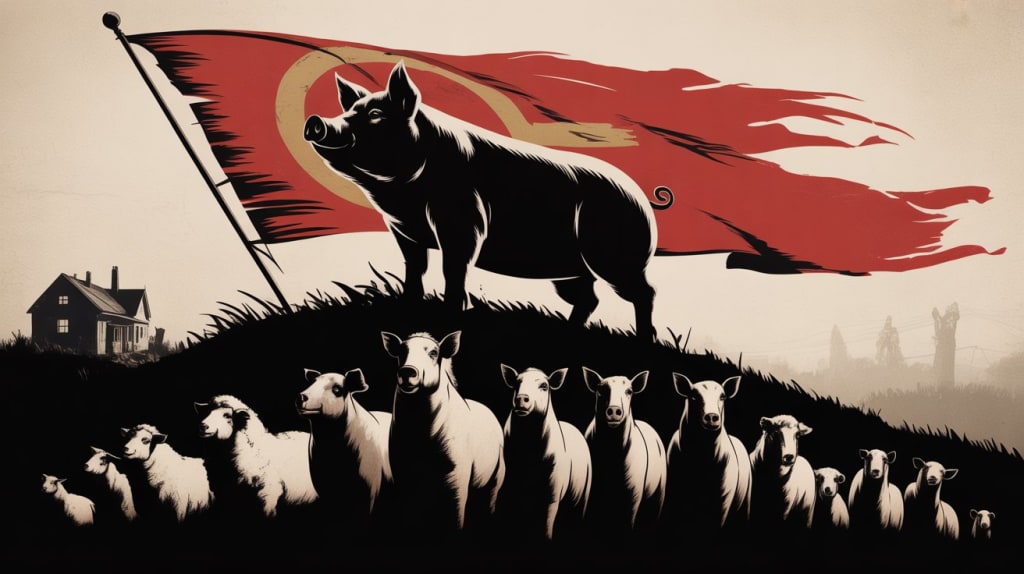
The story begins at Manor Farm, owned by Mr. Jones, a carefree and often drunk farmer. One evening, Old Major, a highly respected 12-year-old middle-white boar, calls a meeting of all the animals in the large barn. Old Major has had a strange dream and wants to share it with everyone. News of the meeting spreads quickly through the farm, and the animals gather eagerly to hear what Old Major has to say.
The barn is full of all kinds of animals: the pigs, considered the most cunning, sit near Old Major. Among them are Snowball and Napoleon, young boars who will later become very important. Clover and Boxer, large carriage horses, Morel the white goat, Benjamin the donkey, and Molly the useless, beautiful mare who loves the ribbon in her mane also attend. The chickens, pigeons, dogs, and even the cat prance, indicating that the entire farm is curious about the old major’s message.
The old major clears his throat and begins his speech. He tells the animals that he has lived a long life and seen many things, but what he really wants to share is the misery of their existence under human rule. He explains that humans are the enemy: they exploit the animals, give them just enough to survive, and then, when they are no longer useful, slaughter them without mercy. The old major instills a sense of injustice in the animals, explaining how they were born to toil, worked to exhaustion, and killed when they were no longer productive.
He explains that everything the animals produce—eggs, milk, wool, labor—is stolen by humans, who give nothing in return. Humans do not lay eggs, do not give milk, cannot pull the plow, yet they take everything for themselves. The Old Major insists that if the animals were free from human oppression, they could live full and free lives. He emphasizes that this is the cause of all their suffering and that they should rebel.
The Old Major then recounts the dream he had the previous night. In his dream, he dreamed of a world without humans, where animals could live in peace, work for themselves, and enjoy the fruits of their labor. This vision inspired him to teach the animals an old song from his youth called "Beasts of England." This song expresses the hope for animal freedom and unity. The verses of the song describe a future where animals rule their lands, eat their own food, and live without fear of the plague.
The song has a powerful effect. The animals are encouraged and inspired, singing "Beasts of England" in unison over and over again. Their voices fill the night with hope and rebellion. Even the less intelligent animals sense its power, though they cannot remember all the words.
The song grows louder and louder until it disturbs Mr. Jones, who wakes up in his drunken state. Thinking that there is a fox among the animals, he fires his shotgun into the night, scaring them and ending the meeting. The animals scatter back to their sleeping places, their hearts still beating with the dream of freedom that Old Major has instilled in them.
In this first chapter, Orwell brilliantly sets the tone for the entire book. Old Major is an allegorical figure, partly representing Karl Marx (with his ideas of class struggle) and partly Vladimir Lenin, the revolutionary leader who inspired communism. The animals represent ordinary working people, while Mr. Jones represents the oppressive ruling class. The powerful message of rebellion, the song "The Animals of England," shows how a simple dream and a shared sense of injustice can spark a revolution.
This chapter is important because it contains the entire impetus for the rebellion. Orwell also indicates how easily such idealism can be corrupted: Old Major is wise and selfless, but his audience includes Napoleon and Snowball, who will later use the dream for their own purposes. The animals' easy acceptance of Old Major's message shows their desperation and willingness to act on any hope of change, which becomes a major theme of the novel.
The imagery of the barn meeting, the list of animals participating, and the emotional, uplifting song all serve to illustrate how revolutions begin in passion and unity. Orwell uses simple language but powerful symbolism to make the reader empathize with the animals, while also foreshadowing how their hope can be harnessed.
At the end of the chapter, the night is silent once again, but a seed has been sown - a dream of animality, equality, and freedom from humans. As you turn to Chapter 2, this dream will soon take its first steps towards becoming a reality, with all the consequences that will follow.
About the Creator
Echoes of Life
I’m a storyteller and lifelong learner who writes about history, human experiences, animals, and motivational lessons that spark change. Through true stories, thoughtful advice, and reflections on life.
Keep reading
More stories from Echoes of Life and writers in Fiction and other communities.
Beyond Reflection
I still remember that morning when I looked in the mirror and it felt like a stranger was staring back at me. The sun was bright, streaming through my window, and I should have felt alive, confident, whole. But instead, all I saw was a dull face with tired eyes—a reflection that didn’t match the events inside.
By Echoes of Life8 months ago in Fiction




Comments
There are no comments for this story
Be the first to respond and start the conversation.