
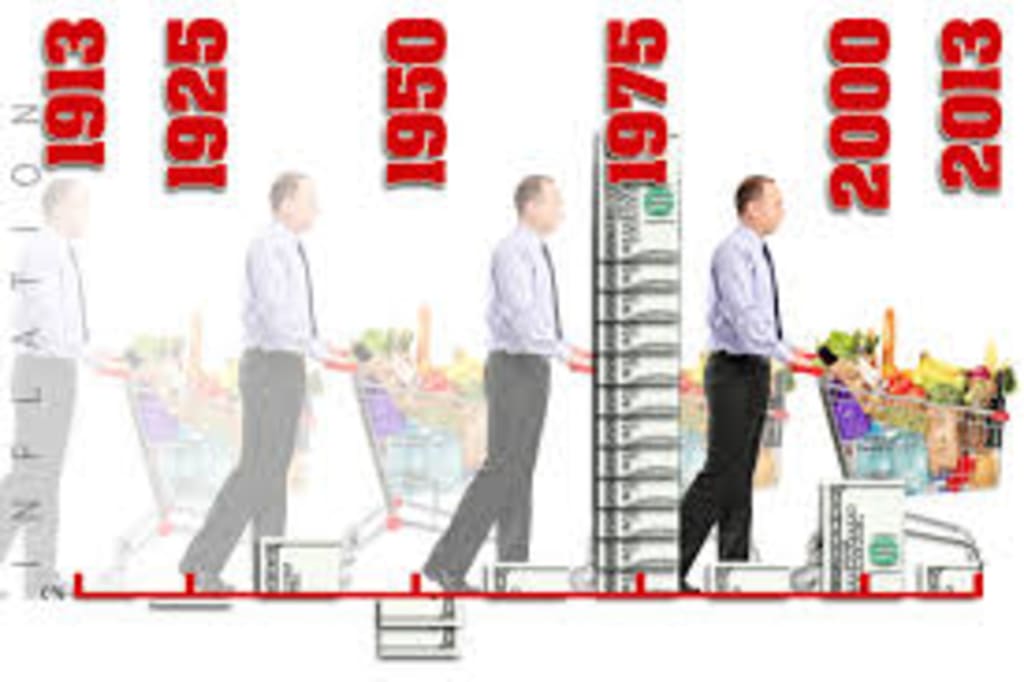
"Dollar Diary: In the Shadow of America's Inflation in 2025"
Setting: A Restless Morning One morning in May 2025, Jacob Anderson, a 32-year-old living in Brooklyn, New York, walked into his favorite coffee shop. When he reached the counter, he noticed that his usual $5 coffee was now selling for $7. The price increase didn't surprise him, because he knew how inflation affected his daily life. But in reality, its impact on his life was deepening every day.
Jacob's Professional Life Jacob is a mid-level software engineer. His salary has been flat for the past two years, but the cost of living has continued to rise. Fuel, food, rent—everything has gone up in price. His colleagues are suffering from overwork and financial anxiety. There are rumors of a sudden increase in layoffs among employees at the office, as the company cuts costs to maintain profitability. Jacob's boss recently announced that the company may suspend new hiring for six months.
The Impact of Inflation Inflation has depleted Jacob’s savings. His plans for the future—buying a house, starting a small business—are now uncertain. Some of his friends have already sold theirs and moved into smaller homes. Meanwhile, his credit card debt is mounting, and his monthly payments are now almost double what they used to be because of rising interest rates. His younger sister, Emily, who is in her final year of college, is struggling to pay for her education. Jacob used to help her financially from time to time, but now it has become difficult. Seeing pictures of people in long lines at food banks in the daily newspaper, he thinks that maybe one day he too might have to stand there.
In search of solutions While reading economic analysis, Jacob realized that the Federal Reserve was trying to control inflation by raising interest rates. But he was curious to learn more about how these measures were affecting the lives of ordinary people like him. He attended a local economic seminar, where economists analyzed the causes of the current situation and possible solutions. The speakers at the seminar said that long-term solutions will not come without increasing transparency and public participation in policy decisions. 5. Personal Initiatives After the seminar, Jacob began to reduce his expenses. He almost stopped eating out, canceled unnecessary subscriptions, and started cycling to work. He tried to reduce his expenses by buying products directly from local farmers. At the same time, he learned about investing and saving by taking free finance courses on YouTube. He decided to sublet the empty room in his apartment and start earning some extra money.
Social Impact Jacob noticed that people around him were also cutting back on their expenses. The situation is even more difficult for low-income people. Food, housing, and medical care have become more scarce for them. While volunteering at a shelter, Jacob realized that inflation affects not only numbers, but also people's respect, dignity, and dreams. He heard the story of an old woman named Nora at the shelter, who was a receptionist for a pharmaceutical company, but after retirement her pension became less than it was worth. Now she has to rely on this center to survive without begging. Tears came to Jacob's eyes.
Protest and Resistance An anti-inflation march is taking place on the streets of the city. Ordinary people are trying to attract the attention of the government. Jacob was hesitant at first, but then joined. There he met Lucy, an economics student who was doing a research on the topic of "Inflation vs. People's Attitudes". Through meeting Lucy, Jacob found a new path—raising social awareness and trying to solve problems using technology.
New Horizons Jacob and Lucy created an app together—"DailyPrice"—which provides daily price updates of products in the local market and provides information on alternative, cheaper products and sellers. The app became popular in a short time. It is not just a technology, but a movement, where people are spending consciously and buying products at fair prices. Local farmers are also starting to connect directly with buyers through the app, which creates an alternative market system.
Future Expectations A year later, in mid-2026, Jacob's life has stabilized somewhat. DailyPrice has now become a national initiative and is working in coordination with the government's agricultural and market plans. Jacob now participates in opinion-sharing meetings with government policymakers, where economic recommendations based on citizens' real experiences are adopted. The Federal Reserve is now enacting new laws to maintain greater transparency and is making policy decisions based on social media and public opinion. Jacob is optimistic. He knows that crises like inflation will come again and again, but through awareness, innovation, and the collective power of people, any problem can be dealt with.
Conclusion "Dollar Diary" is the story of the impact of inflation and its fight from the perspective of an ordinary American citizen. It reminds us that economics is not just numbers, it is the story of people's lives. By delving deeper into the problem, awareness and collective effort
About the Creator
Wild Card Weekend Recap: What Happens Now?
I think I figured out why I love Wild Card Weekend so much. It's because it's the first playoff anything of the calendar year. The NFL season starts in the fall, and once upon a time, the champion was crowned either on or slightly before New Year's. The evolution of the NFL schedule has resulted in the playoffs starting just into the New Year, and currently, the final week of the season falls on the first weekend of the New Year, with Wild Card Weekend coming a week after that. So yes, chronologically, the NFL's Wild Card Weekend serves as the first playoff anything of the calendar year.
By Clyde E. Dawkins6 days ago in Unbalanced



Comments
There are no comments for this story
Be the first to respond and start the conversation.