
All While the Squirrel Monkeys Laugh
Love in the Amazon


The zion-blue bird appears on the river bank, and my heart skips a beat. With my right hand firm around the camera grip, I adjust the lens with my left, then hover my index finger over the shutter button.
Next, I wait.
The agami heron is among the rarest and most striking animals to be spotted along the Amazon. Watching him pad by the water’s edge, my breathing slows, and I become hyper-fixated on the tropical universe before me. I can’t forget what’s at stake: a $10,000 prize for the winning picture of National Geographic’s photography contest.
I’m in desperate need of the money. I’ve gotta make sure this one counts.
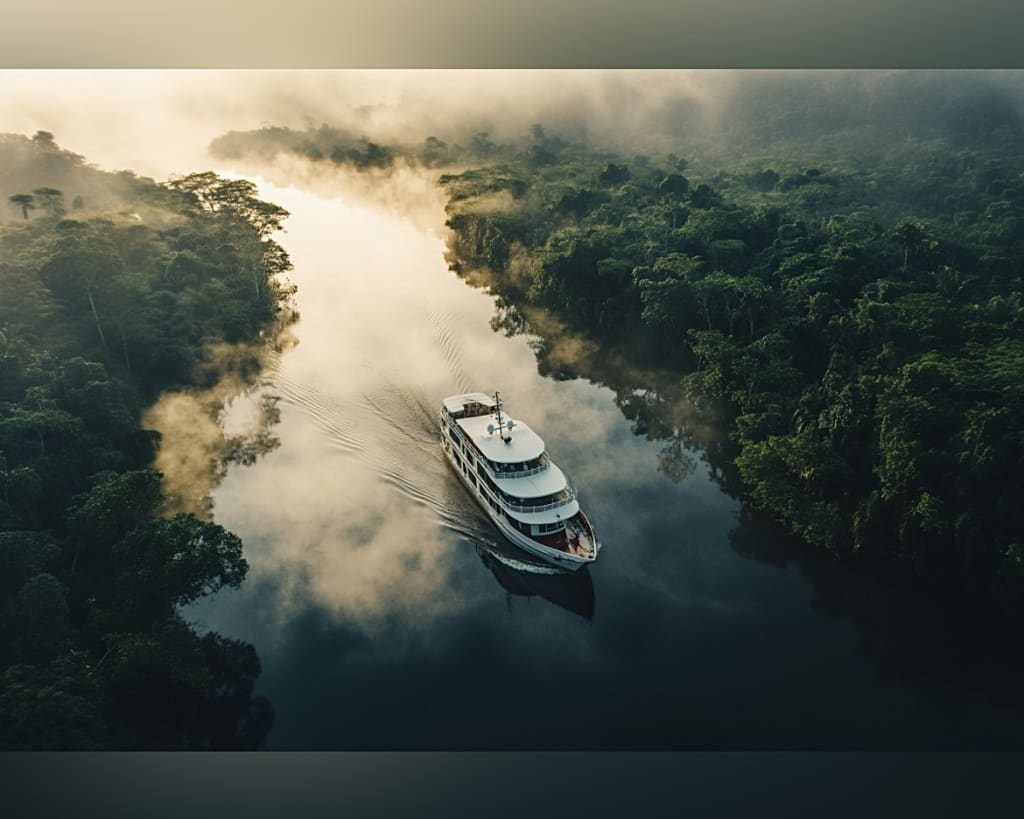
Achieving a dramatic angle on this boutique river yacht is challenging. I raise my eyes from the viewfinder and squint, using my imagination to frame my subject. I’ve spent the last few days speculating about the judge’s grading rubric. I’m convinced they’ll be impressed with a Dutch Tilt—one that showcases the bird’s etherealness against the milky-brown water.
“Damnit,” I curse—I’ll have to hang my torso at a forty-five-degree angle over the railing. It’s the only way to make the shot.
Though I appreciate the quaint luxury of the Tucano, I wish Chejo had agreed to rent a standard voadeira with a native guide. Just two weeks ago, small boat tours were selling for $45 on Groupon.
Thinking about how much better a voadeira would have been for photography makes me livid. I’m not sure how I let Chejo, my on-and-off-again, Costa Rican boyfriend, gaslight me into believing this cruise was superior.
I’m also not certain how he paid for this tour, which has us floating on a frilly dollop of icing down the river’s backbone. If I listen closely, I swear I can hear the squirrel monkeys laughing at me from the trees.
My stomach presses into the railing, and the cool metal shocks my bare midriff. I begin to lean forward, holding my camera into the air. Then, I twist my ribcage, searching for that winning angle.
Half extended over the water, I’m engulfed by an envelope of calmness. I’m divinely patient when it comes to my craft. Waiting for the perfect shot is a form of zen to me. I feel myself absorb into the Brazilian humidity, and I become one with the river and the rainforest.
“C’mon, give me something epic,” I whisper to the heron.
He flaps his lazuline wings—a beat of sky against the earthy-brown water—and sends droplets dispersing like jewels into the air.
I’m about to lay my finger heavy on the shutter button when Chejo’s accent startles me:
“Careful, Giselda. There are piranhas in that water.”
His audacity causes me to jerk and lose grip of my camera. It begins to fall, and my instinct to catch it makes me plunge along with it. My sweaty stomach slips on the railing.
But Chejo catches me by the waist, yanking me back onto the deck. My camera, which I’ve forgotten is strapped around my neck, slams into my torso. I didn’t lose it, thank goodness.
But I did lose the shot.
I turn in dismay, watching the heron fly into the trees. I then cast a furious glare up at Chejo.
“What the hell!” I snap.
Chejo gives me a smirk.
“Cálmate,” he replies, “the floating forest is just up ahead.”
Though I don’t mean to extend Chejo forgiveness, the rage melts from my face.
“The Anavilhanas,” I whisper.
Chejo nods, and his dark-brown eyes glimmer.
“Sí.”
The Anavilhanas, which are a network of seasonally-flooded islands, make up the second-largest river archipelago in the world. During the rainy season, all that can be seen of the islands are the treetops. Like jade nebulas floating in the night sky, they become bursts of foliage that sit atop the darkness of the Río Negro, where the water shifts from umber to onyx.
I’m convinced that if a fantasy world exists in this universe, the Anavilhanas are it. There, the animals siphon superpowers in order to adapt to their ever-changing environment: jaguars hunt caiman whilst completely submerged in the water, and monkeys perform acrobatics just inches away from the river’s surface.
Having forgotten the agami heron, I wipe a layer of sweat from my brow. My stomach throbs where the camera slammed against it.
“You look like you need water,” Chejo says, handing me a half-empty Fiji bottle.
I whisk the bottle away from him and take a swig of clear liquid, swallowing my pride along with it. I hate it when Chejo’s right. Though we’re both foreigners in this country, he reminds me I’m just a fragile gringa no matter where in Latin America I may be.
It wasn’t always like this between us. Our relationship started out fiery, like a romance novel. I was a 27-year-old government worker with a dying soul from L.A., who’d bought a one-way ticket to Costa Rica in an attempt to escape a mundane lifestyle and learn Spanish. He was an adventurous, tall-dark-and-handsome, 28-year-old street-survivalist, whose native level of the language was like poetry to me.
But Chejo was also smart and debonair, and was swift to whisk me away on a tour of the exotic Costa Rican countryside. I fell in love easily. Foolishly.
Fires don't burn long in a tropical rainforest, though, where the flora is too wet to feed the flame. I suppose our ardor is continuously subject to a similar fate.
Then again, the blue flame of fire—the first flame—burns the hottest. For whatever reason, we keep crawling back into each other’s arms, addicted to that initial, clean spark and forgetting our baggage. I think at our cosmic core, Chejo and I are destined to be together, even if we teeter on the edge of killing one another.
Plus, we each need something the other one has. I need Chejo to continue taking me on the exquisite adventures that feed my soul, and Chejo, in all frankness, needs my money.
Except, I’ve run out of money. My savings account is overdrawn and my credit cards are maxed to their limits. So, I need to win this contest. Otherwise, I’ll be packing my bags to head home.
I’m staring ahead, where a cloud of mist is swallowing the bow, when Chejo grabs my wrist and starts leading me to the cabin.
“Vamos,” he says, “they’ve served us some lunch.”
“Aren’t you going to get in?” I ask, pointing to where a group of tourists splash in the water.
Chejo shakes his head.
“No, mae, I told you—there are piranhas.”
I roll my eyes. Surely, the tour guides wouldn’t let us swim here if there were flesh-eating fish lurking about.
It’s odd that Chejo doesn’t want to swim. He’s usually the first to dive in when it comes to situations like this. After all, his carefree spirit is what made me fall in love with him in the first place.
I shrug it off. As he guides me to the dining area, I swear I hear the squirrel monkeys laugh at me again from the shore.
***
We’re eating beef empadões in the cabin when there’s a burst of excitement out on the decks.
“River dolphins!” An English-speaking tourist exclaims.
I nearly choke on a mouthful of stewed meat and turn to Chejo.
“Where’s my camera?!”
Chejo makes a face, then hands it to me.
I shoot him a dumbfounded look. It’s as if he doesn’t want me to have any chance with this contest. I don’t get it.
Whatever. I leave my lunch on the seat and run to the port side of the boat. There, between an amassed group of tourists, the ruddy shapes of dolphins can be seen in the water.
They’re strange-looking creatures—almost alienesque—with bulbous foreheads, long, thin snouts, and rosy-grey bodies. They’re not nearly as beautiful as the common bottlenose dolphin, but they’re charming.
And their unique coloring against the dark water makes for a stunning picture. A winning one, even.
I squeeze past a German family and position myself for the shot.
Fifty feet out in the distance, four dolphins leap from the inky-black water. Their pink bodies glow in the air for a brief moment—an exquisite sight against the backdrop of emerald-green jungle.
Instinctively, I shift my camera to continuous focus mode. This will ensure clear shots are produced while the dolphins jump around. Next, I hold the camera and gaze through the viewfinder. I think a basic, wide-angle perspective is best here. I feel the judges will agree.
Upon finding the correct water-to-greenery ratio, I take a deep breath, find my zen, and weigh my finger down on the shutter button. Just as a dolphin leaps from the river, I hear the satisfying click-click-click of multiple pictures being taken.
I smile, certain I’ve captured something impressive. I’m basking in euphoria when Chejo taps me on the shoulder.
“¡Qué tuanis, Giselda!” he exclaims. It’s Costa Rican slang for “How cool!”
He’s obviously been watching me. I give him a smile. Finally, I think, he’s pleased with something.
“The prize is $10,000,” I say, “do you think I can win with one of these?” I scroll through the images in the viewfinder, allowing him to look.
Both of our eyes light up when we see the one—the dolphin’s pink body arched in the air, flawless river-to-rainforest ratio—expertly executed aperture.
Chejo rubs his jaw.
“Well, National Geographic is very prestigioso, Giselda, but that’s an amazing picture.”
A rush of excitement surges through my body. Realistically, I know I don’t have a chance of winning the contest. I also know I’ll need much more than $10,000 to stay abroad. But being with Chejo has caused me to adopt a very different way of thinking about money. For someone who grew up in the poverty-ridden streets, as Chejo did, there’s always another negocio—a “business”, or “deal”—to be completed for payment.
“When we get the money,” I say, “we’ll have five months of rent in Tamarindo, and groceries’ll be covered. We could even buy those tickets to Chile.”
Chejo shakes his head.
“No, Giselda. Ya te lo dije—there’s that negocio with that mae from Peru. You know, the one with the ropa—the clothes?”
A knot forms in my stomach, and I begin to feel nauseated. Not this again.
“We’re not buying $10,000 worth of cheap clothes from Peru to sell in Costa Rica, Chejo. It’s too risky. We don’t even have a storefront.”
“Diay, we’ll get one! C’mon, Giselda, use your head. The Gamarra merchants sell the clothes for pennies on the dollar. You know how much the people of Costa Rica love fashion. We’ll make a killing!”
The knot in my stomach continues to grow. I’m not even sure how he expects to get past customs with all that bulky, illegal merchandise. I’m about to ask him when something catches my eye.
“Who are they?” I ask, pointing to two men on a small voadeira. I wouldn’t normally be suspicious, but they’re watching us. I might be a fragile gringa, but I’m not oblivious.
Chejo takes his eyes off of me to look ahead, where the men and their voadeira have already faded into the Amazon mist.
“Diay, it’s just two men on a boat, Giselda. Don’t be tonta.”
But I know that look on his face. Something’s up. I want to pry him, but the knot in my stomach has gotten the best of me. I keel over the railing and vomit into the river.
When I finish, I hear those damn monkeys laughing at me again.
***
We’ve finally reached the floating forest. It’s breathtaking, but we can’t get as close as I’d like on this big, stupid boat.
For a moment, I daydream about hijacking that voadeira I saw.
I’m not sure where Chejo is. He left me to sit here and recover after my vomiting incident. I’m sipping Ginger Ale and gazing at the floating trees through the cabin windows.
I should be out on the deck looking for animals, but I’m still queasy. And not because I have motion sickness—because Chejo really pisses me off.
I decide to take another look at the photo I got of the dolphin. I shuffle through my viewfinder until I find it. I study it and sigh.
It’s a perfectly executed picture, but it’s not good enough. There’s nothing special about it. Sure, river dolphins are rare, and it’s cool when they jump, but it’s been done before.
I’m thinking about this, and about the fight Chejo and I just had, when I see something through the window.
Oh, hell no. I knew it.
It’s Chejo, crouched at the stern, conversing with the two men in the voadeira. They’re pulled up alongside the back of the yacht, where no one is watching.
I’m livid, but not surprised. This is typical Chejo bullshit. It doesn’t matter where we are in Latin America—Chejo always knows someone. Always has connections. Always has some type of negocio in his pocket.
But what type of negocio is this?
Then, I remember something: Chejo didn’t want to get in the water.
As it dawns on me, the queasiness in my stomach turns to fire. I bolt toward the stern like a dragon. The rage is all-consuming.
I want to scream and curse him out, but something stops me.
Here in the Anavilhanas, the animals siphon superpowers in order to adapt to their ever-changing environment. I have an idea.
I crouch down low behind a stack of buoys, watching. Waiting.
Chejo knows I won’t win this contest—that we’re desperate for money. He’s adapted. He’s made “arrangements”.
But I want to prove him wrong. While my dolphin shot may not be good enough, I know one that will be.
I wait—my camera steady—until I see it.
Two clear baggies of white powder slip out of Chejo’s pockets, then slide into the hands of one of the men.
I smile, then hear the satisfying click-click-click of multiple pictures being taken.
I’ve already decided what I’ll call the shot: “The Floating Forest Drug Exchange.”
Upon hearing the camera, Chejo and the two strangers spin toward me.
One of the men shouts something at Chejo. My Portuguese is horrendous, but I gather the gist: I told you not to let her near with that camera!
Tension fills the air. One moment, Chejo and I lock eyes. The next, one of the men grasps me firmly around the neck while the other aims a gun at Chejo. My camera goes flying into the water.
Words I can’t decipher dice the river’s humidity. I feel terror, but I also feel something more: a clean spark.
For a brief heartbeat, the love between Chejo and I burns brightly—as if it's been reset—and we forget our baggage. I yearn to jump into his arms, but our hands and feet are bound together.
And then, we’re in the water. And though the river is dark, we turn blue— all while the squirrel monkeys laugh.
About the Creator
Gina C.
Poet | Author | Architect of Worlds
Sowing stories rooted in culture, origin, metamorphosis, resilience, language & love via fantasy, myth, magical realism & botanical prose
Writing my novel!🧚🏻♀️🐉✨
Reader insights
Outstanding
Excellent work. Looking forward to reading more!
Top insights
Heartfelt and relatable
The story invoked strong personal emotions
Easy to read and follow
Well-structured & engaging content
Excellent storytelling
Original narrative & well developed characters
Compelling and original writing
Creative use of language & vocab
Eye opening
Niche topic & fresh perspectives
On-point and relevant
Writing reflected the title & theme
Expert insights and opinions
Arguments were carefully researched and presented
Pearl
1980 something. we all hung out at Pearl and you and i were nothing special, or so i thought. i mean we all danced, drenched in our own sweat, our own saline solution of fear, too many beers, shots, laughter, tears, fucks in the bathroom and i don't know when we began to be afraid. do you?
By ROCK aka Andrea Polla (Simmons)5 days ago in Fiction
Okay.....
Everyone walks and just keeps walking. No one stares or says a thing; they just keep walking. They say nothing as she walks among them. Her beauty is overwhelming, yet her pigmentation doesn't set off alarms. She looks as though she's been drinking too much carrot juice or has taken too many beta carotene tablets.
By John Scipio5 days ago in Fiction



Comments (16)
Wow, so descriptive! You certainly are an incredible stoyteller taking us places we didnt think we would go!
well written
Congratulation on Top story really incredible to read You and feel almost like being in there with You as an observer !
What a story, Gina!!!! My goodness! This has so much going for it! The photography, the romance, the drama! Such an engaging read and unique premise!
Gorgeous descriptions in this. I got flashbacks to "where the crawdads sing" beautiful 😍
It started out so light! Very well done.
I have known a few Cheja's; this reminded me of Marty and Pappa Hemingway's wild, wild love. Such are entanglements if the heart. I can hope she breaks free then leaves him blobbing about. Brilliant!
This should be in a publication, truly intriguing and intricately detailed writing here!!
Excellent! 👏👍
Beautifully evocative and full of meaning, all expertly woven into a stunning story with shock ending. And spookily, I was looking at some squirrel monkeys only yesterday 😨 Sadly not in such an exotic location. Great use of AI illustration BTW - Congrats on the TS
Oh wow, no wonder Chejo didn't wanna swim!! Also, I never knew that there were river dolphins. That's so cool! Hahahahahahhaha those monkeys laughing, lol. I was rooting for Giselda though. Congratulations on your Top Story! 🎉💖🎊🎉💖🎊
Well damn! That was wonderfully unexpected :) I loved this story to pieces! What a brilliantly different direction to go. And so much of your wording was beautiful prose.
Congrats on TS! :)
This is amazing. Gorgeous writing, my friend.
Wow - that was an amazing read! Your story thoroughly captivated me until the end. Well done response to the given prompt!
Wow. This is such an amazing big and unique story! I love it. 🥰