
After I Died, I Found a Box of My Life’s Mistakes
In the afterlife, the narrator is handed a literal box containing physical symbols of their mistakes and regrets. They have to decide what to keep and what to let go.

After I Died, I Found a Box of My Life’s Mistakes
I wasn’t expecting an afterlife.
I wasn’t expecting anything, really. One moment, headlights. A sharp, white flash. The feeling of my body being more air than bone. Then darkness.
And then… this.
I woke in a room. Or maybe it was a clearing, or a space between worlds. It was neither hot nor cold, neither bright nor dim. The air felt like silk, weightless and still. And sitting there, in the center of everything and nothing, was a simple wooden box.
It was unassuming — cedar, maybe. About the size of a shoebox. No lock. No inscription. Just my name, Eliot, etched faintly on the lid.
A woman sat beside it. Or a man. Or neither. Their face was somehow both familiar and utterly unknowable, like every stranger you’ve ever passed who reminded you of someone you loved. Their voice was gentle.
“It’s time to sort your things.”
“My things?” I asked.
They gestured to the box. “The things you carried. The mistakes you made. The regrets you buried. You can’t take them with you. But you get to choose which ones to let go, and which to keep as lessons.”
I hesitated. I thought of all the sermons I half-listened to, the poems I read in the quiet hours, the clichés about life flashing before your eyes. None of them had mentioned this.
Still, my fingers found the lid, and I opened it.
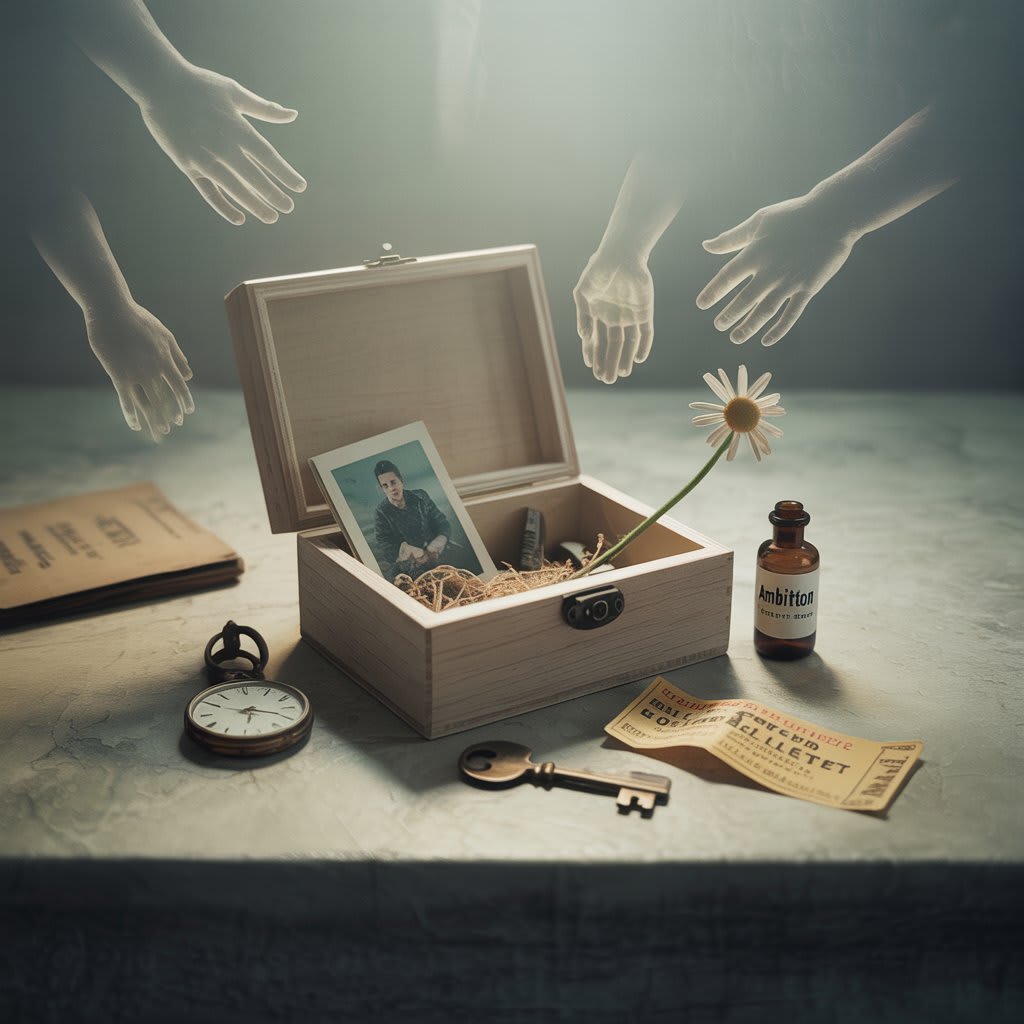
Inside were objects. Ordinary, ridiculous, heartbreaking.
A broken watch, its hands forever stuck at 3:17. The time I was supposed to meet my father for coffee and didn’t show up. We never rescheduled. He died two months later. I’d told myself it didn’t matter — that we had time. We never do.
Next, a crumpled concert ticket. Front row seats to a band my little sister had loved. I bought it for her birthday but never gave it to her. I was too busy, or maybe I was mad about something trivial — I can’t remember what. She went to college. We drifted. The ticket stayed in my drawer. Now, it was here.
A tiny, yellowed photograph. Me at sixteen, arm around a boy with dark hair and a laugh like summer rain. His name was Sam. My first almost-love. I ghosted him after he told me he liked me, too scared of what it meant, too tangled in fear of my parents’ disappointment, of losing friends who wouldn’t have understood. I never replied to his messages. I never saw him again.
A key. Small, rusty. I didn’t recognize it at first, then did. The key to my first apartment. The one I shared with Mia. We fought over rent, over toothpaste caps, over her forgetting to call me on my birthday. But we also danced in the kitchen and watched terrible movies and believed, for a while, that we were the whole world. I’d left that key on the table the day I moved out and never called her after.
I kept pulling more out.
A dried daisy, petals brittle and papery. A half-written letter, ink smudged from tears. A voicemail I’d saved but never returned. A tiny, empty bottle labeled Ambition, representing the jobs I didn’t take, the dreams I abandoned because someone told me I wasn’t good enough — and I believed them.
When the box was nearly empty, I looked up. The figure — my guide, I guess — smiled.
“You don’t have to carry them all.”
My hands trembled. “How do I know which to keep?”
They shrugged. “Which ones still teach you something? Which ones make you human?”
I held the photograph of Sam. The regret was sharp, but so was the memory of the first time someone saw me fully and said, without words, it’s okay. I kept it.
The watch, I left. I couldn’t fix that lost time.
The daisy, I let float away.
The key to Mia’s place, I kept. A reminder that even broken things held beauty.
I held the crumpled ticket a long time before letting it go.
One by one, I chose. Some mistakes weighed too much, anchored to my ankles like stones in a river. Others shimmered with strange warmth, reminders of my ability to feel deeply, to stumble, to care.
When I was done, the box was lighter. Not empty — never empty. But bearable.
The figure took it from my hands. “You’re ready now.”
“For what?” I asked.
They smiled. “For whatever comes next.”
And as the space around me began to dissolve into something vast and shimmering, I realized maybe that was what being human meant — not perfection, but learning which mistakes to hold on to, and which to leave behind.
I stepped forward.
And I was not afraid.
About the Creator
Kine Willimes
Dreamer of quiet truths and soft storms.
Writer of quiet truths, lost moments, and almosts.I explore love, memory, and the spaces in between. For anyone who’s ever wondered “what if” or carried a story they never told these words are for you
Keep reading
More stories from Kine Willimes and writers in Fiction and other communities.
The Things I Never Said to My Father
The Things I Never Said to My Father There are conversations we rehearse in our heads a hundred times but never let pass our lips. Words that sit in the back of the throat like stones, too heavy to lift, too sharp to swallow. This is for all the things I never said to my father — and probably never will.
By Kine Willimes7 months ago in Fiction
I met Her 4 Coffee
We entered my place after defeating this Seattle weather, which gave us every bit of its true seasonal character! I took her coat and was still amazed of the fantastic shape Gemma was in, but I promised to be a gentleman and give her every part of a secured moment, by declining my sexual desire for her! She told me that she needed to get comfortable and to give her a minute!
By Jay LeTron Dobbins3 days ago in Fiction


Comments
There are no comments for this story
Be the first to respond and start the conversation.