
Adam Khan and Durkhanai: A Legend of Love
A Timeless Pashtun Tale of Passion, Loyalty, and Tragic Fate
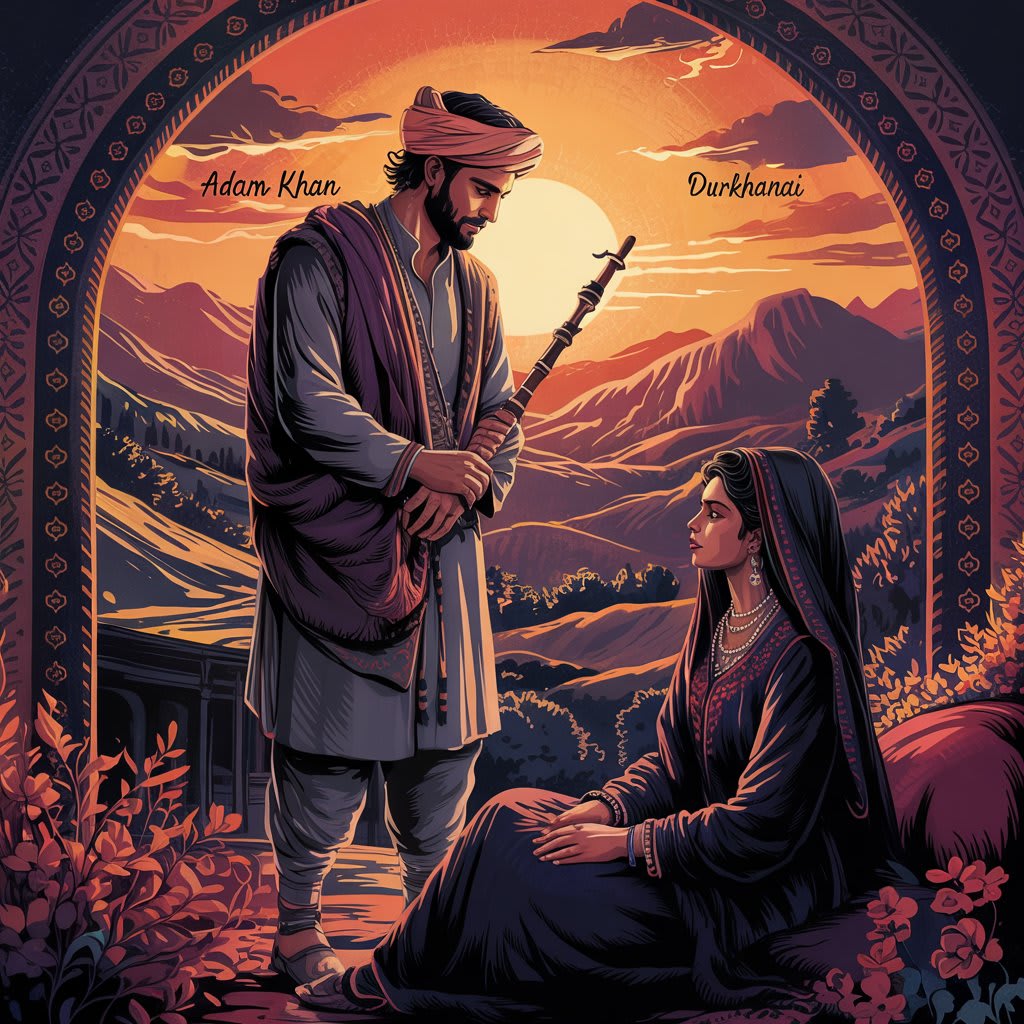
Once upon a time, in the rugged and scenic valleys of Waziristan, surrounded by towering mountains and endless skies, there lived a young man named Adam Khan. He was born into a noble and proud Pashtun family, known for their honor, bravery, and deep respect for their traditions. Adam Khan was not only brave but also blessed with a heart that longed for poetry, music, and true love.
From his childhood, Adam Khan would spend hours sitting by the river, strumming the strings of his rabab, singing verses of love and longing. His songs were famous throughout the village and beyond. Whenever there was a gathering, his soulful voice would touch the hearts of young and old alike.
In a nearby village, under the shadow of the same hills, lived a girl named Durkhanai. She was the daughter of a respected elder, known for her unmatched beauty, wisdom, and grace. Her beauty was talked about in every household — dark almond-shaped eyes, a kind smile, and a voice that could melt even the hardest of hearts.
One spring, when the air was filled with the scent of blooming flowers and the valleys echoed with the songs of birds, fate decided to cross their paths. Adam Khan saw Durkhanai for the first time at a village fair, where people had gathered to celebrate Nowruz — the Persian New Year, which was also a symbol of new beginnings for the Pashtuns.
As soon as Adam’s eyes met Durkhanai’s, time seemed to freeze. He had seen many faces, but none had captured his heart the way hers did. Durkhanai too, felt the spark, though she lowered her gaze, as tradition required. That brief moment planted the seed of an eternal love.
Days turned into weeks, and the young lovers found ways to send messages through friends, through poetry written on pieces of cloth, and sometimes even through the songs Adam would play on his rabab — each note speaking the words his lips could not. Their love blossomed like wild roses in the mountains, pure and untouched.
But love stories are never free from the chains of fate.
When Adam Khan’s family learned of his love for Durkhanai, they were proud. Durkhanai came from a noble family, and their union would be one of strength and tradition. But when Adam Khan sent elders to ask for her hand in marriage, Durkhanai’s father refused the proposal. The old man had already promised her to a wealthy merchant from another tribe, someone whose riches had blinded the hearts of many.
Adam was heartbroken, and so was Durkhanai, but their love was unshaken. On many moonlit nights, Adam would sit atop the hills, playing sorrowful melodies on his rabab, while Durkhanai would silently listen from her window, tears falling down her cheeks. The entire valley became a witness to their unspoken, unwavering love.
As the days of Durkhanai’s arranged marriage drew closer, Adam Khan could no longer bear the weight of separation. He decided to take a step that would change the course of their lives forever. In the dark of night, with only the moon as his companion, he rode to Durkhanai’s house. He knew the risks — breaking into a Pashtun household was against honor and custom — but his love had made him fearless.
Durkhanai, too, had been waiting. She had made her choice: she would rather die than live a life without Adam Khan.
When Adam reached her home, they met for the first and last time, speaking all the words they had kept buried in their hearts. They planned to run away before the morning sun would rise. But fate had other plans. Someone had seen Adam’s horse outside the house and alerted the village. Armed men gathered, and before Adam and Durkhanai could escape, they were surrounded.
Durkhanai’s father stood there, his eyes burning with fury and betrayal. For a Pashtun, nothing was more sacred than honor, and to him, his daughter had stained the family’s name. Without a second thought, he ordered his men to capture Adam Khan and locked Durkhanai away.
Adam Khan was beaten and dragged before the village council, where the elders debated his fate. Some argued for mercy, seeing the purity of his love, while others demanded blood for the dishonor he had brought. At the end, the council ruled in favor of punishment.
As the sun set behind the mountains, Adam Khan was exiled from the land he had called home. Broken, wounded, and with nothing but his rabab, he wandered the wild valleys, singing songs of lost love and shattered dreams. His melodies, filled with pain and longing, traveled across villages and reached Durkhanai’s ears, locked away in her chamber.
Durkhanai, unable to bear the separation, refused food and water. Day by day, her health faded, and her once bright eyes lost their light. One quiet night, she took her final breath, her heart longing for the one she loved.
When the news of Durkhanai’s death reached Adam Khan, he climbed the highest peak in the valley, carrying his rabab one last time. With the sky and stars as his only audience, he played the final song of his life — a song of eternal love and undying loyalty.
Some say, as the last note echoed across the hills, Adam Khan threw himself from the cliff, choosing death over a life without Durkhanai. Others believe he disappeared into the wilderness, becoming a legend whispered by the winds.
Their story lived on, passed from generation to generation, not just as a tale of forbidden love but as a reminder of how deep and powerful true love can be — stronger than walls, rules, and even fate itself.
---
And so, the legend of Adam Khan and Durkhanai became the heartbeat of Pashtun folk songs, their love forever engraved in the soul of the land. Lovers would visit the hills where Adam once played his rabab, hoping the wind would carry his song to them.
In the end, their love conquered time — even if it could not conquer the world.
About the Creator
Keep reading
More stories from Sajjad Khan and writers in Fiction and other communities.
The Cross and the Claw: A Christian Child's Encounter with the Lion
A Tale of Faith, Courage, and an Unlikely Friendship in the Wild Once upon a time, in the heart of Africa, there was a small village surrounded by vast forests and endless golden plains. In that village lived a young Christian boy named Samuel, no older than ten. Samuel had always been a curious and brave child, raised by his widowed mother who taught him the values of kindness, faith, and the strength of prayer.
By Sajjad Khan9 months ago in Fiction
The Pot Boiling Over
Once, there was a pot of about 340 million drops and droplets. Most of them would like to think they lived together peacefully for decades, but that wasn’t true. Different regions struggled, sometimes fought, with each other. And the mainstreams still often pursued and attacked the minorities. Law enforcers sometimes pushed minority drops out of the pot, never to be seen again.
By Gabriel Shames7 days ago in Fiction
Ludacris and Nelly draw backlash over bookings at MAGA-coded music festival
Ludacris and Nelly headlining a mostly right-wing event is good for them. It’s also great for the genre of hip hop. The two rap veterans have showcased their talents on other stages. Why can’t they perform for mostly MAGA folks and grab that bag?
By Skyler Saunders5 days ago in Beat


Comments
There are no comments for this story
Be the first to respond and start the conversation.