
A World Without Sleep
What if rest was no longer part of the human experience?

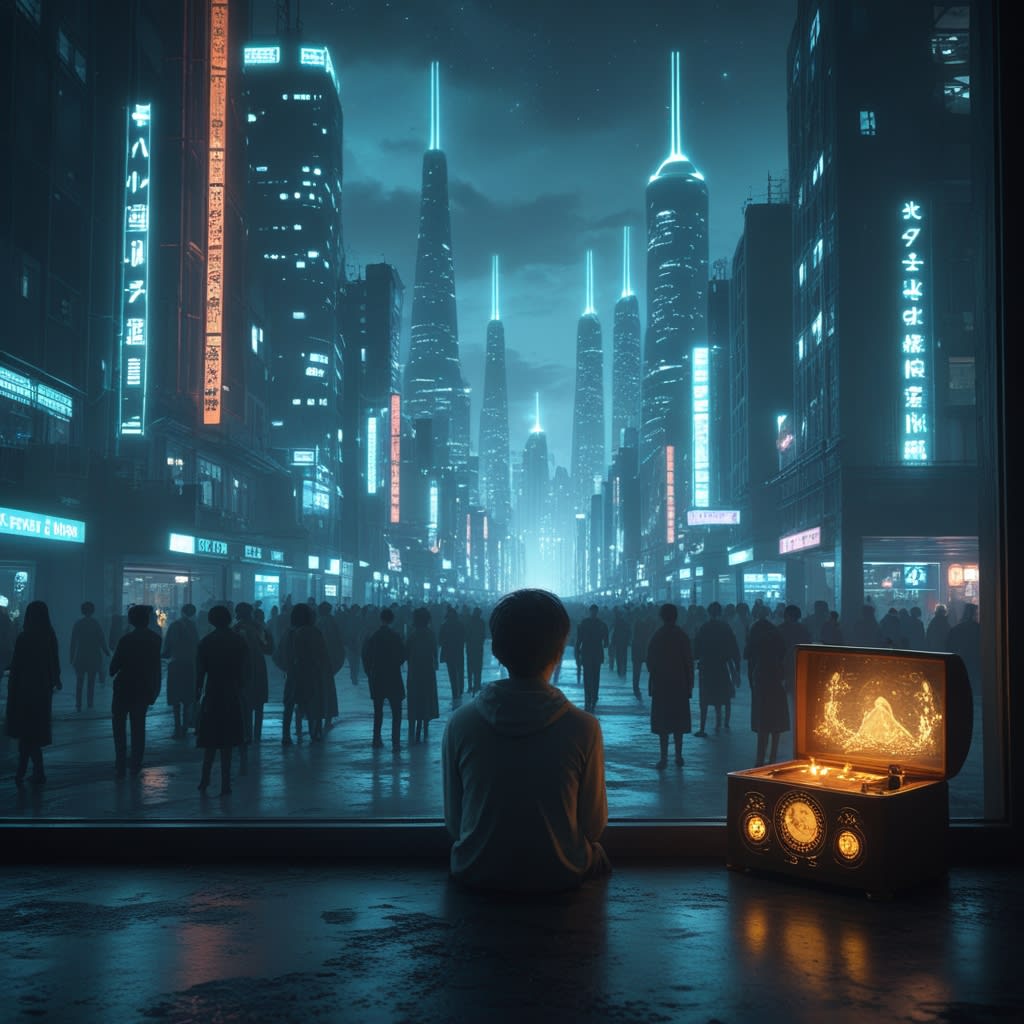
The Day the Night Died
It began with a whisper—an unexplained global shift. First, the insomniacs noticed. They stopped complaining. Then, the dreamers found their nights empty. No yawns, no fatigue, no need for rest. Within weeks, it was official: humankind no longer needed sleep.
At first, it was hailed as a miracle. Scientists called it the Lucid Surge—an evolutionary jump no one could explain. “The brain has found a new rhythm,” they said. No one aged faster. No one fell ill from exhaustion. Our bodies simply… adapted.
We had won back a third of our lives. But the cost wasn’t what we expected.
---
The Endless Grind
With no need for sleep, days became endless. What once were evenings of rest and reconnection turned into bonus work hours. Employers extended shifts. Schools ran 24/7. Cities buzzed with activity around the clock.
Capitalism rejoiced. Rest became laziness. “Why nap when you can produce?” became the mantra on corporate billboards.
People were always available, always reachable. Burnout didn’t disappear—it mutated. Mental exhaustion grew in strange new shapes. Without dreams, creativity suffered. Without rest, perspective blurred.
The world had gained time, but lost stillness.
---
The Dreamless Generation
Children born after the change had never felt the joy of waking up refreshed, never whispered secrets under blankets at midnight, never asked for just five more minutes in bed. They didn’t understand why lullabies existed or what nightmares were.
A new branch of psychology emerged: Nocturnia, a condition where people missed sleep not physically, but emotionally. Therapists began prescribing “dark time”—eight hours a day of stillness, silence, and solitude, mimicking the old sleep cycle.
Parents dimmed lights, drew curtains, and asked children to pretend to sleep. Not to rest, but to remember.
---
Black Markets and Sleep Clubs
Underground movements began to form. People who craved sleep met in hidden basements and blackout rooms. They hired sound engineers to recreate the soothing hum of a fan, or the drip of rain against windows.
Some paid scientists for neural “sleep simulations,” downloaded into their minds like black-market dreams. The elite bought hours of fake REM sleep to remember what it once felt like to surrender control.
A new drug—Somnia—emerged. It didn't make you sleep, but it created vivid dreams in a conscious state. People took it just to feel tired again.
---
The Silence in the Stars
Astronomers noticed something curious. With no one sleeping, city lights never dimmed. The stars grew fainter. No one looked up anymore.
Before, the quiet hours of the night had belonged to the sky. Now, noise filled every second. There were no more midnight walks. No secret kisses under moonlight. Romance began to fade, not because people stopped loving—but because they stopped pausing.
With no night, there was no mystery. Everything was visible, immediate, and lit up.
---
The Rebellion of Rest
It took years, but the backlash began. A movement called “Return” spread across the globe. It wasn’t anti-science—it was pro-stillness. Returners advocated for rest, reflection, and boundaries. Their motto: “Time is not enough—what we do with it matters.”
They closed their shops at sunset. They dimmed their screens. Some even taught themselves to simulate sleep, lying in stillness and letting their minds wander.
The world had given up sleep in pursuit of productivity. But people were starting to remember that sleep was never wasted time—it was sacred time.
---
Epilogue: In the Quiet
I sit now in a quiet room, lights low, Somnia softening the edges of my thoughts. My body will not sleep. It cannot. But my mind can drift.
Outside, a child sings a lullaby they don’t understand. Their voice is off-key but gentle, a ghost of the old world echoing in this sleepless one.
We thought sleep was just a physical need. But it was more than that.
It was the boundary between doing and being. Between surviving and dreaming.
And I—like many—have begun to miss it.
About the Creator
Shafi Ullah
I write on Vocal Media, sharing stories and ideas across fiction, wellness, tech, relationships, poetry, and personal reflections.
Keep reading
More stories from writers in Fiction and other communities.
The Lesions of Devotion
Every day I set myself down on the freshly cut lawn and strip myself bare. I take my guitar and finger the frets and pick at the strings, listening for dissonance. My life is dissonance. I twist the tuning pegs until each string sounds bright. Then I kneel, calves pointing behind me, kneecaps facing forward. All exposed to the breeze. I close my eyes and play the melody.
By Paul Stewart2 days ago in Fiction
Marshall's Observations
Marshall watched seagulls and crows playing in the wind among pink-tinted cloud beds that slowly turned gray as the sun hung at the sea's horizon. He used his iPhone to focus on the reflections in the water and snapped a photo. He liked the result; it showed a butterscotch sun sitting on the water below a pink cloud, with the ferry in the foreground.
By Andrea Corwin 4 days ago in Fiction
Foot Bindings
I asked my grandmother how she knew she'd fallen in love. I am not sure I ever did love him, she said. This was before I met my husband. I was naive, a naked spring, a raw nerve of a thing. That cannot ever be me, I knew. Sadness swept in gently like a Moscow thaw. It is no simple thing, looking into a woman's vast soul and seeing its foot bindings. Now, in Italy divorced with my skin singed off, when I say I don't love him mean: I have succeeded at feeling nothing most days and it mostly works. Do you want the comfort of Nothing? Do you want Nothing, too? Be warned: you'll never be free, even when you are nothing. Here is what doesn't work: Accepting the stages of grief. Talking about it. Sitting with the feeling. Missing him—no, the person you were when you believed in death do us part. Writing poetry. That, too. When I say I don't love him I mean: I feel capsized in an endless, starved tide. What sometimes works: selective memory. You must forget ripe tomatoes and his beard and feeling perfectly sheltered in a big blue world. Forget coffee in bed, laughter watching TV, blowing out the candles on the birthday cake and the quiet all-encompassing knowledge that you are chosen. Remember only how love turned to a banal everyday survival act, a trapeze act unsure whether he will catch you, how the warmth stagnated and became sour, remember the foot bindings and remember the resentment boiling in your veins as you stick it out for the kids. Six-hour Netflix binges help, too. A man's fingers tracing your spine. Frozen pizza at 2 a.m. Random trips to the museum just to stand near things that last a while. The realization that crying won’t change anything. Seeing that life is just a dream, and refusing to participate in your own suffering. Bite your fist. Walk on eggshells around joy. When I say I don't love him, I mean he didn’t break my heart, he just stopped touching it and it forgot how to beat right.
By Ella Bogdanovaabout 10 hours ago in Poets


Comments
There are no comments for this story
Be the first to respond and start the conversation.