
A Room With A View of the Stars
Ad Astra
Nobody can hear a scream in the vacuum of space, or so they say.
They’ve said it over and over again, laughing coldly and spitting in my direction as they go about their work on the station. For all of my knowledge and what I have done to uncover the earth, I don’t actually know if this is true.
I suspect I’ll find out sooner or later.
I wonder if Burt screamed.
The airlock is on the other side of the station. I could not see his last moments. And as they’ve reminded me, there was no way I could hear his scream even if I listened closely.
I am mostly at peace with my fate. After all, I’m spending the final days of my inevitably limited existence among the stars I fought so hard to reveal. I am not frightened. No. Not yet. Although I suppose I’ll feel a great terror in the moments before I am sucked out into the emptiness, after they shut the door and seal the vacuum.
Still, it is fitting I go this way. There are even days when I wonder whether the sentence passed for our supposed crimes is as cruel as they think it is.
I am alone, yes.
My existence will soon be snuffed out by the cold indifference of space.
This would be terrifying for many. It is certainly terrifying for my captors, even though they feign indifference.
But I am here, seeing a universe I fought to uncover.
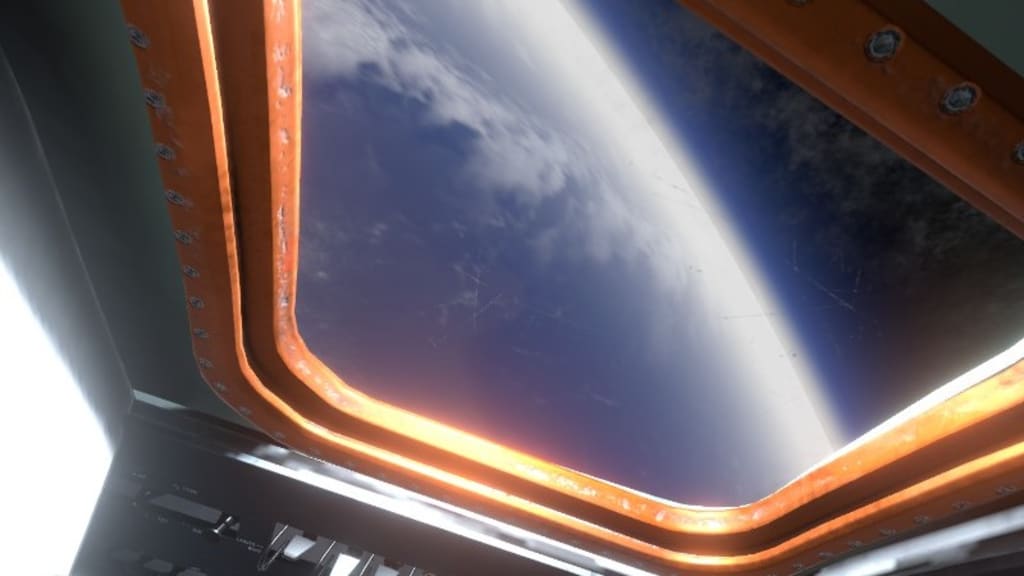
Outside the small window of my cell, I can see more stars than any other person alive on the earth below. Depending on the position of the station, my face is sometimes bathed in a sliver of the harsh but brilliant light of the sun. When I feel its warmth on my face, I smile.
I suppose it shouldn’t surprise me my captors, otherwise bent on cruelty, wouldn’t have thought twice about relegating me to a room with a view of the stars for the last few days of my life.
They don’t care about the stars, or the sun, or anything that lies beyond the confines of their once again darkened world. Even as they mock me, I can see the fear in their eyes. They are eager to return to the perceived safety beneath the veil.
Yes, I am sorry to say as I write these words, the world is dark once more. But I can only hope the brief window of time during which Burt and I managed to lift the veil was enough to inspire others. I don’t know what that would look like, though. As far as I can tell we were working alone. There were whispers of an underground movement, a network of like-minded people conspiring to uncover the sky, hushed rumblings at bars and coffee houses. But Burt and I never sought out that sort of companionship. We had one another. And for us it was enough to witness the sky in all its vastness from the earth below for the brief time we did.
Hardly a soul in generations had witnessed the night sky, nor the sun for that matter. We were taught from a young age to fear what lie beyond the veil. “No one can hear a scream in the vacuum of space,” our teachers would say to us with a sort of hushed solemnity at the beginning of each school day, a sort of informal pledge of allegiance to the benevolence of our corporate caretakers. “Best to keep your feet on the ground,” they’d continue.
The only ones who had seen what lay beyond the veil were members of Evignat’s board, a small number of Evignat employees, and the unlucky few sentenced to death each year by the void of space like Burt and me. A few times a year we were shown a tribute to the employees whose work required them to witness the sky. Many of them, we were told at the time, lost their minds at the sight, gripped with horror and panic for gazing at the stars or feeling the sun on their face for too long.
And then there were the criminals. For those who were truly afraid, who had bought Evignat’s messaging hook, line, and sinker, it was a remarkably effective threat. The idea that one would be propelled into an unknown universe, kept alive just along enough to see its supposed horrors before suffocating to death in the coldness of space, motivated many to beg to stay safely tethered to the earth even if it meant dying by more painful means for their crimes.
Of course, this wasn’t how Burt saw it. Eventually, it wasn't how I saw it, either. And even though so many people in my life professed to be deathly afraid of the supposed terrors that lay beyond the veil, I think they knew on some level their fear was performance.
Even though we always understood we would one day be separated, that our paths would take us to this desolate, breathtaking end, I miss Burt. We loved the challenge of what we had committed ourselves to, but we loved one another as well.
I remember the first day we met. I was working on the agricultural efficiency floor in a high rise back on Earth when he joined our office. Evignat’s commodification of the sky meant that botanists, computer scientists, and physicists were needed who could calculate the precise amount of sunlight needed for optimal food growth without opening the veil beyond what farmers had bought. Because the sky was no longer a public good, employees needed to be able to do their work from a distance without tainting their own propagandized perception, and without providing others access to a good for which they had not paid.
The only glimpses we ourselves ever got of the sky beyond the veil got were the rare days when the air was clear enough for us to see the golden beams of light cast down on the earth from the windows of Evignat’s Chicago office. But most workers on my floor didn’t pay much attention to what was happening outside of our windows. The twinkling lights of the city were always there no matter the time of day. For my part, I remember gazing out in wonder at the city when I first began working at Evignat. I had never seen such a vast sea of light all at once. Access to the top floors of Evignat's high rise buildings in most cities were strictly limited to employees.
As I was given a tour of our floor, I could hear established colleagues chuckling to themselves as they went about their work, no doubt amused by my mouth hanging open at the constellation of city lights below.
Ashamed, I quickly covered the wonder in my eyes, doing my best to build up the pretense of the view being utterly ordinary.
And over time, that's what it became.
Ordinary.
I even joined in the snickering when new colleagues came to us, gazing with the same awe in their eyes I once had at the mechanized universe illuminated below.
But with Burt, it was different.
On his first day in the office, the joy in his eyes at the sight of the lights felt almost tangible. While my colleagues laughed openly at his amazement, I held it with a sort of admiration. There was something different about him. I went over to where he was sitting, waiting to be shown to his desk, his hands pressed against the glass like a small child.
"It's beautiful, isn't it?" I said, placing a hand softly on his shoulder.
He looked up at me, the twinkling lights of the city reflected in his dark eyes, holding my gaze so intently it nearly took my breath away.
"Yes," he breathed, almost a whisper. "I've never seen anything like it." He turned back to the window. "Where does it open up? The veil?"
Just then, I didn't have the heart to tell him that our work, while it had practical effects for the farmers in need of sunlight for their work, was entirely theoretical and done at a distance. At the time I couldn't even be sure the moment I entered my calculations was the same my designated portion of the veil would open up. For all I knew, I submitted my results, which were then reviewed by another department before being implemented. I received visual confirmation on my screen I had made the right calculations. But it wasn't until I met Burt I really understood the power that lay at my fingertips.
I do remember the few times I caught sight of the veil opening in the fields far outside of the city before Burt came along. Once it was when I was on a coffee break, staring idly out the window when a pair of golden fangs caught the corner of my eye. They were so faint, I might have missed them or written them off as some other happening in the distance, perhaps bright spotlights from a concert or baseball game on the outskirts of the city. But it was the direction of the lights that caught my attention. They came not from the earth, but from the sky.
And appear as fangs they did, narrow and cutting. Motionless, they penetrated the earth. I felt my heart seize up in my chest. A fear took me that didn’t quite seem to be mine.
“Ah, floor 26 must be doing some field testing today. Horrifying, isn’t it?” My desk mate at the time, Seth, had wandered over to where I was sitting staring out the window, a practiced detachment on my face.
“Hmm?”
“Horrifying, the veil opening,” he said again. “They’ve got a group upstairs working on calculations for a new set of buyers. Some fresh land opened for corn. Monsanto grabbed it right away," he informed me.
“Oh, yes. Absolutely terrifying,” I responded perfunctorily. “I always worry about the people who live closer to the farms.”
“The way the city has zoned things, it’s not something to worry about,” Seth said smartly, smoothing over his mustache with one hand. “They know precisely where to end residential neighborhoods and construct the wall to prevent anyone from being unnecessarily exposed."
He paused for a moment, an odd smile creeping across his face.
"And thanks to folks like us, it’s never opened wider or for longer than it needs to be, eh Irv?” He slapped me on the shoulder as I was taking a sip of my coffee. I sputtered and coughed.
“Right,” I said. “Thanks to us.”
I admit now with a deep shame I did enjoy the work I did for Evignat before Burt came along. Figuring out the puzzle of farming at a distance fit with my natural curiosity of wondering how the world worked and fit together. I was mostly content to bury my nose in numbers. I'd feel a sort of warm satisfaction when my computer would confirm a correct calculation and I’d watch a digitized version of the veil open up on my screen.
Looking back on the arc of my life, though, it’s really no wonder I ended up where I am today, a few days away from dissolving in the vacuum of space. As a child I often thought about what lay beyond the veil—wondering whether there really were stars and galaxies and distant places like the ones my friends whispered about on the playground, their voices trembling.
“Nobody can hear a scream in the vacuum of space,” they’d whisper, and someone else would scream and run away in terror at the thought. As with previous generations, we were taught to fear what lay beyond the veil. We knew the sun existed, but were told its only purpose was sustaining agricultural growth to maintain the earth’s food production. I remember pretending to live in fear, like my friends. But at night I’d often look up at the blackness from my backyard and wonder, even though I could only imagine what a night sky might look like.
We didn’t live entirely in darkness. The veil just muted the natural light of the sun so the world existed in a sort of muffled grey that became a heavy darkness at night. And changing weather patterns meant that we did, in fact, have cloudy days that were darker than a “sunny” day, though never as dark as the night.
Still, I've heard the early days of darkness were almost unbearably suffocating. Adjustments took some time. “Even the darkest nights before the veil,” I read once in one of my grandfather’s journals that was usually safely locked away in a dusty corner of my apartment, “the nights when the moon was new, could not compare to the darkness we know now.”
As I grew older I wondered about the sun and the stars less and less. I don't think anyone like my parents or a teacher snuffed out my dreams of the heavens, at least not that I can remember right now.
One day, it just sort of happened.
I woke up and decided I had best set about making a life for myself. I wanted a family and a home. I’d hoped for a job that would pay well but still occupy my mind. Now I shake my head and smile thinking about the trajectory of my life: multiple advanced degrees in computer science and physics, a job where my only task was to ensure the opening of the veil. That I ended up here among the stars in the waning hours of my life almost seems an inevitability.
Although such a path may have passed me by, a ghost ship in the endless night, were it not for Burt.
I used to tell myself I didn’t think much about what lay beyond the veil until I met Burt. But my few days spent gazing in awe at the wonders of the cosmos from my small cell have made me realize how deeply I must have felt in my bones we were worthy of something more, even if I didn't understand it at the time.
Indeed, if I look back on my life, my work, and my love, this ending seems a most natural, almost preordained course. I will return my borrowed stardust here among the stars, a thought that somehow brings a bittersweet taste to my tongue. And whether they know it or not, my captors will someday return their borrowed stardust to the stars, too, be it up here in the coldness of space, or below in the darkness of their own making.
Of the two of us, Burt was really the dreamer. It never got snuffed out of him. And it was he who relit the flame I had put out so many years ago, the one I kindled as a child in the darkness of my bedroom at night, lit only by the enigmatic scatter of stars from the nightlight at the foot of my bed.
From the first day he situated himself at the desk across from mine I knew he would be trouble, although now the thought of his mischievousness makes me giggle to myself. Before he came along, I thought I was content with the way things were. I could get lost for hours in the complex calculations needed to assess the precise measurements for opening my assigned segment of the veil. I’d leave the office most days with a sort of pleasant hum rippling through my body, and it would continue as I stared absentminded out the window of the El train at the perpetually twinkling lights of the city.
At night, my neighborhood would light up with fairy lights and electric torches, illuminating a path home for me after I got off of my stop. I’d feel a sort of sweetness settle over me as I watched people in their homes set the lighting just so as they prepared for nightfall, candles lit in their windows. I'd peer into living rooms during the winter to see children playing games in front of roaring fireplaces. During the summer, backyards would be ablaze with bonfires and alive with music, a celebration of the relative warmth those months would bring.
My apartment was the first floor of a two-story brownstone on the north side of the city. It was its own menagerie of bistro lighting and eccentric lamps I had collected over the years. I was especially drawn to lamps with elaborate shades that would cast different patterns and figures on the wall when they were lit.
Looking out at the stars now from my small window, they remind me of the patterns cast by my lamps. And I do wonder if we could have been happy in that place for the rest of our lives, Burt and me.
I promise you, I am glad we did what we did, even if it meant our ending would be cold and lonely, apart. Shivering here in the relative darkness of my cell, though, I suppose I can imagine a universe where it was enough, the life we had before we lifted the veil.
Maybe it would have been enough to sit side by side holding hands on the overstuffed couch in our living room, our ties loosened around our necks after a long day at the office as we read to one another, the lights from our combined lamp collection creating constellations all our own just for us.
Burt came to the Chicago office from an Enignat lab up in the northern reaches of the Arctic. Up there, they were working on a way to maintain food production in absolute darkness. The perpetual night for multiple months of the year made conditions ideal for trying out this sort of thing in the most extreme conditions. But as I understand it, they didn’t have much success. “And it was too dreary,” Burt would tell me over and over again, clasping my hand, a faraway look coming into his eyes. “Being in that kind of darkness for so long…it changes you.”
One of the first things I remember Burt telling me of his work up at the northern Enignat lab was about the darkness.
“It never ends,” he said one night as we were gathering our things to leave. I think it must have been a few days after we started working together.
“Oh, what’s that?” I asked, slinging my briefcase over my shoulder.
“The darkness. Up there.”
At the time, it wasn't clear if he was talking to me or to himself. Shortly after we began working together, he would often gaze off into the distance, mumbling incoherently to no one in particular. I initially found this habit somewhat grating. Now, I would give anything to hear his voice one more time, even if it was the final scream that somehow managed to break the impossibilities of physics and make its way through the emptiness of space to my ears.
“Burt? Are you talking to me?” I asked.
I didn't know why in that moment, but I was overcome with the urge to place my hand gently on his.
He came dreamily to attention at the touch of my hand, as if he was seeing me for the first time that day even though we had been working side by side for most of it.
“Oh? Yes, I suppose I was.” He heaved a heavy sigh and looked up at me from his desk. For a moment his face transformed, and I saw a sort of shimmering melancholy reflected in his otherwise inky eyes. I let my own eyes linger on his for a time. Then, a question had scarcely popped into my head before I said it out loud.
“Burt, would you like to go get a drink?”
I couldn’t be certain, and now as I stare out into the glittering endless night beyond my cell window, I wish more than anything I could ask him about it. But at the time, I could have sworn I saw a small tear slip down Burt’s cheek as he eagerly nodded his head and smiled, gathering the rest of his things.
About the Creator
Mara Suttmann-Lea
I write curiously and try to make myself think differently through my work. I hope it does the same for my readers.
Keep reading
More stories from Mara Suttmann-Lea and writers in Fiction and other communities.
A Good Cup of Coffee
We’ll be arriving soon, shortly after seven. It is nearly half past six in the morning, the first I’ve seen this time of day since I got onto the train. I dare not leave my compartment now. Besides, it seems like Mrs. Finch has made up with her husband. All I have to do is sit back and breathe. I might even close my eyes. I have my notes to pass along, but I’ve decided to wait as long as possible to give them to the car attendant.
By Mara Suttmann-Lea3 years ago in Psyche
Miss Persephone's Manual to a Seemingly Ordinary Life
Miss Persephone was found at the dining table, her blue eyes swollen, her tears arriving and retreating like the tides of the ocean. Earlier that day, her family had visited her in the retirement home where she had lived for eight years. It was her eightieth birthday.
By Imola Tótha day ago in Fiction


Comments
There are no comments for this story
Be the first to respond and start the conversation.