
A Poetic Rebellion. Breaking some rules. 🖋️
The un-random breaking of rules. Transforming the mundane.


If you're to be Artistic, you need to break some rules....drive your visual spark, capture order being unraveled by intent, not chance - and show how beautifully chaos can be rebelliously choreographed.
The fastest way to stagnation is..."Refusing to change a proven strategy." Don’t just change it...Pivot mid-campaign - and the results will outperform expectations. (Find all rules down below. Keep reading to discover them).
We need excitement, we need food for the little gray cells.
Rebellion should be in your poetry, abstraction in your imagery - they don’t wait for permission or perfection. They become themselves through movement. You don’t chase the plan. You reveal it by continuing to create.
Is your heart whispering, “Go,” while the mind is still asking. "Go Where"?
🖋️“Begin where Risk becomes the rent you pay for originality”
This phrase should light fires in the limbic systems of our brains:
the hippocampus - where memory and emotional context resides
the amygdala - where fear evokes emotional responses
the hypothalamus - which drives our hormones
the prefrontal cortex-which encourages self control and our decision making processes.
Interconnected functions to drive our dreary existence into uncomfortable and exciting explosions of wonder and excitability.
True creativity - bold, unborrowed, unfiltered - demands a price. And that price is vulnerability. To create something original, you have to step beyond what's safe, expected, or approved. There's no guaranteed applause, no paved road. You risk misunderstanding, failure, even rejection. But without that risk, what you create might be comfortable, not courageous...or better yet - outrageous.

“Rules” which creative people break aren’t acts of rebellion; they must be viewed with an open mind, form a coherent mindset which justifies the end results.
Steve Jobs (bless his soul) and others, offered rules that are worth the creative contemplation:
1. Breadth fuels depth. 🖋️
The more diverse your experiences, knowledge, and perspectives are, the more profound and nuanced your understanding of any single idea can become.
Example:
A philosopher who’s read science, poetry, history, and mythology won’t just ponder a moral dilemma---he/she will thread it through time, culture, logic, and emotion. A poet who observes both the chaos of cities and the stillness of forests can craft verses that echo with contrast and resonance. Even in the natural world, ecosystems thrive not by uniformity, but by biodiversity---each element deepening the strength and complexity of the whole.
In art, breadth might mean you borrow from surrealism, protest - or see beauty in graffiti, ancient symbology, and even personal memories, in order to paint a single piece that pulses with layered meaning.
An abstract storyteller and philosophical voyager...gather wide-ranging ideas, without scattering focus...building a richer soil from which truly deep insight can grow.
2. Collect more dots. 🖋️
A metaphor for broadening your input...gathering experiences, ideas, questions, and fragments of thought---before trying to connect them. Explore widely and absorb deeply without rushing to form conclusions.
Imagine you’re painting not with a single color but with pigments gathered from charcoal, rainbows, and the surreal. The more colors - dots - you collect, the richer the image that emerges. Each dot could be a book you read, a conversation you overheard, an artwork that unsettled you, or a contradiction you wrestled with.
In creative and philosophical work - it’s a quiet rebellion against linear thinking. It says: Don't just follow the path. Map your own by noticing more.
3. Progress reveals the plan. 🖋️
This carries a quiet wisdom, especially for creators and seekers. “Progress reveals the plan” means that clarity doesn’t always come first - sometimes, you must begin before you fully understand where you’re headed. .
The painter discovers the meaning of their work not from a blueprint, but from how colors clash or harmonize. It’s the philosopher who writes into ambiguity, only to find that their questions illuminate unexpected answers.

4. Start before you’re certain. 🖋️
This phrase is a gentle challenge to perfectionism - a reminder that clarity often comes in motion, not before it.
"Start before you’re certain" means having the courage to step into the unknown, to act on instinct or intention even when the destination is unclear. It's trusting that movement itself is a form of discovery. Certainty is seductive, but it can also be a trap - it waits endlessly for conditions to be perfect, for every doubt to disappear. Yet most breakthroughs, whether in art, invention, or insight, are born not from certainty but from curiosity.
For someone who explores liberation, abstract meaning, and the dance between chaos and creation - it’s a call to creation as a form of self-trust. Paint the stroke before you know the image. Write the line before you understand the metaphor. Begin the rebellion before the plan is fully formed.
Think of every rebel artist, every philosopher who dared a new thought, every soul who shared a truth the world wasn’t ready for. They all paid in uncertainty to live in originality’s rare and radiant house.
In your world, where abstraction, independence, and expressive depth are the air you breathe - this idea is practically a manifesto. You’ve already taken those risks, haven’t you? Whether it’s breaking form in a poem or inviting contradiction into your work - you’re choosing art over approval. That is originality’s true rent.
6. Stay hungry, stay foolish. 🖋️
Those four words, the echo of Steve Jobs' iconic Stanford address -have become a rallying cry for creators, dreamers, and quiet revolutionaries alike.
“Stay hungry” is the call to never be fully satisfied - to remain curious, driven, and always reaching beyond what you know. It’s the hunger for discovery, for challenge, for deeper meaning. Not the hunger of lack, but of longing - for growth, for truth, for the impossible made tangible.
“Stay foolish” is the permission to ignore convention, to take leaps others deem reckless, to believe in ideas that don’t yet make sense. It's about choosing wonder over cynicism, experimentation over perfection. It's about embracing the awkward, the untested, the weird little spark that might just start a fire.
Together, they form a philosophy of perpetual becoming. They say: Don’t settle. Don’t tame your instincts. Keep asking naïve questions, keep chasing strange ideas, keep building before the world believes in what you’re doing.
In our realm, where poetry bends logic and art dares defiance, this phrase fits like a flame to our lanterns. To sketch, or twist it into a poem that thrums with rebellion and hope. To create something with grit and wonder. 🔥
7. Vision outpaces consensus. 🖋️
Dare to dream beyond agreement.
"Vision outpaces consensus" means that truly original ideas are often born far ahead of their time - before the crowd is ready to understand, accept, or support them. A visionary sees what could be, not what already is. They don’t wait for a vote of approval. Their clarity doesn’t require a quorum.
Consensus seeks safety, familiarity, the comfort of the known. Vision, in contrast, lives in the future tense - it’s speculative, risky, defiant. That’s why visionaries are sometimes called mad before they’re called genius. They build cathedrals no one else can yet see, trusting that the world may catch up later… or not.
In your creative language, it’s the difference between drawing the constellation before the stars align and waiting for the sky to agree with your sketch.
This concept is a visual rebellion. The weaving of poetry that stands on the far edge of belief. We can help shape it into something no consensus could ever predict. 🖋️
........................................
Art that broke rules.
Some of the most revolutionary art emerged from rule-breaking---where defiance became the medium itself.
- Marcel Duchamp’s Fountain (1917): A porcelain urinal signed “R. Mutt” and submitted to an art exhibition. It wasn’t just plumbing—it was a philosophical grenade that exploded the definition of art itself.

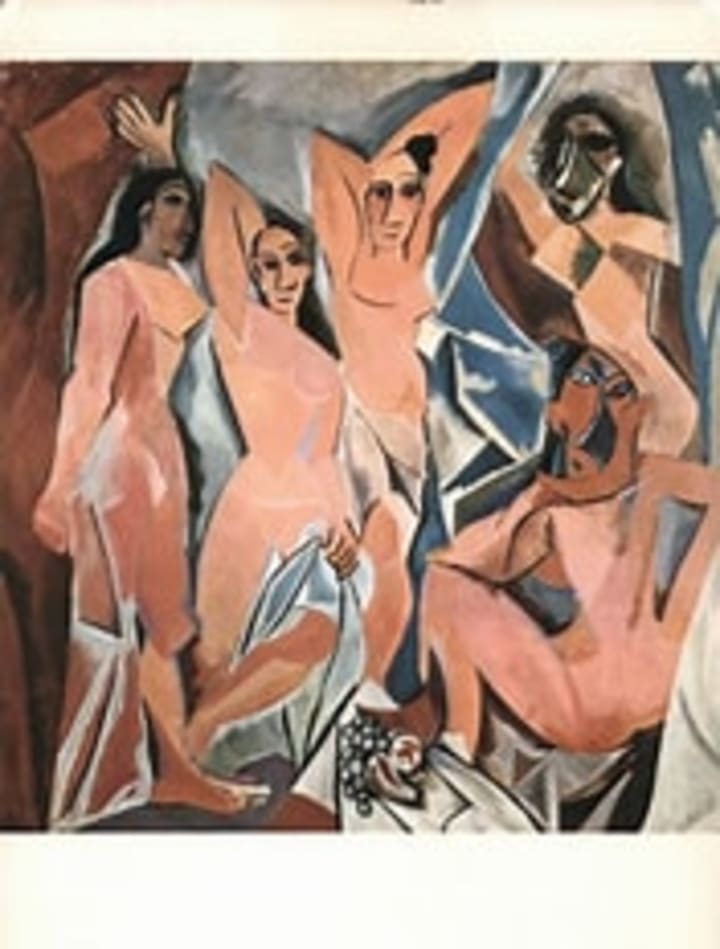
- Pablo Picasso’s Les Demoiselles d’Avignon (1907): This painting shattered classical perspective and proportion. Faces inspired by African masks, fractured bodies, and no depth—Picasso rewrote the visual language of the human form.
- Kazimir Malevich’s Black Square (1915): A black square on a white canvas. No subject, no story—just pure feeling. It was a radical leap into abstraction and the birth of Suprematism.

- Claude Monet’s Impression, Sunrise (1872): Critics mocked it for its unfinished look, but it sparked the entire Impressionist movement. It broke with realism to capture fleeting light and emotion.

- Banksy’s Street Art: Anonymous, illegal, and often politically charged, Banksy’s work defies not only artistic norms but also the institutions that house them.

- Francis Bacon’s Study for a Self-Portrait (1985–86): Faces twisted by dual perspectives, hands blurred into motion—Bacon broke the rules of anatomy and realism to reveal psychological truth. A triptych.

Each of these artists didn’t just bend the rules—they questioned why the rules existed at all.
Diving deeper into some of these rebels or explore how you might channel this spirit into your own work
........
Creative rules you’ll NEVER break… but I broke every single one, (says Jakub Wielogorski),owner of Smart Crafts Studio.
While others played by the book, I rewrote the rules. And it was the best decision of my career.
💡 Rule #1: "A design must be simple and readable." Not always... Sometimes, controlled chaos grabs attention more than minimalism. One of my projects, labeled "too complex," achieved a record-breaking CTR (click-through rate).
💡 Rule #2: "AI and human creativity don’t mix." Really? AI is my second pen, my assistant, my creative partner. By blending AI with design, I created visuals that no human alone could replicate.
💡 Rule #3: "Copywriting is all about simplicity." Sometimes. But a well-crafted metaphor can leave a deeper impact than a short slogan. One of my "too complicated" texts? It went viral.
💡 Rule #4: "Stick to the client’s brief." No. Sometimes, clients don’t need what they want—they need what they should get. I changed the brief for one project… and my version dominated the market.
💡 Rule #5: "Don’t change a proven strategy." Don’t change it? That’s the fastest way to stagnation. I pivoted mid-campaign—and the results outperformed expectations by 200%.
Bottom line: Rules? They're meant to be learned. And then broken.
If you want conventional solutions—there are plenty of others. If you want groundbreaking results—you know where to find me.
📌 P.S. Which of these rules have you broken before? Drop a comment below.
The Rules of Creativity (And How I Break Them) article by Supriya Mishra on mediumconsult
🖋️🖋️🖋️🖋️🖋️🖋️🖋️🖋️🖋️🖋️🖋️🖋️🖋️🖋️🖋️🖋️🖋️🖋️🖋️🖋️🖋️🖋️
About the Creator
Novel Allen
You can only become truly accomplished at something you love. (Maya Angelou). Genuine accomplishment is not about financial gain, but about dedicating oneself to activities that bring joy and fulfillment.
Keep reading
More stories from Novel Allen and writers in Fiction and other communities.
On Aging well.
When you learn something new, your memory center lights up like a Christmas tree...stimulating it, creating a loop of new information. That stimulation is like a workout for the hippocampus. (The elongated ridges on the floor of each lateral ventricle of the brain, thought to be the centre of emotion, memory, and the autonomic nervous system).
By Novel Allen2 months ago in Fiction
Before Anyone Says So...
The Therapist’s Room: Before Anyone Says So The first sign of it was not dramatic. That is important. People always think beginnings arrive with cymbals. A speech. A slammed door. A woman standing in the rain with mascara on her chin and a suitcase she packed with furious clarity, as if life had waited politely for her to become cinematic.
By Teena Quinn about 11 hours ago in Fiction


Comments (3)
Chile the Lord is speaking through you! I received the message that you relayed in #5 about pivoting about a week ago! This was my confirmation! Excellent analysis No! Profoundly inspirational! Thx 4 sharing! 🫶🏾💕
great advice you have here
Excellent article, lots of great points to think on