
A Mother's Goodbye Beneath the Olive Tree
One son's courage, one woman's quiet sacrifice, and the war that changed everything.


The wind whispered through the fields of Amara village, carrying with it the scent of soil, wheat, and a quiet sorrow that lingered in every home touched by war. Mariam stood at the edge of her small wooden porch, her hands rough from years of working the land, her back hunched slightly—not from age, but from burdens carried in silence.
In her hand, she held a letter—creased, worn at the edges, the ink faded from countless readings. It was the last letter her son, Arif, had sent before he vanished into the heart of a foreign war, one that had claimed too many sons from too many mothers.
Mariam had raised Arif alone after her husband passed when the boy was just six. Life was never easy, but the bond between mother and son was strong, woven from hardship, laughter, and shared dreams. Arif was bright, always curious, always gentle. He used to whisper to the goats when he fed them, as if they were part of some secret world only he could see.
When the war broke out, the government called for men to join the army. Mariam, like many others, received a letter bearing the seal of conscription. Arif was eighteen. Her only child.
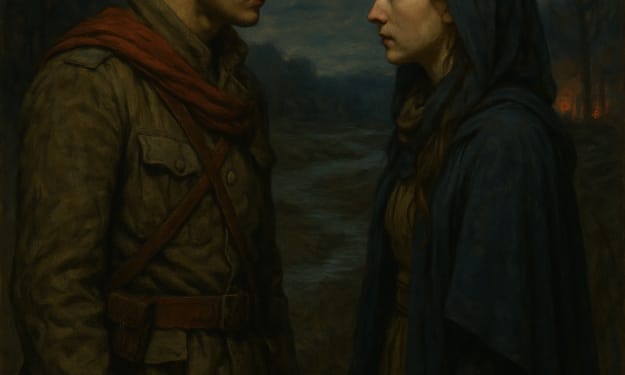
That night, they sat under the olive tree behind the house, where his father had once built a swing from old rope.
“You don’t have to go,” Mariam whispered, brushing a strand of hair from his brow. “We’ll find a way.”
Arif shook his head. “If I don’t go, someone else’s son will. Someone weaker. I have to do this, Ma.”
Her heart clenched, but she nodded. She didn’t argue. She didn’t plead. The sacrifice of a mother begins not on the battlefield, but in the quiet moments when she lets her child walk away.
She packed him a bag with dried figs, his favorite shawl, and a small silver pendant that had belonged to his father. They embraced for a long time before he left, and she pressed her face into his chest, trying to memorize the rhythm of his heart.
Letters came for a while. Arif wrote about the cold nights, the friendships he formed, the way fear came in waves but was always softened by laughter. He never told her about the battles, though she read between the lines. The last letter arrived in early winter.
> Ma,
I miss the sound of your voice when you sing to the birds in the morning. I miss your hands, your cooking, your quiet strength. Things are changing here. They say a big battle is coming. But don’t worry—whatever happens, know that I carry you with me. In every breath. In every step.
Love, always—
Arif.
After that, silence.
The village officials came a month later. They were solemn, respectful. One held his hat in his hands. They offered condolences, a medal, and an envelope with “For Mariam” written on it.
She didn’t cry in front of them. She made tea, thanked them, and closed the door behind them.
Inside, she opened the envelope. Inside was a letter from Arif’s captain.
> Your son was brave. During the last battle, he shielded his comrades when a grenade landed in their trench. He didn’t hesitate. He saved three lives. We owe him everything.
Mariam read the letter once. Then again. And then she folded it and placed it beside Arif’s last letter, tucking them both into the wooden box where she kept her wedding ring, a lock of his baby hair, and an old family photo.
The days passed slowly after that. She returned to her work. The chickens still needed feeding. The fields needed sowing. Life, as it does, refused to pause.
But Mariam was never the same.
Sometimes, in the early hours of morning, she would sit under the olive tree, whispering stories as if Arif were still beside her. To outsiders, it may have seemed like grief turned to madness, but those who knew Mariam understood—this was love that had not found a place to rest.
She never called herself a hero. She never demanded recognition. But in every quiet meal she cooked for neighbors, in every coin she gave to an orphan, in every night she spent staring at the stars—she lived her sacrifice.
Years later, the village built a small memorial for the fallen. On it were inscribed many names, but beneath Arif’s, someone had etched a simple line:
“He was brave because she taught him how to be.”
And so, in a quiet corner of the world, where olive trees grow and the wind still carries whispers of old songs, a mother’s sacrifice lives on—not in war stories or headlines, but in the gentle, enduring strength of love.
About the Creator
Keep reading
More stories from Intresting Stories and writers in Fiction and other communities.
Lightning Never Strikes Twice
The distant rumble, the sudden deluge, the crescendo of sound, the flash of light, the explosive energy — it never gets old. I became an amateur storm chaser about two years ago. My wife, Cindy suggested it. Sort of. She said, "Alex, you know this cancer is killing me. I've come to terms with that, but you're smothering me. Go join a band, write a book, or become a storm chaser, for all I care. I love you, but you need a hobby."
By Julie Lacksonen5 days ago in Fiction
Review of 'Man on the Run'
My wife and I saw Man on the Run, a nearly 2-hour documentary on Amazon Prime, about Wings, Paul McCartney's group that flew around the world from shortly after The Beatles broke up in early 1970 to shortly after John Lennon was murdered at the end of 1980, making a Beatles reunion forever impossible.
By Paul Levinson5 days ago in Beat


Comments
There are no comments for this story
Be the first to respond and start the conversation.