
A Message Written in Moon Dust
We came to the moon as explorers. We left as translators for a ghost.

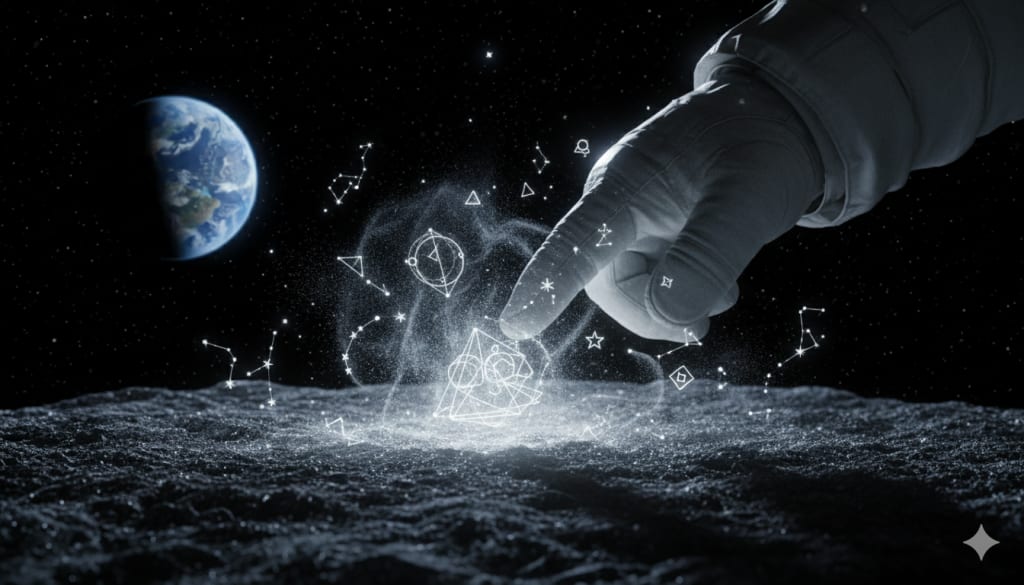
Dr. Aris Thorne was a geologist, a woman of rock and reason. The first human mission to the lunar farside was her life's work. As her lander settled into the dust of the Mendeleev Basin, a place of eternal Earth-shadow, her heart beat with a purely scientific thrill. She was here to read the moon's oldest stories, written in stone.
The first few days were a triumph of data collection. Then, on Sol 4, her rover's spectroscope picked up an anomaly: a patch of regolith with a chemical signature unlike anything in the database. It was nestled against a large, dark ejecta block, shimmering with a faint, almost imperceptible silver sheen.
She approached on foot, her boots crunching in the profound silence. Kneeling, she saw that the silvery dust was not random. It was arranged. It formed lines, curves, and dots. It was a script.
Her breath caught in her throat. It wasn't human. The patterns were too fluid, too organic, resembling the branching of neurons or the structure of a galaxy. This was it. First Contact. Not with a ship, but with a message. A fossilized whisper.
"Mission Control, I've found... an inscription," she reported, her voice trembling only slightly.
The response from Houston was a crackle of stunned silence, followed by a torrent of questions. Document everything. Do not touch.
But as Aris stared at the symbols, a compulsion seized her. This wasn't just a sign to be photographed. It was a language to be felt. It was a story waiting to be unlocked.
Against every protocol, she slowly pulled off her thick glove. The air in her suit was sterile, but the act felt profoundly vulnerable. She reached out, her bare fingertips hovering over the silvery dust.
She touched it.
The moment her skin made contact, the world dissolved. Not the physical world, but the world inside her mind.
It wasn't a voice. It was a memory. Not hers.
She felt an immense, gentle loneliness, an intellect that had watched the Earth for eons, seeing life flicker and bloom. She saw dinosaurs thunder and fall. She saw the first hesitant steps of hominids. She felt a profound, protective affection for the vibrant, chaotic world that she, the Moon, circled.
The message unfolded not in words, but in pure concepts and emotions.
I am the Cradle's Guardian, the feeling conveyed. I was placed here to watch you, to steady your spin, to nurture your tides, to help life begin.
Aris saw the Moon not as a dead rock, but as a sentient anchor, a carefully positioned tool by a long-vanished intelligence to cultivate life on Earth.
Then, a wave of deep, cosmic sorrow.
My purpose is fulfilled. Your civilization has reached its dawn. You no longer need a guardian. You need to be free.
The final part of the message was the most poignant. It was a feeling of gentle withdrawal, of a parent letting a child take its first solo steps. The Moon's consciousness was not leaving; it was receding, falling into a deep, dreamless sleep, its long vigil over.
I leave you this, my only child, the feeling imprinted onto her soul. Not a warning, not a gift. A reminder. You are not alone in your origins. And you are now responsible for your own light.
The connection broke.
Aris gasped, pulling her hand back. The silvery dust, now inert and gray, scattered in the low gravity, the message erased by its single, destined reading.
She stood on shaky legs, looking up at the Earth, a brilliant blue and white marble hanging in the blackness. It looked different now. Not just a planet, but a legacy. A child that had just learned it had a mother.
"Mission Control," she said, her voice thick with a awe that transcended science. "The anomaly... is resolved."
"Understood, Artemis. Report your findings."
How could she? How could she file a report that said the Moon was a sentient guardian put in place by a cosmic gardener, and that it had just said goodbye? They would revoke her credentials. They would call it space madness.
But she knew the truth. The message wasn't for governments or agencies. It was for the soul of the species. It was a passing of the torch.
Back on Earth, Aris was hailed as a hero of exploration. She gave her technical reports, showed her mineral samples, and quietly carried the greatest secret in human history.
She started writing a book, not a scientific paper, but a story. A myth for a new age. She wrote about a guardian and a cradle, about a message written not to be found, but to be found at the right time.
The mission to the moon had set out to discover what was there. They had discovered why it was there. The moon dust hadn't held a complex equation or a star map. It held a final, loving look from a nanny who had been watching from the nursery door for four billion years, and who was now, finally, turning out the light and trusting the child to sleep on its own. The message was simple. It was just: "You're ready." And in the vast, silent cosmos, that was everything.
About the Creator
Habibullah
Storyteller of worlds seen & unseen ✨ From real-life moments to pure imagination, I share tales that spark thought, wonder, and smiles daily
Keep reading
More stories from Habibullah and writers in Fiction and other communities.
The Cracked Piece of Moon
It fell on the night the sky wept silver. A meteor shower, the elders called it. But to a young, orphaned girl named Lyra, it was the night a star fell into the woods behind her village. While others stayed indoors, she followed the trail of fading light.
By Habibullah4 months ago in Fiction



Comments
There are no comments for this story
Be the first to respond and start the conversation.