
A Footnote to a Courtroom Drama
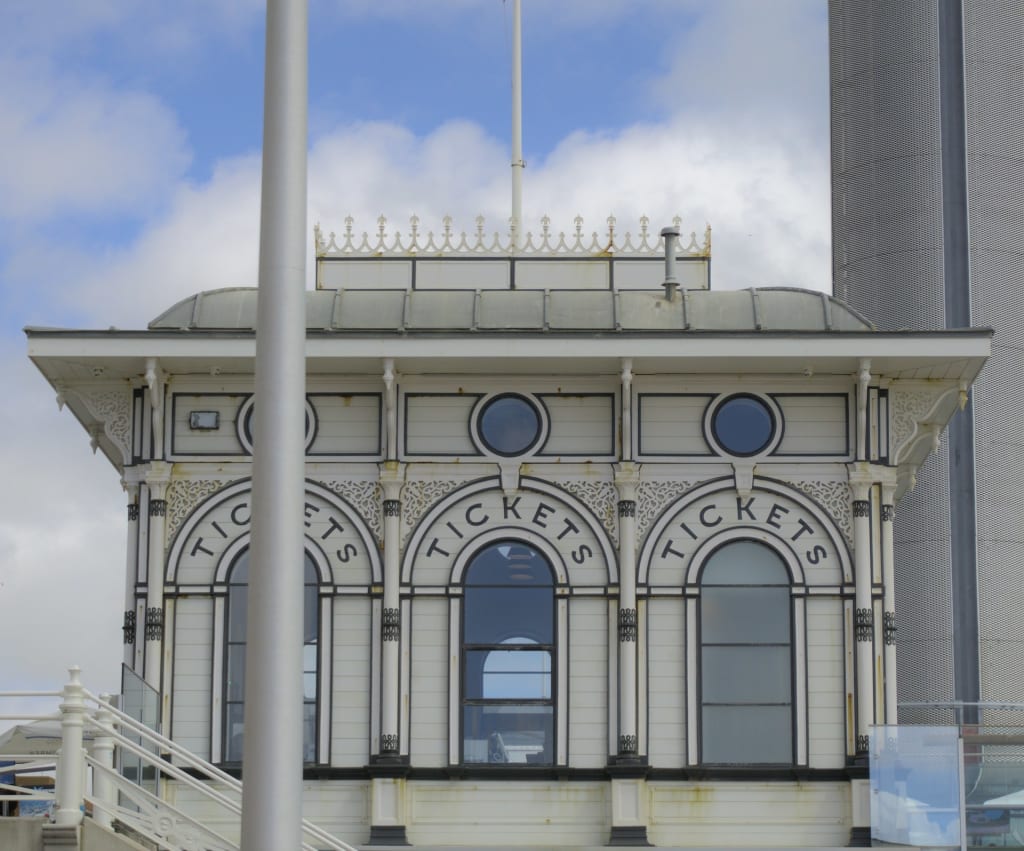
Brighton Beach, May 1963


Dear Reader,
I’m going to suggest that if you are planning on reading this aloud, spend the previous evening shouting until hoarse. According to the fanzines of the time, that’s how Lauren Bacall found her depth, her gravel – and she would make the perfect voice-over for my story.
It has been a lonely few months. To amuse myself, I’ve been thinking how they would tell my story. Knowing them as I do, I think they would concentrate on my affectations. I love a tailored trouser, a string of pearls, an arched eyebrow and my cigarette holder.
Of course, they wouldn’t actually cast someone who looks like me. More likely I would be played by an ex-starlet, someone who has made it past the age of thirty, ravaged so much by time that she has moved from blonde to a definite shade of brunette. She will be prettier than me, with big eyes which will be lowered when demonstrating sadness and raised when being feisty.
I think the first scene will be the arrival at the courtroom, snapping of camera bulbs and a jostling of men. It sets the actress apart, demands some sympathy as she looks isolated and scared, only raising her large eyes for them to be blasted by light.
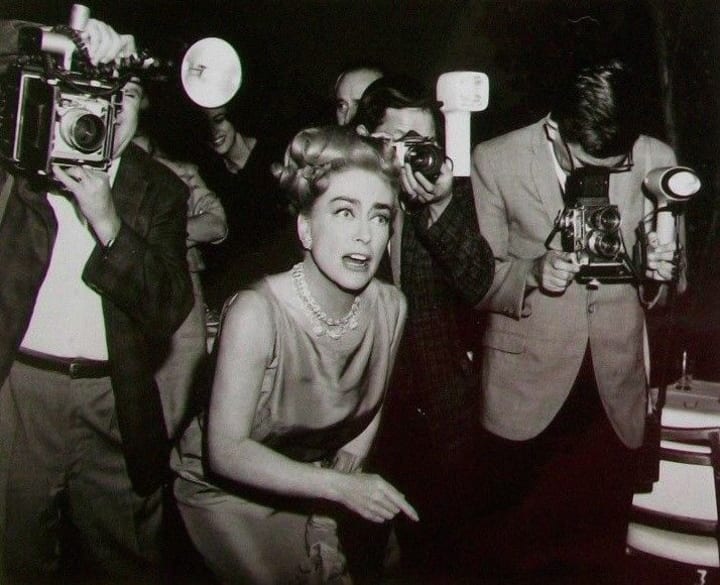
I am using clichés from a previous decade, because right now my gender has fallen out of fashion with the movie industry. But you recognise the scene because Hollywood loves its variations on a theme. It is an art-form built on repetition.
A courtroom drama, requires flashbacks, a woman claiming to have acted in self-defence, battling off ‘flirtatious’ advances, sending secret notes and lingering on small gestures of significance. The only thing on trial is womanhood.
Sorry, I’ve started in the middle. I trust you, my audience, to make sense of the plot as we go along. But you will need introductions. Hello, I am Alice.
It is of course hubris to suggest my story could make a movie. I will be forgotten except as a footnote to a legal case. It is a shame that there will be no film because Hollywood is at its finest and cruellest when exploring itself.
My job title, film critic, sounds fusty. But I made people laugh. My job was to entertain when the movies failed to. You know how they say women aren’t funny? Well, I am a hoot. Of course we know that when they say women aren’t funny what they mean is that they don’t like witty women. We are supposed to laugh along at their jokes rather than make any of our own.
And by ‘they’, in my case, I mean the men of the film industry. The executives who use the casting couch. The men who extol the virtues of one foot on the floor, and the sanctity of marriage above career, while using working women to tell those stories. Any woman reading this will have their own ‘they’. The men who keep you in your place, pretending they want you to succeed. The men who want you to buy their goods, but don’t want to hear why they are not fit for purpose. The men you have to navigate just to proceed with your day. Exhausting, isn’t it?
Of course, now that I’ve said the subtext out loud, I must be punished.
My disdain for this kind of man, the movie mogul, will lead them to make Sapphic suggestions about my life. Reject one man, you reject them all, apparently. They may include suggestive details of my time at an all-girls boarding school. They will linger on the short stint I had as an artist’s model. (She was less interested in me, than capturing the particular redness of my hair). They will show my waywardness as I climbed the walls of my college to be with a lover.
But you should know my early life was not screen-worthy. It was thrashingly dull. My parents found their funny, feral daughters a nuisance, obstructing their desire to watch birds and hike across the countryside of Europe. I was born at the beginning of the century and had we been boys, we could have been slaughtered in some war for their convenience. Instead we were sent away for schooling. It was at boarding school I learnt the word ‘stultifying’ and the memory of the building still fills my chest with the dull thud of polite learning. To escape, Margaret and I built worlds together. She would draw and I would write.
Sensible and bright enough I moved from the no-man’s land of Cheltenham to get into a London college. I chose the grotty pleasure of a London cinema over the endless lectures about Jane Austen. When I close my eyes, I can still smell the fustiness of the velvet seats. Baying audiences, moving pictures, intrigue, music, stories, coming straight at me out of a screen. I was in love. I also met my husband.
Teddy got me an administrative role at the magazine who paid for his photographs. He encouraged my writing and one of my novels caught a director’s imagination to be made into a small budget film. You can imagine my thrill at seeing my name in the credits. However, along with the Catholic church, I hated the film. We denounced it for very different reasons and my review gave birth to my new career.
I started in print, but my film reviews moved quickly into radio broadcasting. To begin, my feminine voice, although already gravelly from cigarettes, was heard as authentic and pretty. I was the antidote to the dull and pompous male critic: the voice of fandom, rather than the distant connoisseur.
And I was a fan. I loved the cinema buildings and the ritual of a press screening. I got excited by the way movies can tell stories. I wanted to see new experiences on screen: to learn about the world, be transported, excited, educated, entertained, to share in secrets. Cinema was my treat as a girl and remained a thrill most of my life, from the opening credits to the heart-stopping finish. I have cried, laughed and stopped in horror. I have been hypnotised by a close up. I have dreamt of locations I have only visited through a screen.
I have also shuddered with disappointment, sighing at the overly-sentimental. My job was to let you know which films would provide kicks and quivers. I was also duty-bound to let you know which films would produce that flatness in our hearts, that dullness of the expected and trite. Along with the other critics, I deplored the clichés and constant repetitions of Hollywood. And I did this with aplomb and wit.
Wit was my downfall. I could say that through reviewing film, I discovered that powerful men do not like funny women. But I didn’t discover it. I always knew it, as all witty women do. We have lived a life of over-stepping the boundaries, quickly moving from delightful figure at the centre of a party, to ignored and vilified. Wit in a woman is supposed to be accidental. When we are precise with criticism, our charm dissipates. I went from being heard as a fan, to being considered out of touch with the female audience. I was no longer one of them, because I didn’t fall for the tricks designed for Hollywood’s ideal of womanhood.
My dislike of the sappy and slushy was seen as problematic. I would argue that we can tell difficult stories without women looking weak. My demand for better art was seen as shrewish. I was banned from press screenings for holding opinions. I wasn’t the first broadcast critic to have this sanction. In fact, there had been two others before me. What had we in common? We were all knowledgeable, bright and entertaining. We made clear our lack of appreciation of a studio’s prestige project. Oh, and we were witty women.
I was the only one of the three to challenge. This was because I needed my broadcast money; I was not independently wealthy. There was no family connection to support me. The necessary turn to a professional body to support with costs had me branded a communist which, apparently, is a bad thing.
The case was protracted. The details show that what cost me was being a woman, the wrong sort of woman. I used intellect over emotion, hence I was unnatural, strident, belligerent. Even my laugh was criticised (charming, but manipulative). My prejudice against the mawkish was related to the absence of a maternal role. (Yes, they stooped so low, that my personal incapacity and biggest regret was used against me.) I was both too much of a woman to understand and too little of a woman to keep my opinion quiet and respectful.
Everything that I liked about myself was apparently prejudicial to my reading of a film. And my wit was the worst of it. I would take a few select words to make a joke and that was my biggest crime.
It might surprise you to hear, I won the case. I was not sacked. Instead, I just disappeared from the revolving door of film critics. My opinions were no longer required. I found myself out in the cold. Because whilst the film world was happy to throw out the prudish nature of the Production Code, they still couldn’t bear to let a woman go unpunished for her indiscretions. I was the villain and I could not be saved.
With Teddy’s encouragement I took up other activities. We moved to Brighton. I learned to sail. I continued to write and my short stories have made their way into anthologies. I was invited onto other radio broadcasts, as I had a distinctive voice for panel shows and mild distraction, but was no longer trusted with holding opinions.
I have lived through an impressive age. Amongst the first to enjoy the movies as part of a weekend ritual, I have watched an industry’s profile wax and wane. I’ve heard sound and seen colour. The shift in pace has made me feel old before my time. The actresses whose looks and voices bewitched me in my youth, now play old women, twisted by their industry. Clothes lie on bedroom floors and lust is fulfilled. Cinema continues to tell stories in ways that shape our worlds, from the clothes we wear to the values we choose. I was just collateral. My story, it appears, has lost its relevance.
My story has also lost my husband. Teddy passed away as I held his hand.
If you are still reading this aloud, your voice should choke up a little here. Maybe treat yourself to a whiskey before you continue as the camera pans to your shaky hand.
I love a voice over.
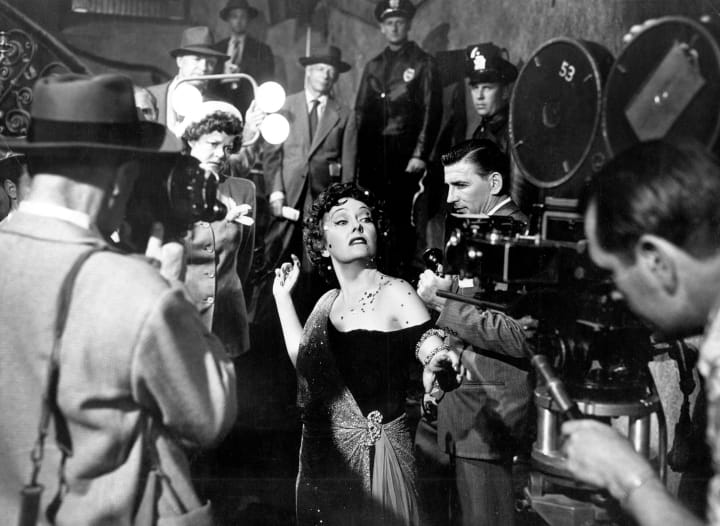
Have you seen Sunset Boulevard? That is how I would tell my story.
I would be Joe Gillis and Norma Desmond. Hard boiled protagonist and faded star. Face down in the pool and ready for my close-up.
I tried to keep going, but it is hard when there is no-one to call you darling. I tried to keep writing, but could no longer conjure up a world worth writing about. These are the last words this hand will write. I hope somebody finds them, but not too soon. I want it to look accidental.
But please, don’t believe them when they say I had no sense of romance. A message in a bottle, washed up on a beach, found, I hope by a young girl who is struggling with being funny and clever. Rather than distraught by the ending she will see hope in my fight. Just know, that I chose a tailored trouser and a string of pearls to wear, as I threw myself overboard.
See, I can do hackneyed clichés too.
Yours,
Alice.

About the Creator
Rachel Robbins
Writer-Performer based in the North of England. A joyous, flawed mess.
Please read my stories and enjoy. And if you can, please leave a tip. Money raised will be used towards funding a one-woman story-telling, comedy show.
Reader insights
Outstanding
Excellent work. Looking forward to reading more!
Top insights
Compelling and original writing
Creative use of language & vocab
Excellent storytelling
Original narrative & well developed characters
Easy to read and follow
Well-structured & engaging content
Heartfelt and relatable
The story invoked strong personal emotions
Masterful proofreading
Zero grammar & spelling mistakes
Keep reading
More stories from Rachel Robbins and writers in Fiction and other communities.
In a Lonelier Place. Runner-up in 3:00 AM Challenge.
The screech and jolt of hard brakes forced Laurel out of sleep. The car careering around a bend, a rock raised in temper. She had both been in the car and watching the car side swerve into the headlights of another driver. A strangled scream. Dizzy. Disorientated.
By Rachel Robbins2 years ago in Fiction
Becca
"Everything is so... flat." Denille said stupidly as she looked around her new neighborhood. She looked around at the muted desert where even the smallest sign of life seemed to have given up. The plant life was shrubs that were half cooked by the heat and where there should have been a lawn, a mess of white rocks laid glistening in the sun. Even the sky looked stretched thin, like the sun had ironed it smooth. She’d moved from Riverside, where at least there were hills, but here in Barstow, everything felt baked and brittle.
By Sara Wilson7 days ago in Fiction
The Synaptic Scalpel
Metal moaned and splintered. The impact came without warning. The car slammed against the guardrail, then twisted, crumpled, and rolled. Tires screamed. Glass exploded like miniature stars. The final blow was internal—bone crushed, ribs punctured lungs, and a jagged fragment tore through his skull. Pain surged and vanished as consciousness faltered, leaving a hollow, fading awareness.
By Mark Stigers 7 days ago in Fiction
The Politics of Playing Dress-Up
Well, to start off I'd like to say a happy world book day to all who celebrate. I know I haven't really posted anything on my socials about it but I'm not a jubilant kind of person. I lay low most of the time. Let's start off with a popular anecdote from the vaults...
By Annie Kapur7 days ago in Geeks


Comments (15)
Great job building the story and taking us along for the ride. Congrats on the honor!
🩷♥️🩷♥️ Excellent work Rachel!
Love the opening paragraph. It sets the stage for a nostalgic ride through harrowing times. And such a chauvinistic industry back then. Shame on the executives, producers and even viewers for discounting the worth of witty women. Great read, Rachel!
I love the voice you’ve given Alice, biting with humour, heavy with truth.
Please support me I am New here
Awesome to read
Beautiful read thank you 📕♦️♦️♦️♦️♦️
Happy to subscribe to your work.
Amazing!!! Very enjoyable. Please support me and read my stories too :)
I was just reading through this week’s TS’s. I was not prepared for such a delightful treasure. Every line was seemingly endowed with charm and intelligence. I was much delighted to happen upon your writing. I loved this line, “ Of course we know that when they say women aren’t funny what they mean is that they don’t like witty women,” from then on you had me. Congrats on TS. You genuinely deserved it.
Nice and congratulations.
So true, this: women aren’t funny what they mean is that they don’t like witty women. Such descriptions of truth: had we been boys, we could have been slaughtered in some war for their convenience. and THEN I continued reading all the fabulous descriptions and got to an OMG at the end. SUPERB story. Congrats on TS and good luck in the challenge!!🥳🥳🥳🥳🥳🥳🥳🥳💕💕💕💕
This is a great read. Really well put together and the nuance and nostalgia are gorgeous. Congratulations on a well deserved top story!
I really enjoyed this. Congratulations on earning Top Story recognition.
Unusual and excellent take on the Challenge