


The knock was polite—three quick, practiced raps—so ordinary it almost made me think it was a neighbor borrowing sugar. I opened the door to see a man in his thirties with a face marked by worry lines and trembling palms, as if the cold had seeped into his bones. He glanced past me, his voice already rushing, breath hitching like someone who’d just run a race he hadn’t prepared for.
“You have to—please—act normal,” he said, with each word detonating like a small explosion. “It’s important. My life depends on it.”
I barely had time to process the absurdity—someone’s life depended on my ability to play background conversation—when a shout cut through the air. “Hey! You got the wrong house!” The voice was a gravelly bark I knew all too well: Mr. Calhoun’s, my neighbor from next door, was at it again, I thought. He’d been shrinking into himself over the past year, muttering about conspiracies and the dangers associated with strangers. His mental illness had gone from an oddity to a hazard. Everyone on the block kept their curtains slightly closed; we exchanged sympathetic nods at the mailboxes, and he pretended his tirades were distant thunder. Mr. Calhoun appeared in his doorway like a man sprung from a bomb shelter—disheveled hair, eyes bloodshot, and a rifle cradled with both hands as if it were a sleeping animal. He leveled it at the stranger with surgical calm. “Fifteen seconds,” he said. “Convince me you knocked on my door by accident, or you will die!”
The stranger’s knees hit gravel. He looked like he wanted to do anything except speak. I heard the neighbor’s voice harden, a judge ready to pass sentence. “If I catch you lying, you cease to exist. Don’t make me shoot you between the eyes so you can’t accomplish whatever plan you’ve got.”
I tasted copper; my heart sounded like someone drumming on the inside of my skull. The stranger’s mouth opened and closed. Then he swallowed and said, in the strangest, most ordinary voice I’d ever heard under a gun, “Silly me—I was on my phone. Missed the number by one digit. I’ll go to the next house.”
Mr. Calhoun didn’t lower his rifle. “You step off this porch. If you’re lying, I will wait here and kill you when you come back. If you’re telling the truth, I won’t. You got a total of thirty seconds to prove it.”
The man looked at me then—eyes pleading, the size of small moons. “Please,” he whispered. “Go along with it. Tell him I came to the wrong place. Tell him you know me; otherwise, if he thinks I’m lying, he will kill me.”
Adrenaline shoved logic out of the way. I could see Mr. Calhoun’s hands—tight, steady, as he aimed his gun at the stranger. Life seemed to move in slow motion as I thought of the times he’d cornered other people on our block: a teenager for stealing a newspaper, a delivery driver for ringing the wrong bell. I knew he was dangerous, not theatrical. I also knew what would happen if I didn’t act quickly!
“Okay,” I said, though my mind was a bit slow to catch up. “Okay. Come in and catch your breath. Now, tell me who you’re looking for, and what’s your name?” Almost immediately, he blurted out, “My name is Johnny!” I quickly pulled him into a hug, trying to mask my fear with a gesture of friendship, desperately clinging to the hope of saving his life.
He flinched as if a tangible weight of relief pressed down on him. Stepping into my foyer like a man teetering on the edge of a cliff, Johnny sank into my battered armchair, hands trembling on his knees. His voice came in hesitating shards as he explained he was searching for a woman named Elena Stone, who lived just down the street. Urgency crackled in his words; he had to talk to her about a car she put up for sale. His story spilled out quickly, sounding convincing enough to be true, yet fragile enough to shatter at any moment.
When I looked across the narrow strip of lawn, Mr. Calhoun’s silhouette loomed like an accusation in the doorway, the gun still steady. He watched me closely. Mr. Calhoun’s gaze didn’t flicker. He mumbled something about checking the car as he walked back across the lawn, each step carefully measured, like a man walking through landmines. He reached his car with an ease that suggested the crisis was over.
Then his phone buzzed. He answered. We could hear nothing of the conversation, only the little exhale he made, a sound like someone letting go of a held breath. He opened his window and mouthed, “Thank you,” then drove off.
After he left, Johnny remained on my couch as if he’d become part of it. We spoke, and he shared that he used to be a soldier, then a courier, and that he couldn’t shake one mistake: a poorly timed note. He shed tears once over a cup of coffee I handed him. He admitted to misreading maps many times and told how friends had trained him to double-check the numbers.
Johnny pressed his palm to mine, fingers like reeds. “You saved me,” he said. “You didn’t have to.”
“You would’ve done the same,” I said, though I wasn’t sure I believed it. We exchanged numbers like two people promising to lessen their loneliness. He called once a week after that, a ritual as steady as breathing. We became good friends who supported each other through many of life’s challenges. He was there for me when I was diagnosed with breast cancer and even took me to many of my doctor’s appointments to offer support. The nice thing is that I could sense he had decided to be there for me just as I was there for him when he faced a possible end to his life.
A year later, I saw Mr. Calhoun at the supermarket. He wasn’t holding his rifle or any other weapon, and looked smaller, as if a man had been deflated inside him. He gave me a sideways, apologetic nod—something people do when they acknowledge the world's cruelty and have given up on life. At that moment, I remembered the fear in Johnny’s eyes and how he had approached me exposed and vulnerable, and remembered how a single knock on a door could have ended his life.
Some doors open into danger, some into strangers, some into stories. That night, my front door opened into all three—and into a beautiful friendship I never saw coming.
Several months later, I was saddened to hear that Mr. Calhoun had died of a self-inflicted gunshot from one of the many firearms he owned.
About the Creator
Anthony Chan
Chan Economics LLC, Public Speaker
Chief Global Economist & Public Speaker JPM Chase ('94-'19).
Senior Economist Barclays ('91-'94)
Economist, NY Federal Reserve ('89-'91)
Econ. Prof. (Univ. of Dayton, '86-'89)
Ph.D. Economics
Keep reading
More stories from Anthony Chan and writers in Fiction and other communities.
Fleeting Leaves
Autumn leaves drift down, Beauty fades as time rushes Life, too, feels so brief.
By Anthony ChanExclusive • 6 months ago
A Single Mother & A Stranger Boy – An Unexpected Love Story
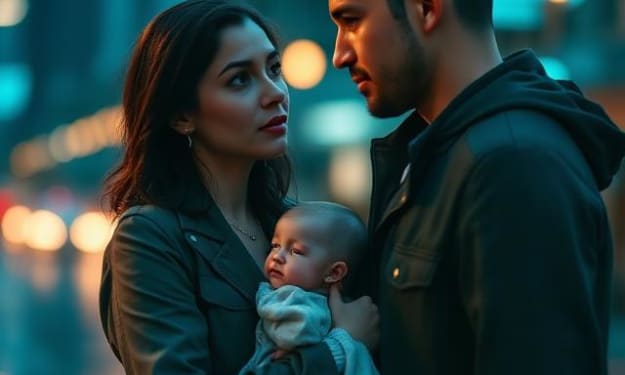
It was raining that evening—the kind of rain that makes everything feel heavier than usual. Ayaan stood under a small café shed, watching the droplets hit the ground like broken memories. He wasn’t waiting for anyone. He never was. Life had taught him to keep moving without expectations. That’s when he saw her. She rushed in, holding her child close to her chest, her hair slightly messy, her face tired—but still… beautiful in a way that didn’t try to impress anyone. “Can we sit here?” she asked softly, pointing to the empty chair beside him. Ayaan nodded. Her son, maybe five years old, clung to her arm. She smiled at him gently, brushing his hair back. “You’re safe, sweetheart.” There was something about her voice… warm, protective, yet hiding a quiet sadness. Minutes passed in silence. Rain poured harder. “You come here often?” Ayaan finally asked. She let out a small laugh. “No… life doesn’t really give me that luxury.” He smiled. “Yeah… I get that.” She looked at him for a moment, studying his face like she was trying to understand something deeper. “I’m Sara,” she said. “Ayaan.” And just like that, something shifted. The next few days, Ayaan kept coming back to that café. Not because he liked the coffee… but because somewhere deep inside, he hoped she would be there again. And she was. Same corner. Same quiet strength. But this time, she smiled first. “You again?” “Maybe I like the rain,” he said. “Or maybe you like coincidences.” “Or maybe… I like conversations that haven’t finished yet.” She looked away, hiding a small smile. Days turned into weeks. Their conversations grew longer. Deeper. He learned she was a single mother. Her husband had left years ago. No explanations. No support. Just silence. “I stopped waiting for him,” she said one evening. “But I think a part of me stopped waiting for everything else too.” Ayaan didn’t say anything. He just listened. Because sometimes, being heard is more powerful than being fixed. One night, the café was closing early. Rain had started again. “Let me drop you home,” Ayaan offered. She hesitated. “I don’t usually trust people easily.” “I’m not ‘people’ anymore, remember?” he smiled. She looked at him… and for the first time, she didn’t say no. Her house was simple. Quiet. Her son had already fallen asleep in the car, and Ayaan carried him inside carefully. “Thank you,” she whispered. Their eyes met. And for a moment… the world outside disappeared. There was something in the air. Something unspoken. She stepped back. “I should… go inside.” “Yeah… you should.” But neither of them moved. Weeks passed. The distance between them slowly faded. Late-night calls turned into long walks. Casual smiles turned into lingering glances. One evening, sitting on a bench under dim streetlights, she finally said it: “You know this isn’t simple, right?” “I never wanted simple.” “I have responsibilities. A child. A past…” “And I’m not scared of any of that.” She looked at him, almost searching for doubt. But there was none. “Why?” she asked softly. Ayaan took a deep breath. “Because when I’m with you… everything feels real. Not perfect. Not easy. But real.” Her eyes filled with emotion. “No one has said that to me in a long time.” That night, something changed. Not suddenly. Not dramatically. But deeply. They didn’t rush into anything. Their connection wasn’t built on just attraction—it was built on understanding. But yes… there was attraction. The kind that makes your heartbeat louder when they’re close. The kind that makes silence feel heavy. One evening, as they stood in her living room, just talking… she stepped closer. “You’re dangerous,” she whispered. “Why?” “Because you make me feel things I promised myself I’d never feel again.” Ayaan didn’t respond. He just looked at her. And that was enough. She didn’t step away this time. Their relationship wasn’t perfect. There were doubts. Fears. Moments when she pulled away, afraid of losing everything again. “People like me don’t get happy endings,” she said once. Ayaan smiled gently. “Then let’s not call it an ending. Let’s just call it… now.” Her son started calling him “Ayaan bhai” at first… then slowly, just “Ayaan.” And somehow, without forcing anything, they became something like a family. Not by name. But by feeling. One rainy evening, just like the first day they met, they sat together at the café. “You know,” she said, “I used to hate the rain.” “Why?” “Because it reminded me of everything I lost.” “And now?” She looked at him… smiling softly. “Now it reminds me of everything I found.” Ayaan leaned back, watching the rain fall. Life hadn’t become easier. But it had become meaningful. And sometimes… that’s more than enough.
By Umar Farooq3 days ago in Fiction



Comments
There are no comments for this story
Be the first to respond and start the conversation.