
4 Unsolved Mysteries You Never Thought You'd Believe
"Inexplicable Enigmas: Unraveling 4 Astonishing Unsolved Mysteries That Defy Reason"
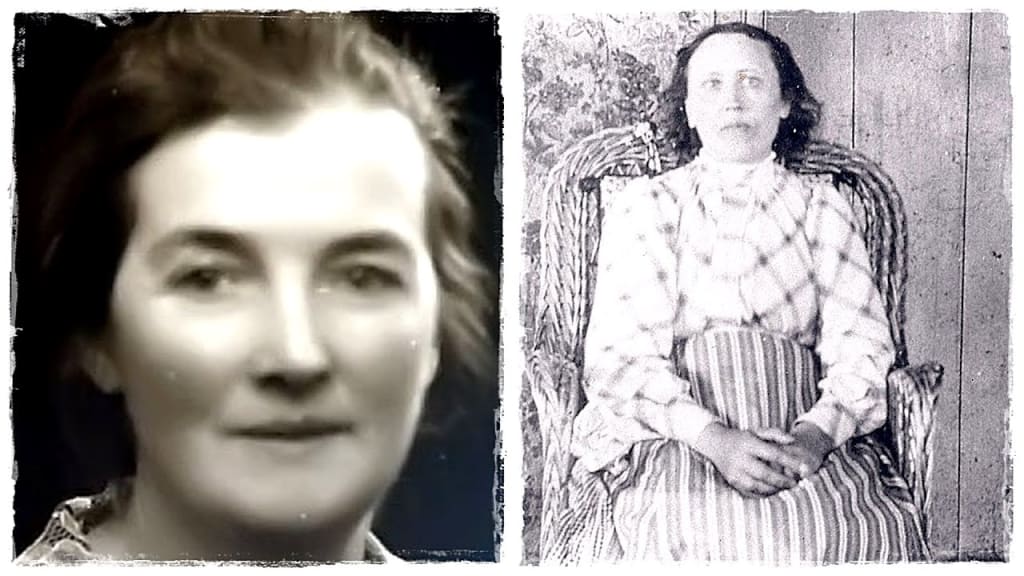
In the late 1800s, a remote area of Sweden found itself on the verge of fairy tale fame. Little did the inhabitants of this secluded region know that they were the home of a real-life sleeping beauty. The enchanting tale unfolded on a small island called Oak now, nestled off the coast of eastern Sweden.
Fourteen-year-old Carolina Olson resided on this island with her family. Carolina came from a large family, consisting of her mother, father, and five brothers. They lived a simple life as farmers and fishermen, much like many other families on the island. Isolated from the rest of the world, their lives remained tucked away.
Carolina Olson's name would have never become a household sensation if it weren't for a peculiar event that occurred when she was a young girl. On an otherwise unremarkable day, Carolina fell into a deep slumber that lasted 32 years. During this prolonged sleep, she remained unchanged, awakening to a world entirely different from the one she had left behind.
This is the real story of the Sleeping Beauty of Oak now. It all began on the 18th of February 1876, when Carolina was returning home to her village, crossing the icy surface of a frozen river. It is said that she fell through the ice, nearly drowning but saved at the last moment. However, other sources claim that she tripped and hit her head, knocking out a tooth and causing a toothache. Regardless of the truth, Carolina made it back safely to the modest cottage where she lived with her family, albeit with a sore face and a toothache.
As days passed, Carolina's toothache worsened, accompanied by excruciating headaches that were out of the ordinary for her. In the superstitious climate of 1876, her father, a local fisherman, and her mother attributed these symptoms to witchcraft. Being in a remote location and facing financial strain, they concluded that there was nothing they could do that evening. Carolina was told to go to bed and see what unfolded the following day.
However, when she fell asleep, she did not wake up. In fact, she remained in a deep slumber for decades. She went to sleep at the age of 14 and would not return to the waking world until the age of 32. Desperate to wake her up, her parents attempted various methods, including using a hot flame on her skin and even pricking her with needles, both on her body and under her fingernails. Yet, their efforts proved futile; Carolina remained fast asleep.
When their daughter failed to wake up after several days, and their attempts to rouse her were unsuccessful, they decided to seek medical help. However, their remote location and limited finances meant that they couldn't afford a doctor at the time. Eventually, they managed to have a doctor examine her, who concluded that she was in a coma. The cause of her coma, however, remained a mystery.
The doctor kept abreast of Carolina's case and implored the medical community to investigate and understand the baffling situation. Other doctors traveled to the secluded island to see Carolina for themselves. They observed that her hair and fingernails showed no signs of growth throughout the entire episode, and she had not experienced significant weight loss despite subsisting on only two glasses of milk and sugar per day. Surprisingly, Carolina remained in good physical shape, with her muscles showing no signs of atrophy. It was as if she existed in a state of suspended animation.
In July of 1882, a full six years after her mysterious slumber began, Carolina was still sound asleep. Her concerned and burdened parents had her hospitalized in the city of Asco Resham, where the doctors attempted to revive her using electroconvulsive therapy, but their efforts proved futile. Frustrated, the doctors gave up and diagnosed her with a severe neuropsychiatric disorder known as dementia paralytica, also referred to as general paralysis of the insane or paralytic dementia. However, there was uncertainty regarding this diagnosis, and it is unlikely that she suffered from this condition. The family received the disheartening news that there was little they could do except wait and hope for the best.
Thus, they waited, and as time passed, years turned into seasons, and the world evolved around them. Family members passed away while Carolina remained in her perpetual slumber. Occasionally, she would moan, toss, and turn, or even sleepwalk and mumble in her sleep. However, she never fully awakened. The only time she exhibited a genuine reaction to the outside world was when she cried upon her brother's passing in 1907, although even then, she remained in her enigmatic comatose state.
Throughout this ordeal, Carolina's mother also passed away, and a full-time caregiver was employed to tend to her needs. This caretaker noticed peculiarities such as Carolina's consistently clean hair that never seemed to grow and her nails that remained unchanged. Additionally, she observed that occasionally, pieces of candy the maid had brought would inexplicably disappear, arousing suspicion. Nevertheless, Carolina remained unresponsive, no matter what attempts were made to rouse her.
As the years wore on, it became apparent that Carolina did not age normally. She looked considerably younger than she should have, as if her entire metabolism had slowed down. This inexplicable state persisted for 32 years until one fateful day when she abruptly awakened. On April 3rd, 1908, Carolina sat up in bed and began to weep, catching the maid by surprise, who had anticipated another sleepwalking episode. Astonishingly, Carolina was now alert, awake, and gazed around the room in confusion.
The family was immediately summoned to her bedside, but Carolina failed to recognize her now-grown brothers. She did not display shock or panic, despite her disoriented state. Over the following days, Carolina remained mostly silent and exhibited discomfort when exposed to sunlight. Gradually, she began speaking again, albeit with difficulty.
Under interrogation, it became evident that Carolina had no recollection of anything since she fell into her prolonged slumber, except for fragmented dreams and nightmares. Medical examinations left doctors perplexed as Carolina displayed no adverse effects from being bedridden for decades. Despite technically being in her late 40s, she appeared more akin to someone in their early 20s. Psychiatrists conducted mental tests, affirming that she possessed all her cognitive abilities and intelligence. Nevertheless, she struggled to adapt to a world that had transformed so significantly during her dormancy news spread rapidly about what the media dubbed the "Sovereign Scan Pa" or the "Sleeper of Aknow," turning Carolina Olsen into a minor celebrity. However, skeptics emerged, questioning how a woman could remain asleep in bed for over three decades without any apparent negative consequences, surviving solely on two glasses of sweetened milk per day.
One theory suggested that her family had been complicit in the ruse, using perpetual sleep to keep her hidden from the world. Swedish psychiatrist Harold Frater Strom proposed another idea, suggesting she might have experienced a profound state of psychosis rather than complete hibernation. Yet, this did not explain her remarkably youthful appearance.
Carolina lived a content and ordinary life until her death in 1950 at the age of 88, always maintaining the truth of her story and taking any secrets with her to the grave. The mystery of Carolina Olsen's fate continues to puzzle us. What truly happened to her?
Interestingly, similar cases have emerged over time, although not as dramatic. In 2012, Stacy Commerford, a 15-year-old British teen, fell into a deep sleep from which she would not awaken for two months. Speculated to be a rare condition called Klein Levin Syndrome or Sleeping Beauty Syndrome, the underlying cause remains poorly understood. Could Carolina Olsen have experienced an exceptionally extraordinary case of this syndrome? How do we explain her recovery without significant mental or physical consequences, as well as her apparent lack of aging during the ordeal?
Unfortunately, we may never find the answers. The case of the Swedish Sleeping Beauty remains an unexplained historical anomaly, a potential medical marvel that continues to elude our understanding.
In another unsettling tale, on a spring morning in 1856, Samuel Cox embarked on a hunting trip from his family's modest dwelling in Spruce Hollow. However, upon his return, he and his wife discovered that their two sons, Joseph (age five) and George (age seven), were missing. Speculation arose that the boys had followed their father into the woods without his knowledge, possibly becoming lost.
The search for the boys lasted two weeks, concluding with a horrifying discovery beneath a large tree on the shaded banks of Gypsy Creek. Had it not been for a prophetic dream, the whereabouts of George and Joseph Cox might remain a haunting mystery.
This account is not a work of fiction, nor is it an urban legend. The story of the Cox brothers' disappearance is a truly chilling and alarming tale, provoking skepticism due to its inexplicable nature. The saga of the Lost Children of the Alleghenies began on April 24, 1856, when the boys followed their father, Samuel Cox, into the woods after breakfast. Oblivious to their presence, Samuel hurriedly pursued a trapped animal, completely unaware that his sons had joined him outside.
The densely wooded area of Pennsylvania, even to this day, presents a thick and profound forest. Getting lost within its depths is easily conceivable. Susanna, the boys' mother, initially assumed they had accompanied their father and would return home soon. However, when Samuel returned alone, the distress and fear intensified as the realization struck that their two boys had indeed vanished somewhere in the woods. The determined search party tirelessly scoured the vicinity surrounding his house, leaving no stone unturned in their quest to find them. They appealed to the neighboring community for assistance, enlisting the support of hunters, trappers, and concerned individuals from far and wide. As time elapsed, the number of people involved in the search exceeded a hundred, demonstrating the collective urgency to locate the missing boys. Hope flickered as fires blazed atop ridge tops, illuminating the night sky, in the hope that the children would spot the beacons and find their way to safety.
Amidst the search efforts, a theory emerged, focusing the searchers' attention on a nearby stream known as Bob's Creek. The stream, swollen with the rushing waters of melting snow, posed a formidable barrier that seemed insurmountable for the young boys to cross without succumbing to its depths. Regrettably, the exhaustive search yielded no fruitful results. The boys remained elusive, leaving no trace behind.
On April 26th, suspicions began to swirl around Samuel and Susannah Cox, raising conjecture that they may have hidden their children away, leveraging public sympathy for personal gain. However, their cabin and garden underwent thorough searches, yielding no evidence of the boys' presence. Local lore, rife with speculation surrounding the boys' fate, even resorted to consulting a witch from Somerset County and a douser in the hopes of locating their remains. Alas, the efforts of the douser bore no fruit, while the witch, despite claiming knowledge of the children's whereabouts, led search teams fruitlessly through the woods for hours.
Legend has it that on the night following the disappearance, a farmer named Jacob Debert heard of the missing children and expressed his wish to dream of their whereabouts. Miraculously, on May 2, 1856, his dream unfolded, guiding him along a path through the woods, past the lifeless body of a deer, a forsaken child's shoe, and a fallen birch tree. Ultimately, the path led him to a cluster of birch trees nestled in a small ravine, where the tragic truth unraveled—the lifeless bodies of the Cox boys were discovered, just as the dream had foretold. This prophetic dream recurred for two consecutive nights, and despite confiding in only his wife, Jacob Debert believed its significance. On May 7th, he revealed his dream to his brother-in-law, Harrison Wysong, who recognized elements from Debert's dream. United in purpose, the two men embarked on a search that culminated in the heart-wrenching confirmation of the boys' fate, beneath the birch trees, down the path adorned with a deceased deer, a child's shoe, and a fallen birch.
Jacob Debert and his brother-in-law, Harris and Wysong, became eternally etched in the annals of heroism, and on the day their discovery was made, church bells resounded across numerous communities nestled within the Allegheny Mountains. Once the boys' remains were returned to the Cox household, the solemn toll of church and school bells reverberated from Pavia to Bedford, all the way to Altoona, disseminating the sorrowful news of their final resting place.
Joseph and George Cox, the lost children of the Alleghenies, found their eternal rest in the embrace of Mount Union Cemetery. In 1906, on the 50th anniversary of this enigmatic tragedy, the community rallied together to erect a monument, a testament to the enduring memory of the lost boys. By 1910, with sufficient funds raised, the monument stood tall at the site where the brothers' bodies were discovered over half a century earlier. In recent times, an intriguing phenomenon has emerged among visitors who pay homage to the monument. They have taken to leaving behind an assortment of children's toys. It seems peculiar, doesn't it? Back in the year 1856, when the monument stood tall, toy cars and stuffed animals wouldn't have held much appeal for the young boys of that era. Nevertheless, this unconventional act serves to emphasize the underlying tragedy, tugging at the heartstrings of those who come to visit.
Let us transport ourselves to the enchanting city of Hamlin in Germany, where a captivating summer tradition has been upheld for generations. As the sun graces the vernal equinox, the townsfolk gather in the quaint old town center. It is during these cherished Sundays that they unite to recount an enduring tale that unfolds right within their beloved city.
Venture into the children's section of the local library, where time has gently cast its veil upon a weathered copy of timeless fairy tales. Concealed beneath the faded cover reside stories of courage, nobility, and true love. They are narratives that eagerly captivate the minds of young dreamers, wherever they may be.
However, amidst the enchanting "once upon a time" and the resounding "happily ever after," there lurks a far more sinister tale. It speaks of a rat infestation, broken promises, and the haunting disappearance of an entire generation of children from the city's embrace. Amongst these darker chronicles, the story of the Pied Piper, also known as the Piper of Hamlin, takes its place.
This classic fairy tale has been passed down through the ages, yet few have ventured to explore its origins. For many, it remains a mere figment of imagination—a delightful yarn spun to impart a moral lesson. Little do they know that the Pied Piper has roots, an element of truth woven into its fabric.
The most renowned rendition of this children's tale was penned in 1857. It narrates the tale of the townspeople of Hamlin in the year 1284, forever etching their plight in the annals of history in a town plagued by a relentless rat infestation, a peculiar figure emerged. The piper, adorned in a vibrant and diverse array of clothing, made a grand entrance. With an enticing proposition, he offered to rid the town of the vermin in exchange for a payment. The desperate townspeople, eager for respite, reluctantly agreed to his terms.
Through the power of his captivating melodies, the piper successfully led the rats away, freeing the town from their incessant scurrying. However, to the dismay of the piper, the townspeople went back on their word and refused to fulfill their end of the bargain. Enraged by their betrayal, the piper departed, vowing to seek revenge.
Unexpectedly, on the fateful day of July 26th, the piper returned to the town. With his enchanting music, he enticed the unsuspecting children, leading them away from their homes, never to be seen again. Just as he had done with the rats, the piper disappeared with the children, leaving behind a haunting void.
Curiously, the original version of this tale, written 45 years prior, lacked optimistic resolution. Instead, the town's children were enticed into a mysterious cave, where they remained trapped until the end of time. Only one child, who happened to be physically challenged, was unable to keep pace with the musically entranced group. As a result, this sole child's life was spared from the tragic fate that befell the others.
Over the years, numerous renditions of this captivating story have emerged, each offering its own unique perspective. Since the very moment these events unfolded, countless authors have taken it upon themselves to recount the tale. Among them, the versions penned by the esteemed Grimm Brothers are the most widely recognized. Their accounts veer far from mere fantasy.
Interestingly, within the confines of a house in Hamlin, an inscription on the interior wall bears witness to the past. Dating back to the 1600s, it reveals an enduring message. It declares that in the year 1284, on June 26th, the day of Saints John and Paul, a piper dressed in an array of colors enticed and lost 130 children from Hamlin at a nearby place of execution known as Copenh. The loss of 130 children deals a devastating blow to the town, jeopardizing its very survival. It is astonishing that despite such a tragedy, Hamlin still stands resolute. The haunting account of over 100 young lives resonates in this plaque, an enduring reminder of a piper who lured innocent children away. The tale transcends mere folklore, instilling fear in the hearts of the local townspeople.
The inscription, now spanning over 300 years, continues to unsettle those who call this area their home. Its presence within the church has even resulted in the destruction of a stained-glass window. The church itself resides in the bustling market square and stands as one of the earliest documented records of the pied piper legend.
Despite the story's age, the town staunchly maintains the existence of an alleged eyewitness account from that time. Within the windows of the historic building, one can glimpse the chilling scene of the infamous piper, compelling children into the depths of a nearby mountain. The account leaves little room for interpretation—a piper saved the city from rats by leading them to the river Wesser, only to seize the children and lead them into a cave, forever vanishing from sight.
Amidst the haze of this 800-year-old tale, the question of its authenticity lingers. What truly transpired in Hamlin? What became of those innocent children? The answers remain shrouded in mystery, begging us to delve deeper into the enigmatic pages of history. There have been numerous hypotheses proposed to elucidate the enigma surrounding this event. One theory suggests that the existence of rats, which is integral to the story, was a later addition, fabricated only in the 16th century. Conversely, there are those who espouse the belief that the black death itself was the genuine cause of the children's demise. However, this theory has largely been discredited since the plague did not ravage Europe until the mid-1347, making it highly implausible that an entire city would have already succumbed to its grasp over 60 years prior.
Several other conjectures have been postulated to uncover the truth behind this tale. One such hypothesis proposes that the children were relocated to the mountains as a preventive measure against the contagion sweeping through the populace. This epidemic, known as the "dance of Saint Vitus" or Korea Siddenham, is documented in the chronicles of Erfurt from 1237 and the Chronicle of Maastricht from 1278.
Alternatively, it is plausible that the children were compelled to leave the city, perhaps as part of a new children's crusade or for participation in a military campaign. The children's crusade has been the subject of extensive deliberation and appears to have emerged from a misinterpretation of the Latin word "puer," which became confused with the word "pauper," meaning "poor." Conversely, military campaigns involving even the youngest individuals were common during that era.
Another intriguing hypothesis suggests that the children may have embarked on an eastward migration, potentially reaching as far as Transylvania. In this scenario, the enigmatic figure with the flute could be viewed as a remarkably persuasive real estate salesman.
An additional captivating hypothesis put forth by Gernot Hussain, a local historian, posits that the devout Catholic Spiegelberg barons sought to eradicate resistance to religious conversion in the region. Allegedly, they engaged the services of a hunter adorned in vibrant attire to fulfill their sinister agenda.
In conclusion, the event in question has attracted a myriad of explanations, each contributing to the perplexing nature of the story. The interplay of these hypotheses imbues the narrative with bursts of complexity and unpredictability, leaving ample room for speculation and further investigation. In the city of Hamline, a staggering 130 children were offered as sacrifices, akin to the crucifixion of Christ. These young souls were given up protecting the men residing near the city. The harrowing ordeal unfolded atop Mount Elf, a mere 15 kilometers away from the quaint town of Hamlet. Interestingly, it is in this vicinity that the infamous Devil's Kitchen can be found—a perfect abode for such sacrificial acts. This site has long been intertwined with pagan customs and rituals. As a matter of fact, the hill known as Oberberg has been recounted in the city's oral tradition as a stage for diabolical festivities and ceremonial gatherings. A pied piper would accompany these dark rites, playing his instrument to entice the youth to partake in dance. Presently, the location of the Pied Piper's residence can be found on Bongo Lawson Strass, a street that traverses the city in the depths of the urban sprawl, where the children were last seen, a peculiar phenomenon takes hold. The strains of music, once vibrant and resonant, have been silenced, an act of somber reverence. However, beyond the confines of this mournful enclave, the city pulsates with rat iconography, ubiquitous and enigmatic. A clock tower, standing tall and resolute, weaves a tale three times a day, while a pied piper statue commands attention amidst the bustling streets. Notably, there exist establishments that daringly serve concoctions known as rat's blood cocktails. As daylight fades, the bells chime, their melodious tones echoing the pied piper's haunting melody. The enigmatic vanishing of 1284's children, a perplexing enigma, lingers in the collective memory, destined to remain a mystery forevermore.
Once upon a time, in an era preceding the advent of the written word, societies sought a means to immortalize their existence, to etch their triumphs and tribulations into the annals of time—a practice we, even in the present day, hold dear. Ancient communities devised a method, a window into their lives, through the medium of rock carvings, intricate drawings, and vivid paintings. These primitive manifestations, unearthed from the depths of history, serve as our time-traveling portals, allowing us to glean invaluable insights into the lives of our long-forgotten ancestors yet on rare occasions, these primordial rock pictures have divulged something entirely different. They have bestowed upon us not merely a glimpse into another era or location but a truly enigmatic narrative or image. Nestled in a secluded valley, approximately two hours away from Milan, lies a renowned site of perplexing rock art known as Valka Monica.
This valley, where Falco Monica is situated, exists amidst the rugged and mountainous terrain of the central Alps. It stands as the largest valley in the region, nestled within the eastern Lombardi region of the Italian province of Brescia. Spanning a vast expanse of 56 miles, it gracefully meanders through fields, forests, and tranquil medieval villages.
These villages, concealed within the serenity of Europe's rustic landscapes, resemble the idyllic settings of our childhood storybooks—untouched by the passage of time and the encroachment of the modern world. The villages of Falco Monica themselves have garnered numerous accolades, repeatedly being hailed as some of Italy's most exquisite.
Abundant with flourishing plant life and vibrant blossoms, the valley possesses an allure that sets it apart from the ordinary the region houses a remarkable abundance of verdant landscapes, exclusively indigenous and unparalleled elsewhere. Recognized by UNESCO in 2018, it was designated a world heritage site and enlisted among the esteemed biosphere reserves worldwide. Moreover, this valley boasts a captivating historical tapestry, boasting ancient castles, Roman ruins, and multiple UNESCO world heritage sites. However, Velcro Monica stands out as its crown jewel, renowned for hosting the most extensive and comprehensive collection of prehistoric rock drawings known as petroglyphs. Astonishingly, these artistic marvels were initially disregarded by the Italian locals, deeming them insignificant scrawls or acts of triviality, until 1914. It was then that Guaterrero Lien, an intrepid alpinist and geographer, stumbled upon these unnoticed carvings, catapulting them into the global spotlight illuminates the fascination of scientists and anthropologists worldwide, as their curiosity is piqued. The valley reveals a captivating sight, adorned with more than 140,000 symbols and figures intricately carved into the rock. However, it is believed that the true count may range between an estimated 200,000 and 300,000, offering a vast tapestry spanning over 8,000 years of history. These remarkable carvings, originating from the Mesolithic Age (15000 to 5000 BC) and continuing through the medieval times (476 to 1453 AD), provide a profound glimpse into a preliterate era. Within these enigmatic depictions lie captivating scenes portraying the daily lives, spirituality, and profound connection of ancient humans with the world around them. Here, one can witness animals, plants, and humans engaged in a rich tapestry of activities, ranging from hunting and magic to religion, war, and navigation. Each carving, meticulously preserved, offers an exceptional glimpse into the enigmatic depths of our past intact and unaffected over the passage of time and exposure to the elements, these remarkable remnants hold immeasurable value to the fields of pre-history, sociology, and ethnology. The expansive engravings have consistently sparked curiosity and captivation ever since their widespread discovery. Notably, they were utilized as tools of Nazi propaganda during World War II, when German scholars Franz Altheim and Erica Troutman began associating the petroglyphs with Nazi ideologies. This swiftly propagated the notion that these ancient carvings depicted an enigmatic ancestral Aryan race, providing so-called evidence of their presumed superiority. Moreover, the carvings also served as instruments of Italian Fascist propaganda. However, it was only in the post-war era, specifically the 1950s, that genuine scientific investigation would once again commence. Eventually, in 1979, the petroglyphs of Valcamonica were officially recognized as a UNESCO World Heritage site, becoming Italy's inaugural designated location of such significance. These enigmatic carvings continue to evoke awe and speculation even in contemporary times, further enshrouding this mystical place immersed in the tides of time, it comes as no surprise that numerous enigmas remain entangled within its depths. Amidst the tapestry of human forms, animals, plants, and intricate geometric patterns, certain anomalies emerge, defying expectation and straying from the norm.
Among them, a collection of petroglyphs captivates the curious gaze, portraying figures whose proportions seem curiously askew. Their heads, rendered diminutive in relation to their bodies, evoke a sense of peculiarity. Adding to the enigma, these adorned beings don what can only be described as protective spacesuits. Atop their heads rest helmets reminiscent of those worn by astronauts, emanating radiant lines that hint at luminous illumination.
Intriguingly, these suited entities grasp unfamiliar implements or weaponry, unlike any depicted in the surrounding illustrations. This idiosyncrasy sets them apart, making this corner of the carvings an unparalleled testament to the uncanny.
Throughout the annals of these artistic records, such a depiction finds no parallel, heightening the allure of this mystifying tableau. The inexplicable presence of these enigmatic figures, their cosmic attire, and perplexing tools evoke wonder, defying easy interpretation and shrouding the past in an even deeper cloak of intrigue. Regarding these carvings, their impression evokes images of astronauts donning advanced equipment and wielding futuristic tools or weapons. However, a conundrum arises when we consider that these carvings predate any possibility of such attire or electrical illumination by thousands of years. How do we interpret this? Why would these ancient carvings depict such imposing figures from a time when their peculiar appearance and out-of-context nature would be surprising? Naturally, some have proposed the idea that these petroglyphs are evidence of ancient extraterrestrial visitors who were revered and depicted by the awe-stricken inhabitants of the region. On the other hand, alternative theories suggest that the petroglyphs are merely artistic representations of religious concepts or depict a battle between two individuals clad in a unique form of armor. Given the antiquity of the images and the disappearance of the people who etched them into the rock, it is impossible to provide a definitive answer. Nevertheless, the enigmatic nature of these images persists, leaving us with a profound sense of curiosity and fascination. In contrast to the mundane depictions and commonplace imagery showcased elsewhere in Falco Monica, these enigmatic images stand out, begging the question of their true nature and symbolic significance. Do they merely reflect the whimsical expressions of an artist from ages past, portraying ordinary scenes that have been distorted through misinterpretation? Or do they possess a deeper, more profound meaning? Similar enigmatic petroglyphs have been unearthed in various locations worldwide, leaving us intrigued and fascinated by the ones found in Falco Monica. Regardless of the answer, they continue to captivate our curiosity, defying easy explanation.
About the Creator
Fanta Diaby
For me, writing is not just a skill; it is an unbreakable bond, a love affair with the written word that forever dances in the depths of my soul.
Keep reading
More stories from Fanta Diaby and writers in Fiction and other communities.
Unveiling the Harsh Reality of Recessions: Brace Yourself
In the depths of economic uncertainty, a swirling vortex of questions engulfs our minds. Are we languishing within the clutches of a recession, its ominous presence lurking in the shadows? Alas, the answer remains enigmatic, as clarity eludes us like a fleeting mirage.
By Fanta Diaby3 years ago in Journal
Our Song
Evening has given way to night. Gently, I settle next to you on the comfortable, old love seat and reach for your hand. You snatch it away, again. It cuts me to the quick, but I hide the pain, understanding that the reaction is but part of your demented state. Since the accident, your presence here in our cozy home has been clouded by a haze I can't see. Nevertheless, I feel the frigidity of your expressions and it serves as an excruciating reminder of the immeasurable distance between us.
By Dana Crandell7 days ago in Fiction




Comments
There are no comments for this story
Be the first to respond and start the conversation.