
334 Terraforming Mars: Part 10
For SciFriday, November 29, Day 334 of the 2024 Story-a-Day Challenge

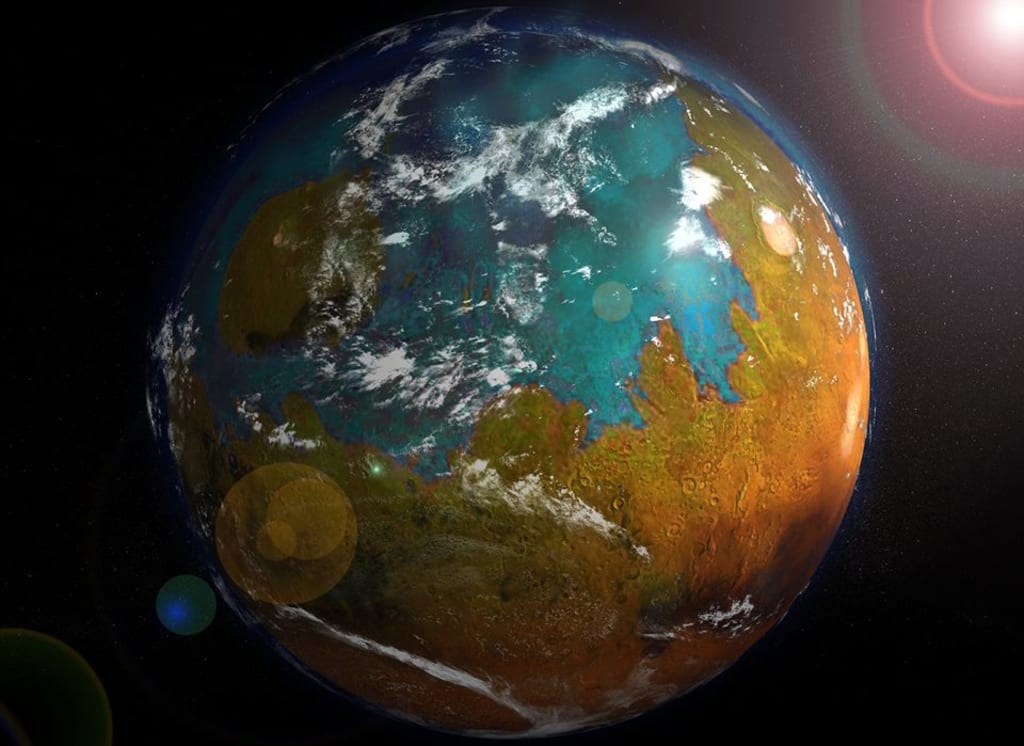
Phase II, not to be outdone, involved lassoing and nudging three well-aimed comets to the deep Hellas, Valles Marineris, and Acidalia Planitia depressions. Automated pulverization of the central equatorial bands of latitude released more oxygen and deposited topsoil that would be so necessary for the Phase III to come—actual colonization.
By the end of Phase II, the planet-wide sub-polar depression known as the Vastitas Borealis became the Vastitas Ocean; the filled Hellas crater became the Mare Hellas, or Hellas Sea; and the 4,000-km long, nine-km deep, 500-km wide Grand Canyon of Mars, the Valles Marineris, with its vast array of interconnected canyons, became known as the Grand Canal.
The Grand Canal’s water flowed forcefully at the Valles bottom, likened to the Colorado River on Earth that flowed relentlessly within its own Grand Canyon.
The photosynthetic algae and cyanobacteria seeded into the waters around Mars produced large amounts of oxygen, and the Oxygen-Nitrogen atmosphere very much liked the ocean and the seas. They held each other in a firm embrace for the meteorological dance of this former planetary wall flower.
Mars partied.
Liquid rolled again like it had when the Sonotomes were first laid down in the canyons. When lush trumped stark. When there had been actual Martians.
Phase III saw colonial expansion and the “canali” projects which dug the canals that eventually allowed communication of the Grand Canal, the Valles Marineris, with the vast hydration platforms at the poles. For the first time, real canals on Mars could be seen from Earth.
Fr. Pietro Secchi and Giovanni Schiaparelli, who thought these were what they saw in the 19th Century, would have been pleased.
Phase III also involved a vast planting and forestry initiative, until bands of vegetation, kilometers wide astride the arrays of canals, presented to Earth telescopes as widening and darkening borders and bands along them.
Percival Lowell, who first thought these were what he saw at his Arizona observatory a hop away from the future site of the ṺberCollider, would have been pleased, too.
The irony was that what terraforming had accomplished so far had changed the desolation of the real Mars to the canals and seasonal flora that the first telescopes had imagined.
About the Creator
Gerard DiLeo
Retired, not tired. Hippocampus, behave!
Make me rich! https://www.amazon.com/Gerard-DiLeo/e/B00JE6LL2W/
My substrack at https://substack.com/@drdileo
Keep reading
More stories from Gerard DiLeo and writers in Fiction and other communities.
Inside Rebels
You stared at the chalk‑dusted blackboard, the harsh scrape of the marker echoing the teacher’s voice as it cut through the quiet of the classroom, and you felt the weight of every syllable settling like a stone on your shoulders. It was Mr. Harrow, the man whose reputation for cruelty preceded him, and you and your partner, Elena, had already learned to keep your heads down when he entered the room. “If you cannot answer the question, you are simply unworthy of learning,” he had snarled, his eyes flicking between you as if searching for a crack in your resolve. The air grew colder, and you sensed Elena’s trembling hand brush against the edge of the desk, a subtle reminder that you were not alone in the mounting dread.
By Forest Green6 days ago in Fiction



Comments (1)
This is a stunning imaginative accomplishment, Gerard. Great stuff!