
12 Kilometers for Hope
Amir's Journey Ended Before He Could Taste Survival

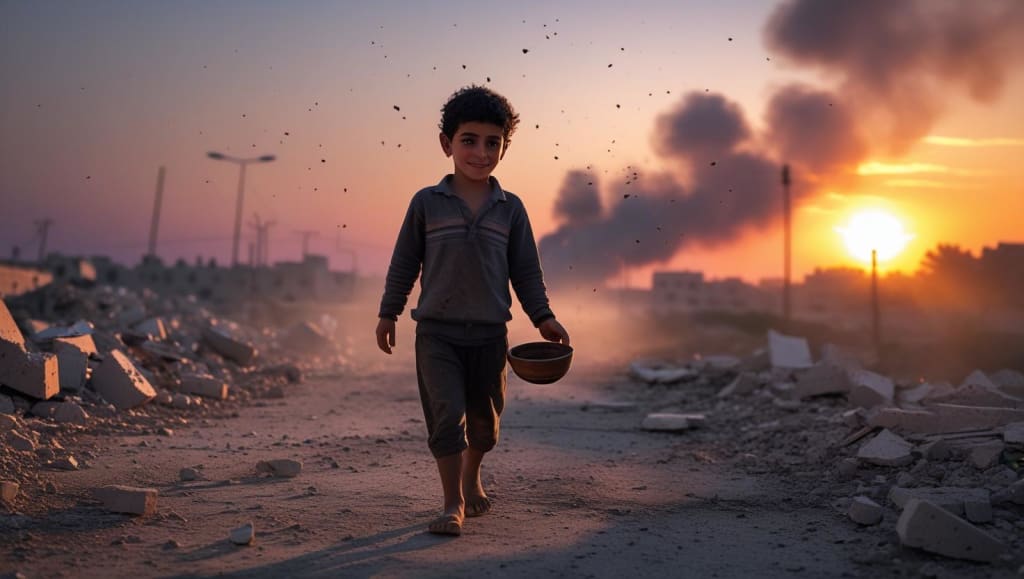
Amir was only a child—thin, barefoot, and dust-covered from the long walk he had taken. In the rubble-strewn streets of Gaza, where dreams have been replaced by drone sounds and sirens, Amir walked 12 kilometers in search of something many take for granted: a piece of food.
It wasn’t a feast he hoped for—just rice and lentils, distributed by a local relief center. That modest meal, which once might have seemed ordinary, had become a symbol of life, of hope, of the possibility to endure another day.
When Amir finally arrived at the center, his eyes lit up. His small hands reached for the food, a smile beginning to form. He had made it. He had survived the walk, the danger, the hunger—until that very moment. Just as he was about to eat, a shot rang out. The bullet, fired by Israeli forces, ended his life instantly. He died holding hope in his hands—hope he never got to taste.
This harrowing account came not from a journalist or a foreign correspondent, but from a U.S. Army officer who, shattered by what he witnessed, chose to resign. His testimony, filled with grief and guilt, revealed the unbearable truth: even a child’s attempt to survive can be a death sentence in Gaza.
Today, Gaza is a land where hunger has replaced lullabies. Mothers, desperate to keep their children alive, are feeding them sand—not out of cruelty, but because there is nothing else. There are no kitchens, no clean water, no safe zones—only destruction, dust, and death. The sound of a baby crying is now often followed by silence. Not because they were comforted—but because they are gone.
Amir’s story is not unique—but it is unforgettable. He symbolizes every child whose life was cut short before it could begin, every dream destroyed before it could take shape, every mother who must bury her baby with empty arms and an empty stomach.
In a world flooded with images, Amir’s never went viral. His death wasn’t trending. But it lives on in the conscience of the few who saw, and could no longer be silent.
As readers, as humans, we are left with questions too painful to ignore: What is a child’s life worth in war? Who speaks for the voiceless? And how many more Amirs must fall before we listen?
About the Creator
Shohel Rana
As a professional article writer for Vocal Media, I craft engaging, high-quality content tailored to diverse audiences. My expertise ensures well-researched, compelling articles that inform, inspire, and captivate readers effectively.
Keep reading
More stories from Shohel Rana and writers in Fiction and other communities.
TeamWater: A Global Wave of Change
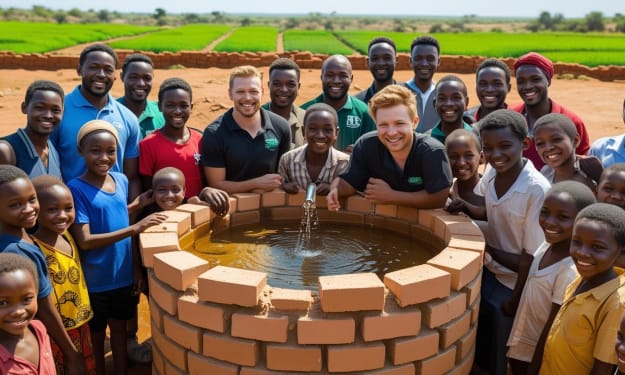
TeamWater: A Global Wave of Change Creators Unite to Bring Clean Water to Millions In a world where digital platforms amplify voices and spark movements, a group of visionary creators, led by the inimitable MrBeast—often celebrated as one of YouTube’s brightest stars—has embarked on an extraordinary mission: TeamWater. This ambitious campaign, launched on August 1, 2025, is not just another fundraiser; it’s a clarion call to transform lives by addressing one of humanity’s most fundamental needs—access to clean water. With a goal of raising $40 million to provide sustainable water solutions for 2 million people, TeamWater unites over 3,000 creators from 84 countries, weaving a global tapestry of compassion and action.
By Shohel Rana8 months ago in Fiction
The Family Riches
According to family legend, our massive wealth originated from the creative genius and business acumen of my great-great-great, Grandfather Oliver Dooley. Ever since I was a young child, my parents and grandparents talked about this ancestor as though he were a cross between a conqueror and God himself. The older I got, the less believable I found these tales of his grand exploits to be. I began questioning the family lore. When I did, my elders would give me a disgusted look, point to our time- worn family bible, and exclaim, “If you don’t believe me, look it up. The family history is all in the book.”
By Mark Gagnon6 days ago in Fiction
My First Time Skiing and I Got Lost, Alone, in the French Alps
Looking back, I can trace some of my life’s biggest adventures to a simple action from my sister. She’d introduced me to Tommy (a very long time ago), a colleague of hers, who had overshared his penchant for Italian-looking women, and I ticked that box.
By Chantal Christie Weiss3 days ago in Humans


Comments
There are no comments for this story
Be the first to respond and start the conversation.