
10% Brain Myth
Unleashing the Full Potential of Your Brain: How the 10% Myth Holds Us Back
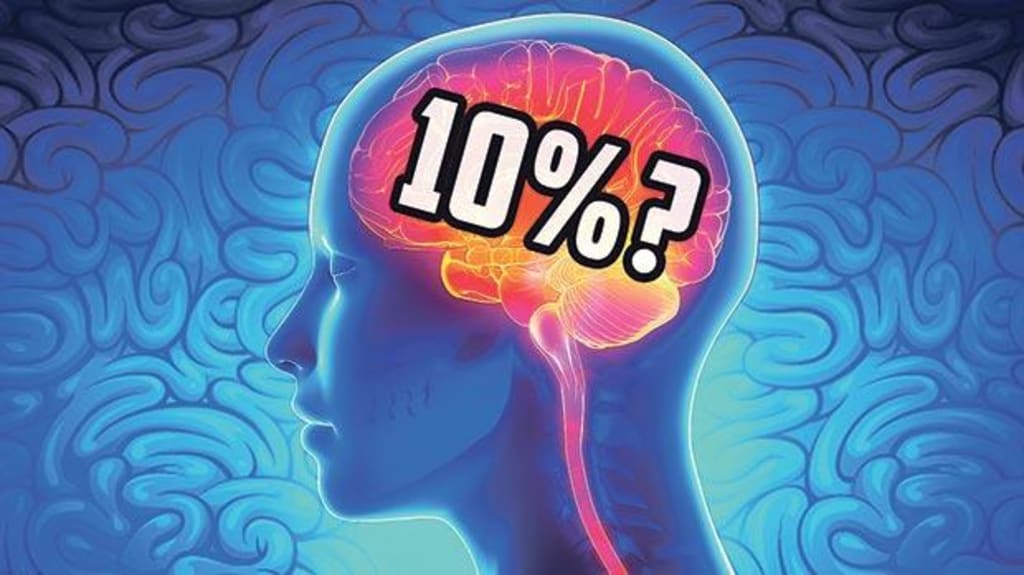
Hook: Have you ever heard the phrase "we only use 10% of our brain"? It's a popular myth that has been perpetuated for decades, but the truth is much more complicated. In this article, we'll dive into the science behind the 10% brain myth and separate fact from fiction.
Introduction:
The idea that humans only use 10% of their brains has been around for a long time. It's been popularized in movies, books, and even advertisements. The myth suggests that if we could tap into the other 90% of our brain, we would be capable of superhuman abilities such as telekinesis, mind reading, and even levitation.
Despite its widespread popularity, the 10% brain myth is simply not true. In fact, it's a gross oversimplification of the complexity of the human brain. In this article, we'll explore the origins of the 10% brain myth, examine the scientific evidence that debunks it, and discuss the real potential of the human brain.
Debunking the 10% Brain Myth
The idea that we only use 10% of our brain can be traced back to the early 1900s. William James, an American psychologist, was quoted as saying, "We are making use of only a small part of our possible mental and physical resources." This statement was then misinterpreted and eventually transformed into the 10% brain myth.
Despite the fact that the 10% brain myth has been widely debunked, it continues to be perpetuated in popular culture. In fact, a 2013 survey found that 65% of Americans believe that the myth is true. So, let's take a look at the scientific evidence that disproves the myth.
The Brain is Always Active
One of the most compelling arguments against the 10% brain myth is that the brain is always active. Neuroimaging techniques such as PET scans and fMRI have shown that even when we are resting, our brains are using a significant amount of energy. In fact, it's estimated that the brain uses about 20% of the body's total energy.
Furthermore, different parts of the brain are responsible for different functions. For example, the occipital lobe is responsible for processing visual information, while the temporal lobe is responsible for processing auditory information. If we only used 10% of our brain, it would mean that 90% of our brain is redundant and serves no purpose. This simply isn't the case.
Brain Plasticity
Another argument against the 10% brain myth is the concept of brain plasticity. Brain plasticity refers to the brain's ability to change and adapt in response to new experiences. Research has shown that the brain is constantly rewiring itself based on our experiences and behaviors.
For example, if you learn a new skill such as playing the piano, your brain will create new neural connections and strengthen existing ones. This means that the brain is always in use and is constantly changing and adapting.
The Real Potential of the Human Brain
While the 10% brain myth is not true, the human brain is still an incredibly powerful and complex organ. Research has shown that our brains are capable of incredible feats such as problem-solving, creativity, and empathy. The potential of the human brain is virtually limitless.
In fact, neuroscientists are still uncovering the mysteries of the brain and discovering new ways in which it can be harnessed. For example, researchers are studying ways to use brain-computer interfaces to help people with paralysis regain movement, or to help people with neurodegenerative diseases such as Alzheimer's.
Conclusion:
In conclusion, the 10% brain myth is a pervasive and persistent idea that has been debunked by science. The brain is always active and constantly adapting to new experiences through brain plasticity. While we may not be able to access 100% of our brain at once, the potential of the human brain is virtually limitless.
As we continue to learn more about the brain, we may be able to harness its power to help people with a variety of conditions and to unlock new possibilities for human achievement. So the next time you hear someone repeat the 10% brain myth, you can confidently correct them and share the exciting and complex reality of our brains.
About the Creator
sanju P Joy
An beginner writer with a passion for exploring new ideas and sharing them with a wider audience. Focuses on delivering engaging and informative content that is both educational and entertaining.
Keep reading
More stories from sanju P Joy and writers in Fiction and other communities.
Debunking the Myth of the Airplane That Landed With a Skeleton After 35 Years
The internet is rife with stories of strange events and unsolved mysteries that have captured the imagination of people around the world. One such story that has gained a lot of attention in recent years is the tale of an airplane that supposedly landed with a skeleton on board after being missing for 35 years. This story has been shared widely on social media and online forums, but is there any truth to it? In this article, we'll examine the origins of the story and uncover the facts behind this intriguing tale
By sanju P Joy3 years ago in Fiction




Comments
There are no comments for this story
Be the first to respond and start the conversation.