
Why We So Often Confuse Lust for Love
The Heart's Mirage

In the tumultuous landscape of human connection, few mix-ups are as common or as consequential as mistaking the blazing flare of lust for the steady flame of love. It is a timeless confusion, one that has fueled sonnets and sitcoms, broken hearts, and built ill-fated relationships. Both are powerful, all-consuming forces, yet they originate from different parts of our being and are destined for different ends. Understanding the chasm between them is not to diminish the power of lust, but to honour the profound complexity of love.
At its core, the confusion is a perfect storm of biology, psychology, and cultural narrative. We are, in a very real sense, set up to get it wrong.
The Biochemical Deception
The initial stages of intense attraction are a potent cocktail of neurochemicals designed to make us feel euphoric, obsessed, and convinced we have found our "other half." Lust is primarily driven by testosterone and estrogen, the hormones that ignite our libido. But it’s the accompanying cast of neurotransmitters that creates the illusion of something deeper.
When we are intensely attracted to someone, our brain is flooded with dopamine, the same chemical associated with the high of winning a gamble or taking a drug. This dopamine rush occurs in the brain’s reward center, creating a powerful association between the person and feelings of pleasure. We become addicted to the high of their presence. Simultaneously, norepinephrine (also known as adrenaline) kicks in, making our heart race, our palms sweat, and our focus narrow until the object of our desire is all we can think about. This combination of euphoria and hyper-focus feels remarkably like the depictions of love in movies and songs.
Even oxytocin, the so-called "cuddle hormone" or "bonding molecule," is released through physical touch and intimacy, further blurring the lines. After sex, a surge of oxytocin can create powerful feelings of attachment and trust, convincing us that this physical connection must signify a profound emotional one. Our own biology is whispering (or shouting) that this is love, when in reality, it is a brilliant evolutionary mechanism encouraging procreation and pair-bonding, at least temporarily.
The Psychological Blueprint
Beyond the chemistry, our personal histories and psychological needs play a starring role in this mix-up. Lust often masquerades as love when it fulfills a deep-seated emotional void or validates a fragile sense of self.
If we struggle with loneliness, the intense attention and desire from another person can feel like a salvation. We interpret the relief from our isolation as love. If we have low self-esteem, being desired by someone we find attractive becomes a powerful antidote to our insecurities. We think, "If this incredible person wants me, I must be worthy." In these cases, we are not loving the other person for who they are; we are loving the way they make us feel about ourselves. This is a consumption, not a connection.
Furthermore, lust is often projection in its most flattering form. In the early, dizzying stages, we don't see the other person clearly. We project onto them all the qualities we desire in an ideal partner—kindness, intelligence, humor, stability. We fill in the gaps of our limited knowledge with fantasy. We fall in love with the potential we see, or the character we have created, not the complex, flawed human being they actually are. Love, in contrast, requires seeing someone fully—their strengths and their weaknesses—and choosing to build a life with that real person.
The Hallmarks of Distinction
So, if the feelings can be so identical, how can we tell the difference? The key lies in moving beyond the feeling itself and observing its nature, its focus, and its endurance.
1. The Trajectory: Peak vs. Foundation
Lust is like a firework. It is spectacular, intense, and has a rapid peak, but it fades quickly, often leaving behind smoke and a sense of emptiness. It is obsessed with the climax. Love, on the other hand, is like building a hearth. The initial spark is important, but the true work and warmth come from carefully tending to the fire, adding logs, and ensuring it can provide steady, lasting heat. Love is found in the quiet embers as much as in the roaring flames.
2. The Focus: Self vs. Other
Lust asks, "What can I get from this person?" It is fundamentally self-referential. It is about how they make you feel, how they satisfy your desires, how they enhance your life and identity. Love asks, "What can I give to this person?" It is oriented outward. It finds joy in the other’s happiness, support in their struggles, and investment in their growth as an individual, even when it offers no immediate personal reward.
3. The Test of Time and Trouble
Lust thrives in the vacuum of perfect circumstances—romantic getaways, exciting dates, effortless chemistry. It often evaporates in the face of reality: financial stress, family obligations, boring Tuesday nights, or personal conflict. When the dopamine fades, if there is nothing substantial beneath it, the "relationship" collapses.
Love is revealed precisely in these mundane or difficult moments. It is the choice to be kind when you’re tired, to listen when you’re stressed, to argue fairly and then repair, to show up not only for the celebrations but for the hospital visits and the losses. Love is an action, a consistent series of choices, long after the initial high has worn off.
4. The Scope of Connection
Lust is primarily, though not exclusively, centered on the physical. The connection is strongest in private, in intimate moments. Love encompasses the whole person. You want to know their mind, their dreams, their fears. You enjoy their company in a crowded room, on a long car journey, while doing mundane chores. You are proud to introduce them to your friends and family because your connection is integrated into the entirety of your life, not compartmentalized from it.
Honoring Both
To distinguish lust from love is not to demonize desire. Lust is a vibrant, joyful, and essential part of the human experience. It can be the thrilling gateway to a deeper connection. The danger lies in building the foundation of a lifelong partnership on a feeling that is, by its very nature, transient.
The next time you find yourself swept away, pause. Look past the dopamine haze and the racing heart. Ask yourself: Do I want this person, or do I cherish them? Is my focus on what I can take, or what we can build? Does this feeling make me a better version of myself, and do I want the same for them?
Love is not just a feeling; it is a policy, a commitment, and a construction. Lust is the spark that can ignite the engine, but it is not the fuel for the long journey. By learning to tell the difference, we save ourselves from heartache and clear the path to find a connection that is not just passionate, but profound, enduring, and truly loving.
About the Creator
Keep reading
More stories from Abiniah Thineshkumar and writers in Families and other communities.
Why People Pretend to Be Okay Even When They’re Not
Have you ever looked at someone smiling and thought, “Are they really okay?” Many people pretend to be fine even when they’re hurting inside. It’s like wearing a mask—comfortable for others, but heavy for the person holding it up. In today’s world, pretending to be okay has become a quiet skill many people master. But why? Let’s break it down in simple, relatable terms.
By Abiniah Thineshkumar4 months ago in Motivation
St. Patrick's Day
When I was a child, I really thought our family was Irish. We always celebrated St. Patrick's Day with a chocolate cake with green frosting, and it was pretty common to wear green and to have corned beef, cabbage, and boiled potatoes for dinner that day.
By Denise E Lindquist6 days ago in Families
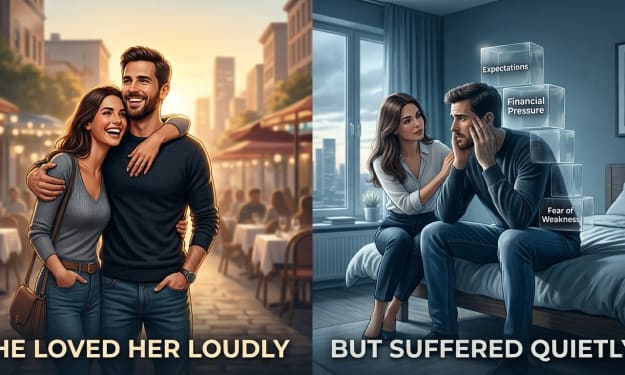
He Loved Her Loudly but Suffered Quietly
Subtopics: The Burden of Being the Reliable Man When Love Feels Like Performance The Fear of Looking Weak Silent Competition in Modern Relationships Emotional Exhaustion Behind Masculine Pride Learning to Be Seen, Not Just Needed Redefining What It Means to Lead in Love
By Benjamin Patrick4 days ago in Families
The Piggy Project
I’ve had so many names in this life I lose track of which ones were ever really mine and which ones I wore because someone needed me to. Some were handed to me before I had words to refuse them, before I knew what they meant, before I knew I could say no. Most weren’t meant to hurt. That doesn’t mean they didn’t leave marks. Marks that told me who I belong to, who I am by way of who claims me, recognizes me in the good and bad, who walks beside me.
By Fatal Serendipity5 days ago in Confessions



Comments
There are no comments for this story
Be the first to respond and start the conversation.