
Why I Still Set a Plate for My Dead Son
Grief doesn’t ask for permission. It just moves in and makes a home.

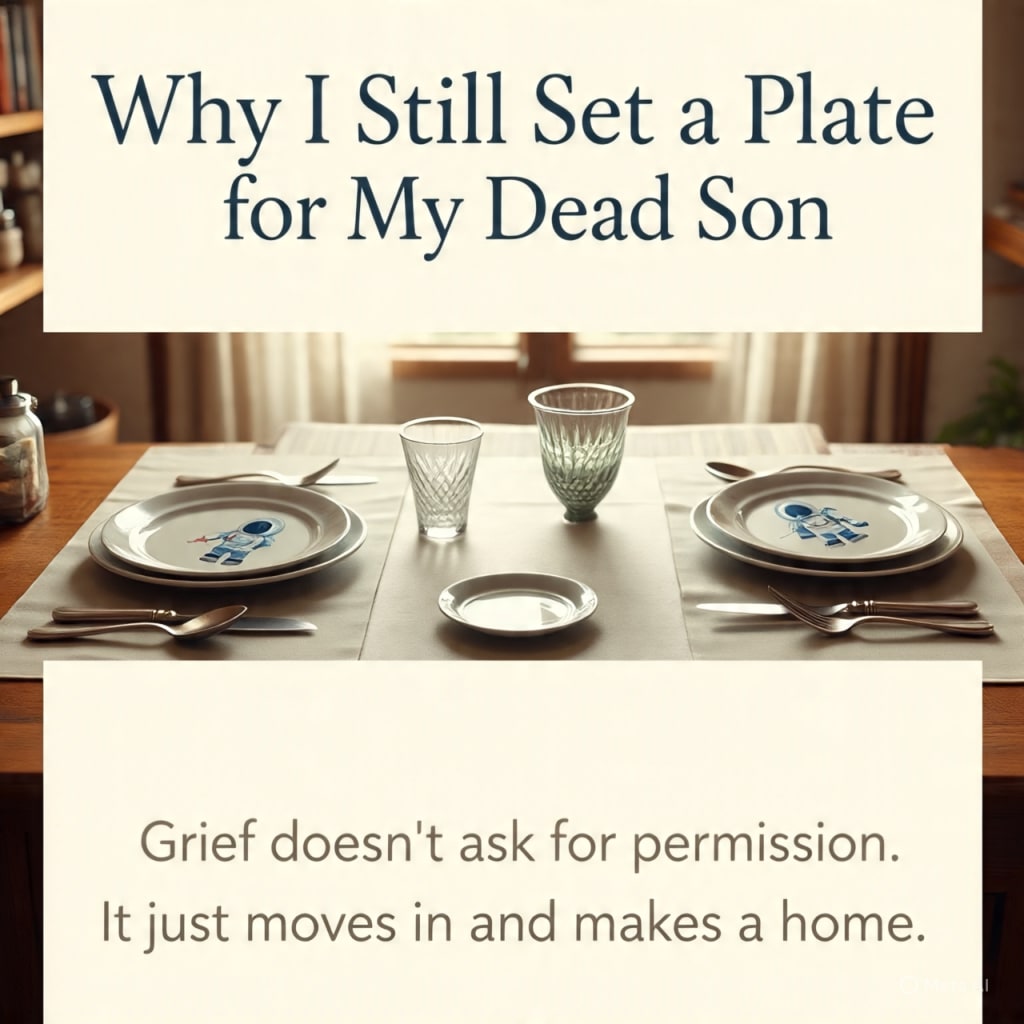
Every evening at 6:30, I set the table for dinner. Fork on the left, knife and spoon on the right, cloth napkin folded neatly. Three plates. Mine. My husband’s. And the third — a small ceramic plate with a faded cartoon astronaut in the middle — for my son, Daniel.
He’s been gone for four years.
I still set his plate.
I’ve been told it’s not healthy. That I’m “feeding the grief.” That I should “move on.” As if grief is a choice. As if love ever goes away just because a body does.
Daniel was eight. He had a laugh that made people turn around and smile without knowing why. He loved space, even though he was terrified of the dark. We used to lie on the grass in the backyard and stare up at the sky while he named constellations he’d memorized from his picture books. He’d make up stories about space whales and planets made of jellybeans.
Then one day he came home from school with a fever.
Just a fever.
It was nothing at first — something every child gets. But then it didn’t go away. Then came the hospital visits. Then came the scans. The whispered terms. The tight smiles from doctors. And then… the long silence after they said the word we never wanted to hear.
It all happened so fast. One week we were eating spaghetti and laughing about aliens. Six months later, I was holding his hand as he slipped into something quieter than sleep.
---
I remember that first night after he died. I cooked dinner because I didn’t know what else to do. I set two plates. Out of habit, I reached for a third. My hand froze over the cupboard.
I thought, He doesn’t need a plate anymore.
But I gave him one anyway.
It felt wrong not to. It felt like erasing him — as if setting two plates was me saying he’d never been there at all.
So I kept doing it.
Every night since.
---
It’s not about pretending he’s still alive. I know he’s gone. I don’t speak to the plate or imagine it moving. I don’t serve it food. It stays empty — just like the chair beside it.
But the plate is there because he was here.
Because he matters.
Because love doesn't stop when breath does.
---
Sometimes, when people come over, I hide the plate. I know how it looks. I know the discomfort it causes — how people glance at the extra setting and then quickly look away. They mean well. They always mean well.
But grief makes people nervous. It makes them question the rules they live by — the rules that say time heals all wounds, or that if you just stay busy enough, the ache will shrink.
Some wounds don't heal. Some holes never fill. We just learn how to carry them.
---
There are days when the pain knocks me down like a wave. When I wake up and forget for half a second that he’s gone, and then remember all over again. When I hear a child’s laugh in the grocery store and have to step into the freezer aisle to cry.
There are also days when I remember the good things: how Daniel insisted on wearing mismatched socks. How he danced when he brushed his teeth. How he once told me, “If I ever get to go to space, I’ll bring you a star.”
I never got the star. But I still have the socks.
---
My husband grieves differently. He visits Daniel’s grave once a week. Talks to him there. I’ve only been a few times. The grave feels too final to me. Too silent.
The kitchen table, though — it still holds echoes.
That’s where Daniel made volcanoes out of mashed potatoes. Where he built LEGO rockets while eating cereal. Where he once spilled an entire glass of orange juice and cried like the world was ending.
I see him there.
Not as a ghost. Just as a memory that refuses to leave quietly — and why should it?
---
People like stories with resolution. They want clean endings, arcs that bend toward closure. But grief isn’t a movie. It’s a room you live in after the windows have all shattered.
Setting his plate is how I remind myself: he was here. He is still part of me.
Love didn’t end. It changed.
It became quieter. But it’s still present — in an empty plate, a silent chair, and a mother who still remembers.
So yes, I still set a plate for my dead son.
Not because I can’t let go.
But because I will always hold on.
About the Creator
Keep reading
More stories from Azmat Roman ✨ and writers in Families and other communities.
A Letter I Never Sent to My Mother.
I found it yesterday, tucked away in a journal I had abandoned halfway through my sophomore year of college. A yellowing sheet of notebook paper, folded twice and stained at the corners. I recognized the handwriting instantly—mine. The ink had faded in places, but the words still held the weight they did when I first scribbled them down, late one night, in the silence of a dorm room three hundred miles from home.
By Azmat Roman ✨9 months ago in Families
Why the Maldives is the Ideal Destination for a Family Holiday
The Maldives is often linked with couples and luxury travel, but its island resort system also makes it very suitable for families. Most resorts are based on private islands, which create safe, organised, and easy-to-manage environments. This structure helps families travel together with less stress and more time to relax.
By ameliarosanna3 days ago in Families




Comments
There are no comments for this story
Be the first to respond and start the conversation.