
When News Becomes Noise: How Media Stress Affects Children’s Emotional Safety
From breakfast broadcasts to bedtime anxiety—how media shapes young minds

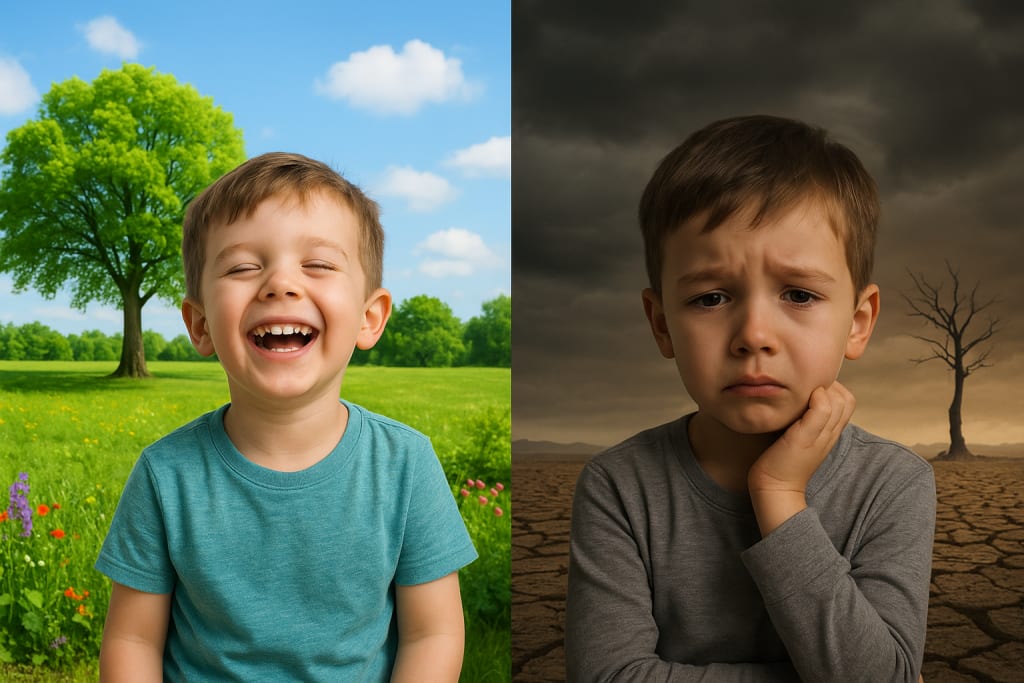
Adults can analyze the news. Children only feel it.
It’s a regular morning. The family sits around the breakfast table. The TV hums softly in the background, reporting an economic crisis.
Dad scrolls through his phone, reading the latest update about a war in a distant country. Mom sighs: “Things get worse every day”.
Their six-year-old son, quietly nibbling on his toast, suddenly asks:
“Mom, are we going to lose our house too?”
She freezes. Never did she imagine that a single casual remark could plant such a deep seed of fear in her child’s mind.
Why News Headlines Don’t Belong in a Child’s World
We adults often talk freely in front of children, forgetting that little ears are always listening. Even when a child seems busy playing or appears distracted, their brain is quietly picking up every word, every tone.
The problem is that children lack the ability to analyze what they hear. Words like “inflation,” “layoffs,” “climate crisis,” or “war” translate into just two meanings for them: “danger” and “loss of safety.”
When Parents’ Anxiety Becomes a Child’s Burden
Adults have tools to cope with stress—conversation, logic, experience, hobbies. Children don’t. So our worries often turn into a vague, persistent anxiety for them.
This stress can show up in many ways:
Nightmares
Trouble sleeping
Unexplained stomachaches or headaches
Clinging too much to parents
Irritability
Decline in focus and learning
Media: The Background Noise That Shakes a Child’s World
A constantly playing TV, news on the radio, or videos on social media have the same effect. Even when we think they’re not paying attention, that background noise—full of crises and disasters—seeps into their mind, unsettling their sense of safety.
How to Tell the Truth Without Taking Away a Child’s Sense of Safety
You don’t need to hide the world’s problems completely. Kids should understand that life isn’t always without challenges. But there’s a big difference between “explaining reality in child-friendly language” and “drowning them in a sea of adult worries.”
For example, if your child asks, “Will the war come here?” you might say:
"Yes, in some countries people face difficulties. But here we are safe, and adults are working hard to solve these problems."
This response doesn’t hide the truth but still preserves the child’s sense of security.
How to Make Home a Shield for Your Child’s Peace of Mind
Simple steps for parents:
Limit the news:
Avoid keeping the TV or radio on news channels unless it’s an educational, age-appropriate topic.
Set a time and place:
Have serious conversations about such issues when children are not around.
Keep answers short and simple:
Respond honestly to questions, but in clear, age-appropriate language.
Reinforce safety:
Frequently remind them that home and family are safe and that you are there to protect them.
What I Learned from Anxious Little Hearts
As a pediatric occupational therapist for many years, I’ve seen firsthand how stress impacts children’s behavior.
Some children start therapy with strong engagement and bond well with their therapist, only to suddenly refuse to enter the therapy room a few sessions later—clinging to their parents for no obvious reason.
Others show steady progress, then experience a sudden drop in focus, as if they’ve taken several steps backward without explanation.
In my parent workshops, I always emphasize this: extra stress can significantly disrupt a child’s growth—and with it, their learning and therapy progress. Creating a calm, secure home environment is one of the most powerful ways to support healthy development.
Children with Special Needs Are at Higher Risk
Kids with developmental challenges can experience high stress over things most of us consider minor. A simple change—like moving furniture or adjusting mealtime—can feel overwhelming to them.
That’s why these children need even greater care when it comes to shielding them from unnecessary stress.
Final Word: Lifting the Weight Off Small Shoulders
The children of today are the adults of tomorrow. Life will bring them enough challenges in due time. Our responsibility is to ensure that their growth happens in the healthiest way possible—so they are well-prepared to face those challenges when the time comes.
Exposing children too early to adult-sized worries can be harmful and may disrupt their development.
By simply monitoring the conversations and news they are exposed to at home, we can provide a form of protection just as vital as food, education, or physical safety.
Children should never carry the burden of adult fears. Our words can become a shield, creating a safer world inside their little hearts.
If you care about the next generation, share this article with those raising and shaping it.
About the Creator
Morteza Shamsian Norasteh
Occupational therapist, author, and educator from Iran, focusing on child development, parenting, mental health, and the everyday realities of families with special needs children. I write to inform, empower, and connect.
Keep reading
More stories from Morteza Shamsian Norasteh and writers in Families and other communities.
How Excessive Screen Time Is Changing Childhood—And What We Can Do About It
The Quiet Crisis: When Screens Replace Childhood A four-year-old boy sits silently on the couch, mesmerized by the glow of a colorful screen. No tantrums. No demands. No sound.
By Morteza Shamsian Norasteh6 months ago in Families
Wise~Guys
— Look Behind what's in Front of You ~ Make Good Choices — Hey, So how you Doin'..! Made~Men — Mobster Movies romanticise a distinctive, elegant appearance, impeccable attire style, along with the 'Families' expressive lingo. Making their 'Bones' gave them Panache — with vintage fedoras, tailored pin-striped suits, mirror-polished wing-tip shoes adorned with tassels; with their 'Gun Moll' gorgeous dates on their arms.
By Jay Kantor19 days ago in Families
Bettijo Hirschi
Introduction Bettijo Hirschi is a multi‑talented creative professional from the United States. She works as a designer, art director, photographer, writer, and event planner. Bettijo has built a long career in creative work and media. People know her for her artistic skills, her work in magazines and television, and her lifestyle blog. She is also known in recent news because of changes in her personal life.
By Farhan Sayed5 days ago in Families



Comments
There are no comments for this story
Be the first to respond and start the conversation.