

It was only after giving his dad’s eulogy that Mark realised how little he knew about the man. He had spent hours trying to draft something heartfelt and even after writing the words he felt empty. Not because he felt any grief, mind you. He just didn’t care.
Standing behind that podium in a suit that still had tags, Mark’s speech could have been about literally anyone. Not that it mattered. In the end, only three people had attended the ceremony. Two, if you didn’t count the priest, which Mark didn’t. The only other person was a live-in carer who had stayed with his dad just before he died. She was a retired nurse, even older than his dad had been. She sat near the back of the small chapel, staring vacantly, except for when she stepped outside to smoke.
Mark didn’t bother going to the gravesite. He had said goodbye to his father when he was sixteen and had left home. Instead, he sat outside the chapel on a bench by the road and looked at his 64-page inheritance. After funeral expenses, there had been practically nothing left. His father had never owned his own home and his belongings had all been sold. There was a little money, but not enough worth writing about.
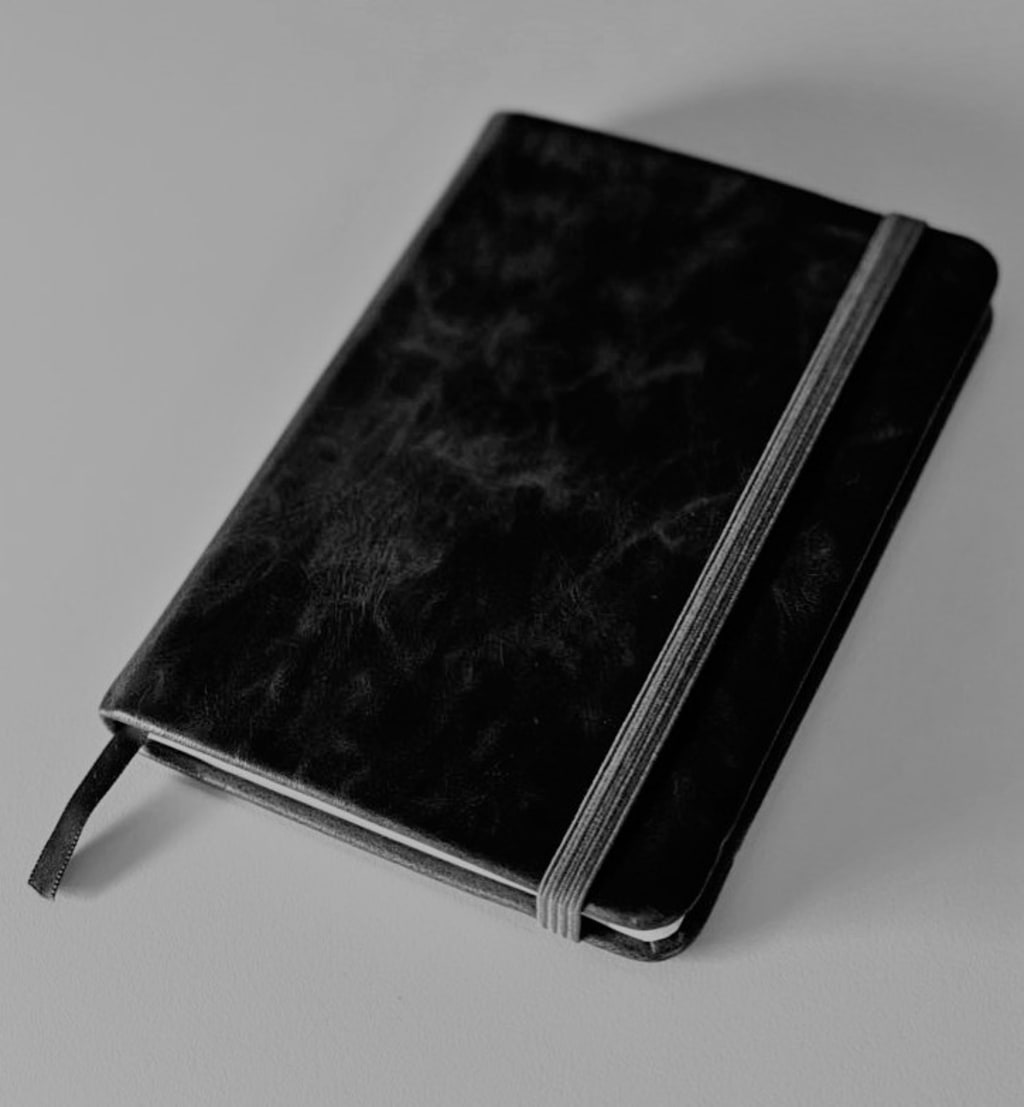
The one thing that had been left to him specifically was a notebook.
Mark ran his finger along the spine. The sable moleskin was handsome in its own way, straightforward and unfussy. He flicked it open to a random page. Blank. He fed out the remaining pages. Empty. Mark smiled. At least he wasn’t the only one. Mark turned back to the front and opened it from the beginning.
His dad’s handwriting was neat and small, like the man himself. A series of names descended the left-hand side of the page and were accompanied by what looked to be private addresses. They shared the page with two other columns, the headings were ‘Date’ and ‘Money owed’. A few of the names were crossed out. Mark closed the notebook, sighing and pushed a hand through his hair.
Of course.
That had always been the problem with Dad. He was the kind of person who would never take any responsibility for himself, who could never admit when he was wrong. It was the reason Mark had left, and the reason why the two of them had never spoken after that day. Back then, Mark had promised to himself that he would be someone that people could depend on. The first step in doing that had been leaving the man who had constantly let him down. Now that man was dead and had left his only son a book of debts as his inheritance. Typical.
He opened the notebook again. The first entry was dated nearly thirty years ago. About the time I left, Mark thought to himself. He slipped the notebook into his bag and spent the rest of the morning looking up train timetables.
Two trains later, on a drizzly Good Friday, Mark found himself standing outside the door of Elizabeth Ryder, 23 Herringbone Lane. Or so he hoped. It was the second day of his bereavement leave but Mark still had the weekend shift. He folded his suit jacket over his arm and trilled the doorbell. Mark hoped that he didn’t look like a salesman. Do people still do that anymore? He wondered.
Eventually, the door unlocked. A woman whose forties had been kinder to her than Mark’s looked out from behind the half-open panel door. She blinked once.
“Yes?”
Mark smiled and tried to make himself look like a nice person.
“Hi, are you Elizabeth? I’m not sure if you remember a man, John Hughes? I’m his son.”
Mark had been expecting a blank stare. It was thirty years ago after all. He hadn’t expected that kind of smile.
“Oh, you’re John’s son? Oh, please come in.”
She swung the door wide and ushered him inside. They shuffled around each other in the hall. Mark asked if it was okay for him to wear shoes inside. She said it was. They moved into the living room. It was tastefully decorated, with Swedish-style couches and warm cushions. Mark settled into an armchair with a knitted throw. Elizabeth was still standing.
“I just boiled the kettle. Can I make you a cup of tea?”
“Ah, no thank you.”
“Coffee? It’s just instant, I’m afraid.”
“Um, sure. That would be great, thank you.”
A grand old clock sat opposite Mark on the far wall. The sound it made while ticking was a solid thunk, like the noise of a car door shutting. A light sleeper, Mark usually couldn’t stand the sound of big clocks, but this one felt reassuring. He wondered if their bedrooms were on the other side of the house. Hopefully. Elizabeth returned with drinks and seated herself delicately on the edge of the couch.
“So, how is John?”
Mark shifted slightly.
“Um … he passed away, I’m afraid.”
Elizabeth dropped her eyes a moment.
“Ah, I see. I’m sorry for you. I lost my mother last year. Once you get to our age though, you seem to start losing people every other week.”
Mark offered a small laugh and immediately regretted it. He cleared his throat.
“That’s actually why I’m here. Da-” Mark stopped. “John left this notebook behind. It has your name in it. I think he must have owed you money, maybe?”
A blank stare.
“What?”
Mark gave what he hoped was an understanding look.
“I know it was a long time ago, but you may have lent him some money in the past? A hundred dollars? Anyway, I just wanted to come and settle things on his behalf.”
Elizabeth leant back onto the couch, her chin raised slightly.
“Ah.”
The tall clock in the living room ticked uninterrupted for some seconds.
“John never owed me anything. It was the other way round. That was money he lent me.”
Mark blinked.
“Sorry?”
“I was pregnant with my first daughter at the time, with the wrong sort of guy. It was a big scandal. My parents gave me two choices. Go to the local convent, give birth, and then give the baby up for adoption, or leave.”
Elizabeth drank her tea.
“I was sitting outside the bus station, crying. I didn’t have any money. I remember people just kept walking past me, like I wasn’t even there. That’s when your dad came over. He was short, I can remember thinking that. He asked me what was the matter.”
She gave a wry sort of smile.
“He wasn’t exactly friendly, your dad, but he listened. When I was done, he was quiet. Then he wrote down his phone number and gave me a hundred dollars. He said to call him when I got settled.”
Mark leaned forward, his elbows on his knees. He pressed his hands together tightly, his knuckles stood out whitely against his tan skin. Elizabeth was wearing wombat slippers; he could just see her white socks peeking out the tops.
“Eventually I met my husband, this was his parents’ house. We’ve lived here now for the last twenty years. Your dad would call from time to time, ask me about my daughters. I was always grateful to him, although we never met in person again.”
Mark felt like he was underwater. He could hear her voice, but it sounded muted and distant. He stood up suddenly.
“Well, I’m glad that’s all it was. I’m sorry, but I really must … I really have to go.”
He turned and started walking to the door.
“Wait a second.”
Elizabeth moved past him silently and walked over to the console table. She pulled out a small cheque book and a pen.
“Here.”
The pale blue paper was thick. In a narrow, loopy font was his name and the amount. Two hundred and fifty dollars.
“A hundred dollars was a lot of money in those days. I’m glad I can at least give this to you.”
Elizabeth hesitated for a moment before reaching out and putting a hand on his arm.
“Take care of yourself, Mark.”
Mark stood outside the house for ten minutes after they said goodbye, the blue cheque still in his hand. Not a single thought passed through his head. All he could hear was the colour white. Eventually, Mark put the cheque in his pocket and pulled out the notebook. He looked at the next name.
So it went for the next three weeks. Mark travelled to old addresses and houses, talking to the people whose names were on the list. Sometimes their children. Always it was the same story. They had been desperate. They had been alone. They had needed help, and his dad had helped them. In all those times he had never asked that the money be returned. More often than not, Mark left those houses with money. Sometimes cash, sometimes cheques, sometimes bank transfers. Everyone was eager to pay what was owed. Everyone was happy to see John Hughes’ son.
The last person had been the live-in carer from the funeral. Her name was Joyce. She had borrowed thirty dollars for a pack of cigarettes. That had been a week before he had died.
When Mark finally crossed out the last name in the notebook, he was sitting at a picnic table by a rest stop. All told, it was a little more than twenty-thousand dollars. For the first time since he had died, Mark let himself feel something. It still wasn’t grief, instead, maybe something closer to regret. The fact that he had never got to see his dad trying to be someone better.
I suppose in his own way, he had been trying to be someone that people could depend on too. Mark wondered if him leaving had anything to do with that.
“Hi, excuse me?”
Mark looked up. A woman in her early thirties was standing in front of him, a small flushed-looking boy of about three on her hip.
“We’ve just run out of petrol and … Oh, I’m so sorry, I’m disturbing you.”
She was looking at him with concern. Mark palmed the tears away from eyes.
“Um … no, no. That’s fine, sorry. I’m okay.”
The woman seemed to waver, shifting the small boy to her other hip.
“Again, I’m really sorry. I would normally never ask a stranger, but my phone just died and I’m pretty sure I’ve left my purse in the other car and Jaden is sick and I just, I just …” She sighed, trailing off.
Mark looked back down at the open notebook, at the clean lines underneath the last words his father ever wrote. He smiled in a small way and looked up again.
“Do you need some money? Let me get your name.”
About the Creator
Jarrod Hogan
Jarrod is an Australian researcher who is passionate about education, social justice, and working with disaffected youth. He recently reignited his love of fiction writing after taking a decade long break from being a pretentious teenager.
Keep reading
More stories from writers in Families and other communities.
Feliz Día de San Valentín: 20 Ways to Celebrate Love and Connection Around the World
Introduction to Feliz Día de San Valentín Feliz Día de San Valentín is celebrated on February 14 every year, serving as a reminder to express love, appreciation, and emotional connection. While traditionally associated with romantic couples, the celebration has grown to embrace friendships, family, and self-love.
By Story Prism5 days ago in Families
Nostalgia About Mornings
I am 43 now. I live in the USA and burn my midnight oil every day. That's my normal. Even as a village girl in India, I was a night owl. I read story books or painted late into the nights. May be the less chaos at night, gave me quality solitude and productivity.
By Seema Patelabout 12 hours ago in Families



Comments
There are no comments for this story
Be the first to respond and start the conversation.