

I wasn’t expecting much when the executor of my grandfather’s estate told me the old man left me something in his will. I had not attended the funeral. I hadn’t been invited. It seemed unlikely the old badger had undergone a change of heart on death’s door. The last time I’d seen him he had told me, with visible satisfaction, that his house and stock portfolio were going to my cousins in Dallas.
The voicemail from the lawyer was vague. He informed me I needed to appear in person to claim the bequest.
As I drove up to Monterey, it occurred to me that maybe what awaited me was some kind of practical joke; a slap in the face from beyond the grave. It would be just like the old man to have me drive up from LA so his lawyer could read a list of the ways I’d been a disappointment.
The reality was worse.
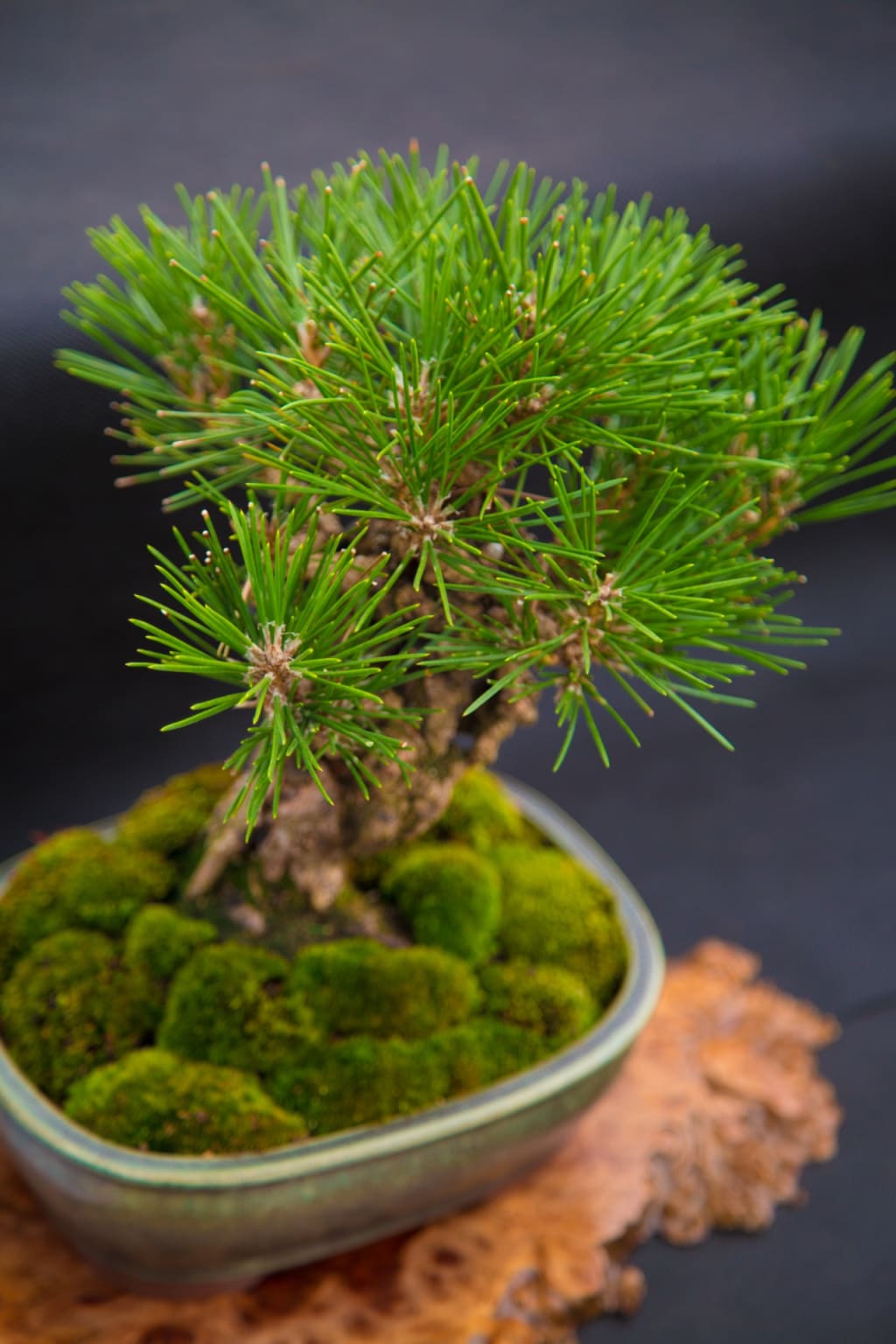
“His final bequest to you, is… well this,” the lawyer said, gesturing at the bonsai tree that sat on his desk. The gnarled trunk curled up into a tightly groomed fan of emerald quills.
“I don’t want it,” I said. God, I hated that tree.
The tree was a fixture of grandad’s house since I was a boy. It occupied pride of place by the bay window in his study. He’d acquired it, so he claimed, for five dollars when he was stationed in Osaka after the war.
When I was ten, grandad took a business trip to Dallas. I was enlisted to look after the tree for the month he would be gone. In return I would be compensated to the tune of twenty dollars, a fortune for a ten year old.
Before he left, grandad instructed me on proper care for the tree.
“Are you listening?” he interjected repeatedly. His tone suggested he was losing faith in my abilities as a substitute gardener. He explained how to water the tree so the soil was damp to the touch, but not so much that water dripped from the tray. He showed me how to feed it from the packet of fertilizer under his desk, how to prune the tree, and how to rotate it so that every part had exposure to the sun.
“Well, do you have any questions?” he asked. I shook my head. Even if I’d had a question the thought of asking anything of this terrifying, fierce eyed man made my palms sweaty with fear.
“The important thing,” he said, gesturing to a small, black notebook that he kept on his desk, “is to note everything you do here.” He tapped the notebook. “Every time you trim a needle off the tree, everytime you water it. And make sure to record what music you play.” This was another request I had accepted with mute terror. Grandad had informed me that I was to play one of his classical records for the tree each time I stopped by. “Nothing modern though,’ he told me. “It lost two branches last time I played Stravinsky.”
Three days a week I biked to his house after school, put on a record and tended to the plant. I took notes as instructed in the little, black book. The pages of the notebook were filled with extensive notes in grandad’s tidy cursive, notating the temperature and sun conditions, the music he played that day, how much water he gave the plant, and even sketches showing where he had trimmed the foliage.
For the first few days I remained diligent, notating every detail of how I cared for the tree. After a few weeks though, habits began to slip. Did I really need to play Beethoven’s Pastoral in its entirety? Did I have to rotate the tree every day? My notes in the little black notebook became patchy. My failure to comply with these elaborate rituals did not seem to affect the bonsai, which looked healthy as ever.
When he returned, grandad summoned me into his study. I was expecting to receive my twenty dollars. The expression on his face tipped me off that something was wrong.
“Did you rotate the tree like I told you?” he asked. He held my gaze. His eyes were the color of a cloud gathering rain.
“Yes,” I said.
“Why didn’t you note it in the book?” he asked. I noticed the notebook, opened on his desk to where I had recorded my last days tending to the bonsai. The pages were worryingly blank.
“I…”
“Do you see this?” He turned the tree away from the window and pointed to a spot on the trunk, near the network of roots. Grey speckles were growing from the bark. “This could have killed the tree,” he said. His voice was a whisper, which somehow made it worse than if he had shouted. “This is why you record everything in the book!” he said. “The key to doing anything well is to do it consistently. One day you’ll understand that Felix.”
I did not not get twenty dollars. Instead, I spent every Saturday that summer doing yard work as a way of making up for the damage. Now, here it was; a reminder of how I’d disappointed him. The old man certainly could hold a grudge.
“You don’t want the tree?” the lawyer asked.
“Use it for kindling for all I care.”
He looked puzzled.
“Well, we can arrange a charitable writeoff for the twenty thousand.”
“Sorry, did you say twenty thousand?” I asked. “As in dollars?”
“Yes,” he said. “That’s what our independent estimates determined to be the value of the tree. It’s one of only a few bonsai in North America that’s over two hundred years old.”
The old man might have intended it as a monument to my failure, but I wasn’t about to turn down a year’s rent.
“Where do I sign?” I asked.
The lawyer handed me the documents. “Also,” he said. “He wanted you to have these.” He pulled out a banker’s box from behind his desk. Inside was a stack of records and sitting on top of them a tiny, black notebook.
As I was strapping on my seatbelt for the drive back to LA, the bonsai and the box of records secured in the back seat with bungee cords, a woman came running up the driveway. She had a round face, black glasses and a bob of white hair. She tapped the window of my car and I obligingly rolled it down.
“Are you Felix Rice?” she asked, panting to catch her breath.
“That’s me.”
“I’m Ellen Tanaka, chair of the Fujiyama Memorial Bonsai Museum and Garden, in Cerritos.” She handed me a business card. “We’re the ones who did the appraisal of your grandfather’s tree?”
“And?”
“Have you considered donating your grandfather’s bonsai to the museum? Not only is it one of the oldest in North America, it’s also a cultivar that is nearly extinct. We can assure the tree will be properly cared for, and that it can be enjoyed by the public, like your grandfather would have wanted.”
“Like my grandfather would have wanted?” I said. “Let me tell you something lady, all my grandfather wanted was to spite me. Do you know what he said when I told him I wanted to be an actor? He said ‘You'll probably fail, and I don’t think you have the character to handle failure.’”
“I’m sorry to hear that,”she said. “I also had a difficult relationship with my grandfather.” She studied my face. “We can offer ten thousand dollars.”
“It’s worth twenty.”
She shrugged. “We’re a non- profit. That may be the assessed value, but you’ll have to find a buyer.”
“I’ll take my chances,” I said. I rolled up the window and hit the gas.
When I got home I set the tree in the window of my apartment and ordered Chinese takeout and a Heineken. I drank beer between mouthfuls of chow fun, and glared at the bonsai.
I’d been sober for just over a year, ever since the morning I was too hungover to show up for an audition. Lately, I’d started to treat myself to the occasional drink.
“It’s fine,” I said. I realized the fact that I was talking to a tree suggested things were not fine. I couldn’t shake the feeling that it was judging me.
The next morning I watered the tree before my audition for a cat food commercial. I opened the little, black notebook. There, inscribed in grandad’s cursive, were the words “Don’t screw it up this time.”
Over the next few days, while I waited to hear back from the cat food people, I scoured the internet for buyers. There was a collector in Portland, who wanted to examine the tree before his purchase, and another in Norway who wanted a certificate of health from a licensed medical arborist; a job title that apparently did exist.
The problem was that the health of the tree had deteriorated since I brought it home. At first I noticed it shedding needles. Then I found white fungus on the roots of the tree.
I recorded everything in the little, black notebook. I rotated the tree. I even went to a vintage store and bought a record player so I could serenade the tree with Beethoven and Vivaldi. Nothing worked. The rot was creeping up from the roots. The tree was withering before my eyes.
I decided to give Ellen Tanaka a call. Ten thousand dollars suddenly seemed like a sweet deal. I’d assumed I was calling an office, but when I reached the number on her card the voice on the other end was that of a child.
“Mom’s not home,” the kid said. “Who’s calling?”
I left a message for Ellen Tanaka to come pick up the tree tomorrow.
After I hung up with the kid, I got a call from the cat food people. They had decided to go in a different direction. I decided I deserved a drink.
I retrieved the bottle of Macallan from the spot under the kitchen sink where I had hidden it from myself. I poured a shot, downed it, poured another, and then another. My sense of despair curdled into a clarifying rage.
“This is what you wanted, right?” I shouted. “I guess I screwed it up again.”
I walked over to the bonsai. I had a vague idea I could scrape the rot off. I reached for the tree, but my balance was off. It had been awhile since I’d been drunk. I slipped, and grabbed out for something to steady myself. The tree and I crashed to the floor. Bits of porcelain and soil scattered everywhere. I pulled the tree from the wreckage. The wizened trunk had cracked cleanly in half from the foliage down to the roots.
The next day I buzzed Ellen Tanaka up to my apartment.
“I can pay twelve thousand dollars,” She said cheerily. “Oh!” She stared at the table where I had attempted to reassemble the broken bits of pottery and the hopelessly splintered tree.
“I think the deal is off,” I said.
“Obviously. It doesn’t look like you’ve had a good day, “ she said. “Would you like to see a bonsai garden?”
We drove down to Cerritos in Ellen’s van, the carcass of the tree in the back seat. I signed papers entrusting the remains of the tree to the museum. Apparently, it might still have research value.
The garden was beautiful. Rows of miniature japanese maples and cherry trees formed a tapestry of red and gold.
“We have volunteer gardeners,” Ellen said, “if you’re interested.”
“I think I’d like that,” I said.
She handed me an aquamarine pot. Inside a tiny green sapling nudged it’s way through the soil.
“If you want to practice,” she said.
When I got home I set the bonsai up on the window and placed the little, black notebook next to it.
About the Creator
David Jesse Reiss
David Jesse Reiss is a writer, traveler and insufferable know-it-all. He writes fiction, essays, and poetry, if the mood strikes. He speaks German at the level of a precocious, but grammatically challenged 11 year old. He has many opinions.
Keep reading
More stories from writers in Families and other communities.
Wise~Guys
— Look Behind what's in Front of You ~ Make Good Choices — Hey, So how you Doin'..! Made~Men — Mobster Movies romanticise a distinctive, elegant appearance, impeccable attire style, along with the 'Families' expressive lingo. Making their 'Bones' gave them Panache — with vintage fedoras, tailored pin-striped suits, mirror-polished wing-tip shoes adorned with tassels; with their 'Gun Moll' gorgeous dates on their arms.
By Jay Kantor23 days ago in Families
Dementia Red Flags That Matter and What to Do When You Notice Them
The last moment that is often the most crucial one is that one notices that something is wrong and makes a decision. Dementia does not present itself in a loud voice. It creeps in under the carpet pretending to be stress or getting old or even bad week. By the time most families seek assistance, the symptoms have been years old. The beginning at the end approach implies that the sooner the action is taken the more chances there are to save the independence, to make the lives better and to afford the families time to make their plans without panic and hesitation.
By Laura Partonabout 13 hours ago in Families



Comments
There are no comments for this story
Be the first to respond and start the conversation.