


The question about the relationship between pain and comedy is very old. As old as zoning out in human behavior. One of the theories dates back to Aristotle and Plato, and it’s adopted by many philosophers and psychologists. it’s known by the superiority theory, that laughing at other people’s pain is simply gloating. Because seeing people go through trouble in front of you makes you feel superior, or at least you’re satisfied that you aren’t alone, and you better about yourself. So, you laugh subconsciously. Because gloating makes you feel superior. Researchers who specialized in studying laughter… Imagine an entire research field about laughter! Researchers think that the reason for laughter is the pleasant psychological transformation, which means a transformation happens in your psyche to make you happy. You turn from someone who felt helpless and incomplete into someone who feels superiority and control. In an experiment, one of the researchers deliberately treated some participants rudely. Then, he spills tea on himself in front of them. And of course, you find that people were happy about it more than if the person spilled the tea after treating them nicely. Here they feel that they are better than him, and they do want to be better since he treated them badly. So let’s take all that, and apply it to Tom and Jerry. The American historian Jerry Beck says that the global popularity that “Tom and Jerry” has is because people understand Jerry’s point of view since most of us have someone in our lives that controls us and decides our happiness and drives, like your boss, father, or politicians, or even the homeowner, or her cat Tom. So we laugh because we see this small weak animal’s victory over this big figure, we see Jerry’s victory as one of our own as weak people. Because it’s what we want to happen in real life. This is one of the successful comedy types that’s very famous and it’s called role reversal. We know that naturally strong beats weak, old beats young, and the cat beats the mouse, much like what Horace Walpole said, (and please take this quote and post it on your Twitter too): “The world is a tragedy to those who feel, but a comedy to those who think.” Regardless of the morality of the situation, you’ll accidentally laugh when a student makes fun of a teacher, because the teacher is powerful and has authority, but the student is nothing (unless it’s a language school).
In the beginning, my friend, Tom, and Jerry looked like similar animals. When Tom was in pain, he screamed like a cat. Which was annoying. Because then we’ll think of cat pain. So they made Tom scream like a human (Wooohooo). Firstly the idea of hearing a man’s voice coming from a cat in and of itself, even when Tom makes a sound, his voice sounds a bit hoarse, the second reason is that we can understand human pain more than our understanding of the hurt this animal is going through. Because we don’t sympathize with animals as we do with humans…
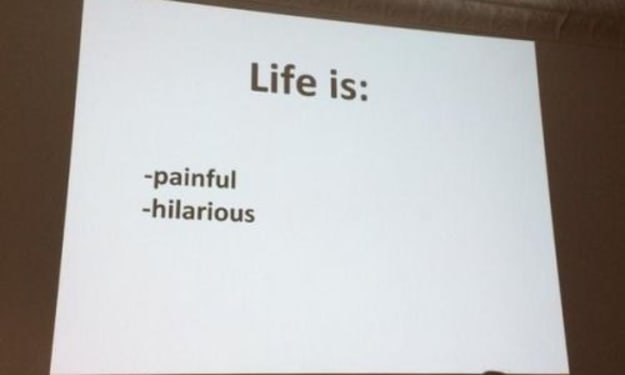
Laugh and pain, my friend, are more connected than you think. It might seem that both are on opposite paths, but in the end, the path is a U-turn. Let me surprise you and say that laughter isn’t always happiness. Why? Because laughter isn’t an evolution of smiling behavior. Laughter is connected to behaviors of eagerness panting and heavy breathing it encourages the release of endorphins which is responsible for decreasing the sense of pain, and also social bonding. That’s why Dr. Robin Dunblar from Oxford University saw that laughter increased with the increase of pain to reduce its intensity, and the British psychologist William McDougall says that we laugh, because humans are miserable creatures, so, when we laugh, it makes us feel better, because, again, laughter in his view doesn’t express happiness, however, it is a generator of happiness. Even if you’re intentionally laughing (aahahahahah *boosting happiness*) And the mentally worse you are, the more you need laughter to reduce the intensity of the pain, as a defense mechanism. Dr. Sophie Scott from UCL describes laughter as a pressure cooker explosion because the emotional buildup is sometimes expressed by laughter, which is a healthy way to get rid of built-up emotions. Emotions like nervousness, anger, and awkwardness, cringe comedy like “The Office”. A comedy based on awkwardness. That’s why my friend people who suppress their emotions too much are always laughing their heads off, these people easily laugh at anything as an alternative adjustment to express pain. The Indian-American neuroscientist V.S. Ramachandran supposes in his book “A Brief Tour of Human Consciousness” that laughter evolved as a sign to ourselves and others that what seems painful and threatening is actually not like that. He sees it as an evolution to inform people around us not to waste their energy or valuable resources on that situation because it’s a false alarm. Like when you laugh at your friend falling or Tom and Jerry when they beat each other up, surely, in addition to the comedic context they’re in. and no matter what type of pain we’re feeling, it could be, in some context, a funny story, much like your tweet. Like, if you lost to someone in the past, you could have hurt yourself. But as time goes by, you start to live with the loss, you could also laugh about it. You’ll notice it in football fans, my friend, One team could lose 6–0, so, it’ll definitely be a disaster and a tragedy and very infuriating. But then a few years later, it’s a running joke, a pun, and we use it to make fun of others, of the players, and ourselves.
About the Creator
Yahya Tragha
Philanthropy and philology
Keep reading
More stories from Yahya Tragha and writers in Families and other communities.
Wise~Guys
— Look Behind what's in Front of You ~ Make Good Choices — Hey, So how you Doin'..! Made~Men — Mobster Movies romanticise a distinctive, elegant appearance, impeccable attire style, along with the 'Families' expressive lingo. Making their 'Bones' gave them Panache — with vintage fedoras, tailored pin-striped suits, mirror-polished wing-tip shoes adorned with tassels; with their 'Gun Moll' gorgeous dates on their arms.
By Jay Kantor22 days ago in Families
Why Slowing Down Isn’t Giving Up, It’s Learning What Matters
For a long time, I equated being busy with being productive. When my days were full, I felt accomplished and validated. When I slowed down, I felt uneasy, as if I were falling behind. Rest felt like something that had to be earned instead of something freely allowed. Over time, being busy became a badge of honor, even when it left me feeling drained and overwhelmed.
By Lisa Charlestonabout 18 hours ago in Families



Comments
There are no comments for this story
Be the first to respond and start the conversation.