
To Try, Perchance To Fly
What my father showed me...

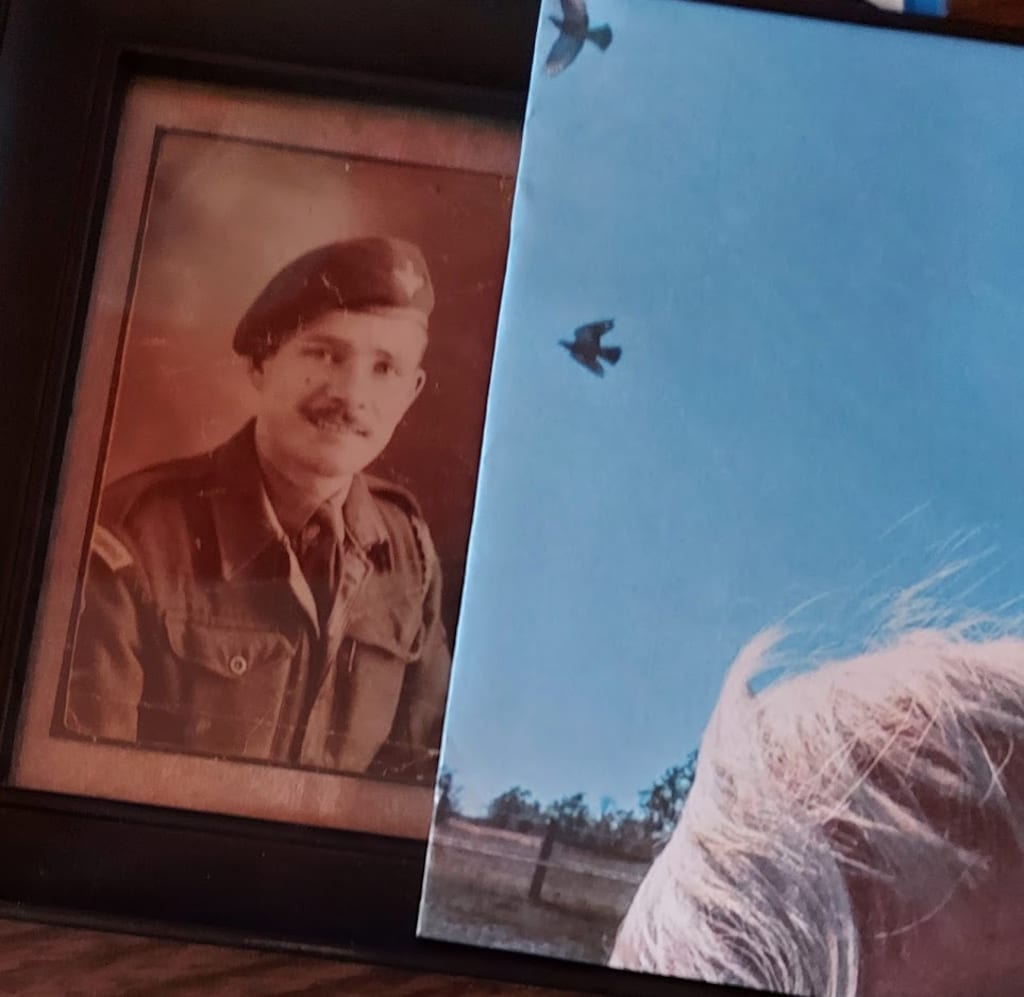
Every time I see a hawk in flight, I watch, almost mesmerized. Like eagles and falcons, birds I see less often, the majesty of their form, the strength of their wings and the graceful ease with which they can swoop, then rise again into the wind, are humbling. The skies are theirs, and there they defy the power that gravity imposes on us, the mere mortals.
Often, as if in acknowledgement of the reverence with which they are held, they will hang, hovering just above me, seemingly motionless. In those moments I am certain he or she knows that this is exactly what I want, and they oblige. More times than not, I feel a heat rising in my throat as tears form in my eyes, and I cannot but wish I could join in such flight.
As long as I can remember, I have felt a connection with them, as awestruck and insignificant as they make me feel. Certainly I see in every bird that glorious freedom of the skies, but I feel something deeply spiritual in the hawk’s flight, their appearing almost as angels amid the clouds or silhouetted against a cornflower blue expanse of sky. Maybe it’s because I yearn for such freedom, to view the world from on high, myself, alone. I don’t know if this is a sentiment I acquired and have nurtured on my own, or if it took its cue from my father’s.
My father always wanted to learn to fly, from when he was a schoolboy in Northern Ireland. To be a pilot was his dream, and I believe for him it was born of a desperate need to escape the cramped house, in which he lived with many siblings, four of whom died before the age of 12. Of the seven remaining, they and their parents shared two tiny bedrooms. Food was scarce, breakfast was porridge that had been made in the wee hours, hardening by the minute and successive serving. Many a time he or some of the others went without. There just wasn’t enough. Evening meals were similar, generally with some soup and bread, and only enough for as many as got to the table before it was gone. To help financially, his mother sometimes took in boarders. During those stays, my father recalled he’d have nothing to eat from one morning to the next. He was always awake, and in for porridge, during the first wave of the house inhabitants. It was no wonder he and neighborhood boys would hike fences and pilfer apples from the private orchards of the more affluent. Indeed, it would have been well nigh impossible to be less affluent than his family. How they managed, how my granny got a husband, seven children and (sometimes) a boarder or two clothed and fed, albeit meagerly, I do not know.
And I cringe to contemplate nappies for the babies, old torn shirts that would be fashioned for tiny buttocks, worn, then rinsed out and hung to dry in a climate where there was rarely a day without rain.
He was an excellent student, my father and, while others may have taken their academics less seriously, as something demanded by society, my father applied himself with a fierce purpose: to excel and, with luck, escape the poverty - indeed the very country that imposed it on him - never again to be contained in a place with no hope of escape. He worked hard, long and diligently. Ultimately, he succeeded. His name is still on a plaque in The Christian Brothers School in Omagh, Northern Ireland, as the top achiever in his year. I like to visit it whenever I am in Ireland, usually on the same day I visit my parents’ graves just outside the town.
As he was applying himself to his studies, the Nazis were invading Poland and advancing across Europe. I still have the Atlas he and all his siblings used in school. In it, he has left his substantial mark, tracing Hitler’s advance and England’s response (with his own commentary). I was never told exactly, but I know he was determined to finish school and join the Fleet Air Arm of the RAF (Royal Air Force). It may have been British, and not palatable politically to my father’s people, but it would be his chance to learn to fly. He never talked about his childhood or young adulthood; in fact, he talked very little about himself in any personal way. But I knew him through and through, his ambition, his boundless energy and drive, and can look back - from my own perspective now - across the many and diverse goals he set for himself over his lifetime, challenges he sought to conquer, projects he determined to undertake and can say, in all honesty, he never once fell short. I have always been in awe of him, and everything he accomplished.
World War II apparently had plans that did not include my father’s fighting pitched air battles with the Luftwaffe, or being shot down during the Dresden bombing or, indeed, anything involving flight. Just as he was ready to enlist, eager to get the pilot wings he so cherished, the Second World War in Europe let him down entirely on V-E Day – Victory in Europe – when victory over Hitler was declared May 8, 1945. Hostilities ceased, Germans surrendered and the RAF had little need for training pilots to guard the skies over Britain. No doubt this was a great disappointment for my father but opportunity – an exciting one – of another sort presented itself almost immediately.
V-J Day – Victory over Japan – was declared just three months later, on August 14, 1945. Hong Kong and Singapore, long British colonies, had been occupied by the Japanese between 1941 and 1945. With the Japanese surrender, Britain was quick to reclaim the territories, calling upon its military to restore the colonies to status quo ante bellum, in this case to British sovereignty. It was then that my father was posted, as a Captain, to Hong Kong and environs not, as luck would have it, as an RAF pilot but as a member of The Buffs infantry regiment.
He rarely talked about his time in the Army, though I’ve often made my way through hundreds of photos he took, some of fellow soldiers and some of the people he met in Hong Kong and Singapore, but most are of architecture, villages, rice paddies, oxen, motorcycle trips up mountainous roads that proved anything but safe. My father defied the odds then, as he would continue to do until age and cancer claimed him. While I can remember three distinct brushes with death he’d had during the time I was in his world, those apparently paled in comparison to some of the near-death situations he managed to orchestrate while stationed in Southeast Asia. Though not reckless, my father was possessed of a steely, focused determination that nothing would stand in his way. I have come to believe he did march to a singular rhythm not of his own creation, but to some sort of music set by an ephemeral assemblage, the strains of which were audible only to him.
No one, not even my father, could deny that those years he spent flung far across the globe afforded him an exceptional experience of the world, something denied virtually all others. And, being him, it whetted his appetite for more, more of the same, please. And even more than that.
Back home in Ireland, he used his Army educational benefits to become a Quantity Surveyor, virtually coincident to marrying my mother (whom he’d first met when they were 15), becoming my father and, then, emigrating to Canada where there was ever more opportunity for him to succeed in life as far away – in this massive country – from the wee pokey home and life that had shaped him. There was no shame in him for having come from such humble beginnings, but he had the intelligence and ambition and determination to run from it.
He had tasted freedom, and possibility. Back in Northern Ireland, in Belfast, married, with me aboard, he passed his Quantity Surveyor final and was given three choices for employment abroad, within Her (by then) Majesty’s Commonwealth as a QS (some mélange of architect/engineer/estimator, a degree seemingly uncommon outside the realm) in Australia, South Africa and, finally, Canada. He was game for any and all. My mother, on the other hand, was less than enthusiastic. She – quite simply – did not want to leave Belfast, but she was ever supportive, and had known this man she married was unlikely to linger about the Northern Ireland of the ‘50s, especially in general construction where a Catholic had little hope of the kind of success my father wanted to achieve.
God love her, my mother. We never discussed any of this. I only know that it was she who decided on Canada. In my head, the elimination process ran thus: Australia – FAR too far away to get home in an emergency (this was the 1950s, remember); South Africa – Of this I only hope: Perhaps she mentioned it once to me, but it is what I choose to believe. There would be no living in an Apartheid state for my mother. That would have been my choice at that time; I pray it was hers. Thus, Canada won the draw and, despite my mother’s and my unhappiness at leaving Ireland, we made the move when I was all of 2 ½.
Once in Canada, employed as an ‘estimator’ (since Quantity Surveyors don’t exist as a distinct qualification here), my father exceeded all expectations. In less than ten years, he had formed his own General Construction partnership with an Engineer from the firm where he’d been employed. Success begat success, at least in the workaday world. He, my father, had proved himself and had succeeded. His company built churches and schools and medical buildings and so on and so forth all around the city in which we lived, then moved northward and northward, until they were building things in the far and bitter recesses of Northern Ontario.
Yes. He had proven himself. He was a success. No one could possibly deny it. But there were still so many more things he wanted to do. Never content with proving himself in one category, he was off and on to so many more. I don’t think he ever managed to complete everything he’d hoped to tackle, but he mastered more than any ordinary person (I think of myself here) ever could have done.
And, now, I return – aware of the many other projects my father undertook and at which he then, of course, excelled – to that need for the ultimate freedom of the skies. We are an unwinged species, we mortals. Would we could rise up and take to the skies on any a whim.
When I was eight, my father took flying lessons. He won the Dow trophy for having the best results of his class and, then, with two other construction company owners, he bought a Cessna four-seater: CF-VZF (Victor Zulu Foxtrot). For the next three years, I spent every Saturday or Sunday with him, flying here and there across Southwest Ontario. I loved flying, especially in such a small plane and, even more, in one wholly-piloted by my father. I don’t know if I knew then about his oft-thwarted flying ambition. I do know I trusted him implicitly. He could do no wrong. My special treats were the ‘stalls’. I begged for them because of the incredible power felt on the tail end. He would take the plane to a height I imagine was one used in flight school, then cut off the engine. The plane was then just hanging on its own, until gravity forced descent. How I loved that feeling of heading toward the earth, always knowing (and trusting) that my father - he of so many successes of which I really was unaware, but just knew somehow as if by blood - would, at the last second, grab the controls and send us back up into the vastness of sky.
I suspect those were the best times I ever spent with my father. My mother, on the other hand, absolutely refused to go up with him, being afraid of heights and all. When, finally, he persuaded her to give it a go, she got as far as take off, then demanded to be set back on terra firma immediately. That was her first and only flight in the wee Cessna 172.
It was a sad day for me when ‘Cissy’ (as I thought of the twin-prop) was sold. I don’t know why that happened, though I suspect it had something to do with my mother’s illness, and the trauma of her nervous breakdown that followed. I had regular trips back to my home country of Ireland, at least annually, and to this day am giddy with excitement when boarding a plane. The entirety of the flight isn’t what I crave. It’s the takeoffs and landings, those moments when – near breathless with anticipation – I await the millisecond of dispatch from the earth and the aftermath of feeling weightless…farther and farther above the meager trappings of earth. I love the landings because there’s always the distinct possibility (at least in my mind) that it could end in a fiery crash. Every time I get on a plane, I calmly nod to myself and agree we may die this time, but it doesn’t matter a whit. I feel such sheer and utter exhilaration up in the sky, even if it’s not under my own – or my father’s – steam; even if I don’t have the wings I would love so that I could soar and swoop and hover and own the world, as I envy those hawks whom I believe do.
When he was 75, many years after Cissy departed, my father studied and obtained anew the pilot’s license he had let expire about 10 years earlier. Just to prove he could. He did that a lot. If it were a general assumption that something were too hard or time-consuming, or required too much energy or strength or vitality, then my father had to prove otherwise. There was really no other reason for him to qualify for his wings again, at that age, as his eyesight – even corrected – wasn’t good enough to fly solo. And if he couldn’t solo, I knew he would have believed there was no point.
He never stopped being that eager, driven, ambitious young schoolboy – seemingly trapped in poverty and inaction – all the way until the last days before his death from lung cancer at 82. Only three years earlier, before he “slipped the surly bonds of Earth” (‘High Flight’, John Gillespie Magee), I had been beside him as he hammered with a mallet above his head. I can’t remember what he was hammering, or why, but I had used that mallet and knew it was extremely heavy. As I watched the yet-defined bicep muscle on his thinning arm, I marveled anew at his strength, at his determination and how he looked life straight in the face, willing it out of his way. He wasn’t done yet.
He spent a week in palliative care before he finally left. I was, of course, with him constantly. My mother by then had Alzheimer’s and didn’t really understand what was happening, so it was just him and me. Every day, at some point, he would describe to me the two “hawks…or maybe eagles…no, hawks” that would sit on the window ledge in his hospital cubicle. Sometimes, he said, they would settle at either side of the foot of his bed, and he’d talk with them. It was a half hour-drive from my house to the hospital, and the route – that I followed for my three visits daily – took me along a scenic, bush-lined road. On every trip, there and back, except the late night return when darkness would claim the panorama, I would look up to see the sky dotted with hawks. How many I don’t know, but they were there, always just gliding and hovering, hovering and gliding, for me to see, as I went to and from him.
It was just before midnight that he died. On the drive home, with my mother and daughter, well into the early morning hours, it was the dark sort of night typical of waning winter. I can’t recall if we were crying or just numb, but I don’t think much was said. When we passed the spot where, in daylight, I would watch the hawks as they directed my path to and from all was, of course, darkness. And everything was still, surely. It must have been. And, yet, I know I saw movement and I know I was meant to see that movement.
My father was going home, through the freedom of the sky, in the company of those glorious birds he so revered. It’s a rare day now that I don’t see at least one, and a rarer day that the sight doesn’t bring me to tears. Not tears of grief, despite my very real loss, but of joy that he is finally unshackled from the weight of gravity and that there – wherever – unleashed and free, he remembers to send me a hawk to remind me of what is to come.
About the Creator
Marie McGrath
Things that have saved me:
Animals
Music
Sense of Humor
Writing
Keep reading
More stories from Marie McGrath and writers in Families and other communities.
Love Letters Through Time
Context: Grace (Gráinne) Gifford, was a participant in the Irish nationalist struggle against British rule, which led to ‘The Easter Rising’, Easter Monday, 1916 in Dublin, Ireland. She was betrothed to one of the leaders, who were due to be executed the morning after being taken prisoner. Joseph and Grace were married the night before in his prison cell. Joseph (Seosamh Pluinceid)) was one of the leaders of The Rising, a signatory of the Irish Proclamation and, in death, a revered Irish hero. These are my imaginings of ‘her’ final words to him. I include a few words in Irish Gaelic as the movement that led to the rebellion favored speaking Irish, instead of English. I would wager a guess, as they were both poets and writers in the Irish republican movement that she would have chosen to marry her love of country with her love of him in expressing her devotion.
By Marie McGrathExclusive • about a year ago
How to Plan Your First Trip to the Maldives Without Overpacking or Overplanning
A first trip to the Maldives often creates pressure to prepare for every detail. The islands look minimal, yet travellers frequently overpack and overplan in an attempt to avoid mistakes. In reality, island life follows a predictable rhythm shaped by climate, transport schedules, and limited space. Planning well means understanding what is actually required and allowing the setting to guide the rest.
By Aurora Gianna4 days ago in Families




Comments
There are no comments for this story
Be the first to respond and start the conversation.