
The Wicked Empress Who Plunged Russia Into A Dark Age
Anna Ivanovna, dubbed "Ivanna the Terrible" for her terrible manners and nasty sense of humor, tortured and imprisoned her enemies for a decade.

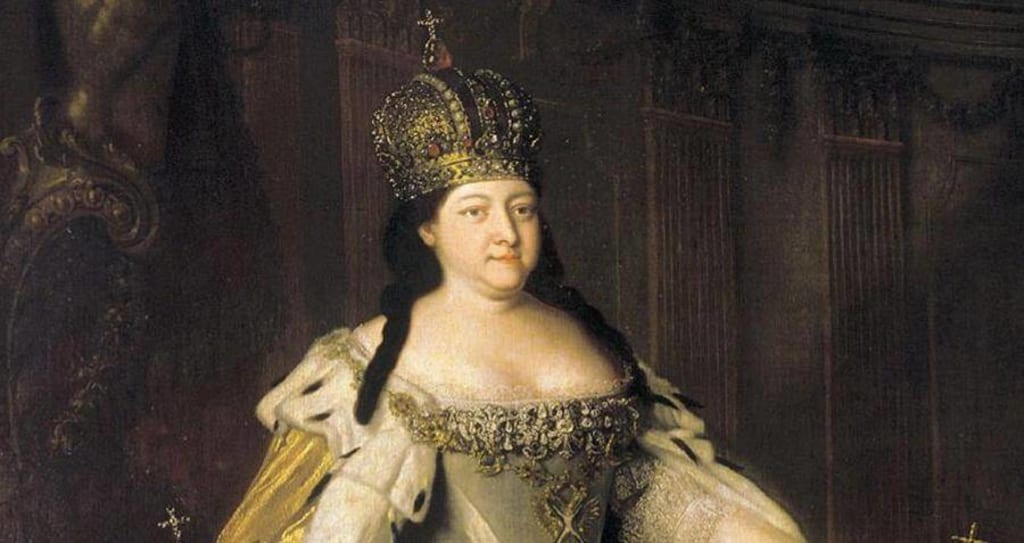
Anna Ivanovna was born a princess, but her life was not a fairy tale. Tsar Ivan V was intellectually and emotionally absent from her life. Her mother was unhappy and stern, and Anna, not known for her looks, was once mocked for resembling a “Westphalian ham.”
Anna Ivanovna's marriage to the Duke of Latvia in 1710, however, suggested that all was about to change. Unfortunately, shortly after their wedding, her new spouse passed away, leaving her alone in a distant country.
Anna Ivanovna, however, became Russia's empress through a sequence of improbable occurrences. She ascended the throne unhappy, lonely, and vengeful. Her 10-year rule is regarded as a "dark age" in Russian history, and she constructed a magnificent ice castle to humiliate, torment, and execute a nobleman she disliked.
This is the narrative of the unhappy Russian empress Anna Ivanovna.
How Anna Ivanovna Became Known as "Ivanna the Terrible"
Anna Ivanovna was born in 1693 to Ivan V, who, despite being Tsar, lacked real authority.
Mentally incapacitated and dubbed "Ivan the Ignorant" for the many hours he sat in complete silence, Ivan performed only ceremonial duties while his younger half brother, Peter I, also known as Peter the Great, held the real power.
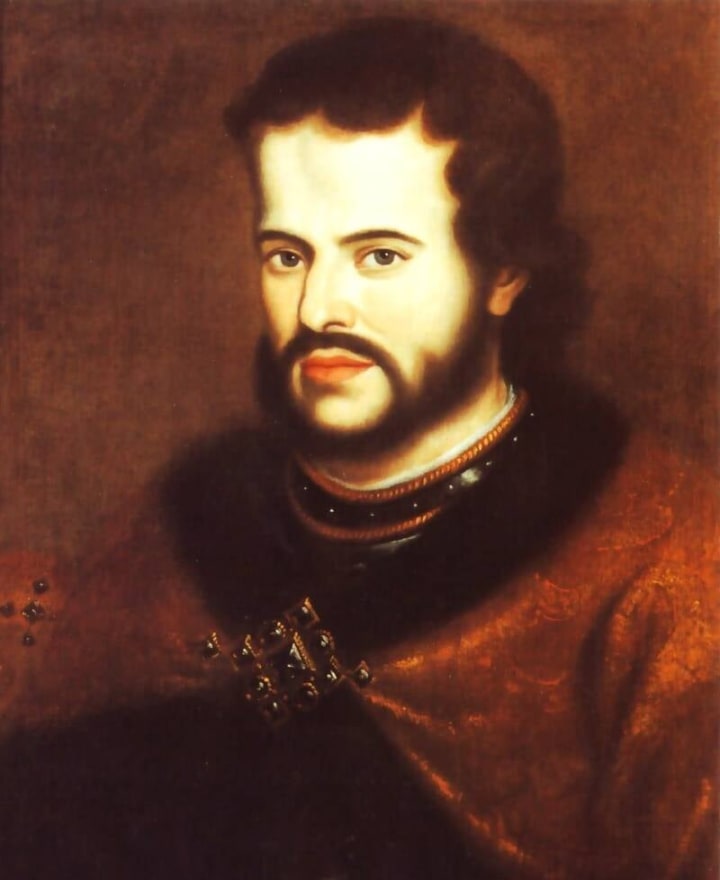
Her father's death at the age of three cemented Peter I's hold on power. Perhaps this early setback also had an effect on Anna's personality, as she was known as a child to be cruel, stubborn, and gloomy, earning her the nickname "Ivanna The Terrible."
Peter was able to arrange her marriage to Frederick William, the Duke of Courland, which is now Latvia, in 1710, despite her personality and generally negative opinions regarding her appearance. Anna was ecstatic and wrote to her fiance:
“I cannot but assure Your Highness that nothing could delight me more than to hear of your declaration of love for me. For my part, I assure Your Highness that I share your feelings. At our next happy meeting, to which I look forward eagerly, I shall, God willing, avail myself of the opportunity of expressing them to you personally.”
The newlyweds had a magnificent, expensive wedding, while Anna's uncle planned a sham wedding for her in Russia with two children.
The young duke then allegedly challenged the tsar to a drinking contest. The groom drank so much that, a couple of months later, he died. At the age of 17, Anna Ivanovna became a widow.
The Widow Becomes an Imperial Tyrant
In 1711, after the tragic death of her husband, a grieving Anna Ivanovna became the monarch of Latvia. She presided over the distant land with dismay for twenty years.
Upwards of 300 letters were written by the despondent woman pleading with her family to get her a new husband. Her pleadings were ignored. Ivanovna would never marry again, but an improbable series of events would lead to her becoming the Empress of Russia.
Her ascent to the throne was precipitated by a contentious succession dispute. Peter the Great's grandson Peter II, who died without heirs, was next in line. Together with her sister and the children of Peter the Great, Anna Ivanovna and her daughters were the next candidates for the throne.
Anna Ivanovna's marital tragedy proved her biggest advantage in the end. The Russian Supreme Privy Council considered her a suitable contender for the crown because, as a widow, they believed she would be easier to influence.
Nonetheless, if the Russian Supreme Privy Council thought they could control Anna Ivanovna, they were gravely mistaken. As soon as she assumed power in 1730, she dismissed the council and had her opponents executed or deported to Siberia.
Anna Ivanovna became the only ruler of the Russian Empire as a result.
Building An Ice Palace To Torture One Man
Ivanna the Terrible had not softened with age. If anything, her heartbreak and quasi-exile to Latvia had made her all the more bitter and vengeful. She set her sights on Prince Mikhail Alekseevich Golitsyn after gaining power.
What was Golitsyn's transgression? First, he was a member of one of the aristocratic families that had influenced the old Russian Supreme Privy Council, which Anna Ivanovna had dismantled. Second, he was blissfully, deliriously, and dreamily in love with his new bride.
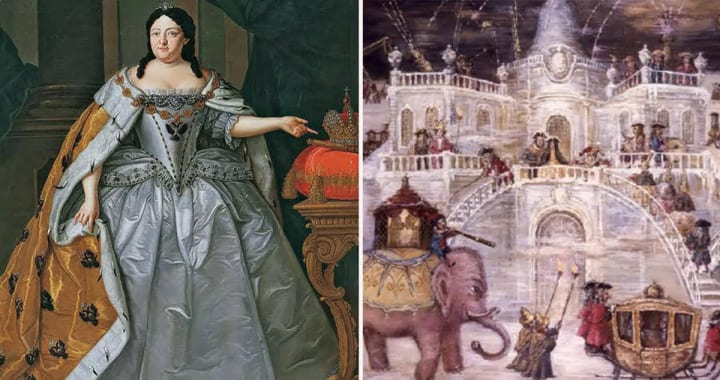
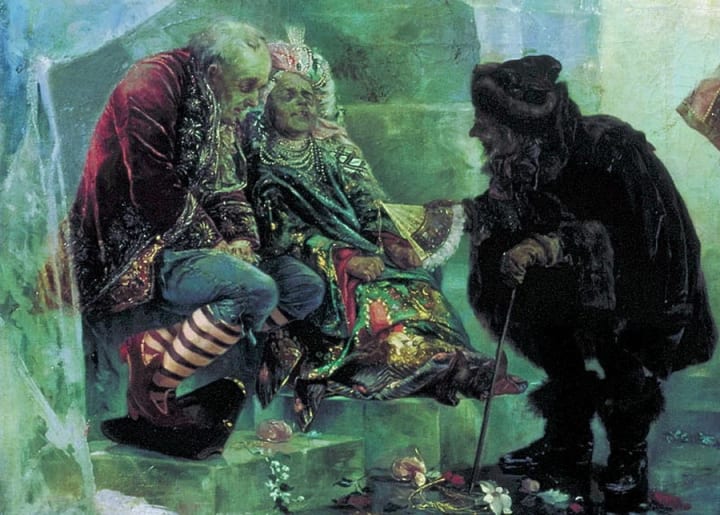
Anna Ivanovna set out to punish Golitsyn, even after his wife died. She made the prince her imperial court jester. Anna went even further in 1739 by marrying Golitsyn to an old lady in her service, Avdotya Ivanovna. It has been said that Avdotya was so ugly that "even the priests feared her."
The subsequent events, however, would cement Anna Ivanovna's legacy as an especially cold ruler. She commanded the building of an ice palace.
The ice "palace" measured 80 feet in length, 20 feet in width, and 30 feet in height. It had an intricate staircase, a bedroom with an ice bed, complete with ice cushions, an ice bathroom, and an elephant statue. Anna Ivanovna had more sinister purposes for such a work, despite its seeming beauty.
The newlyweds were obliged to parade in front of the palace disguised as clowns in a cage atop an elephant. Then, they were compelled to spend the night naked in the ice bedroom during a cold Russian winter.
Anna Ivanovna reassured them that they would likely survive if they had sex all night long. As guards blocked the exits, she abandoned them to their deaths.
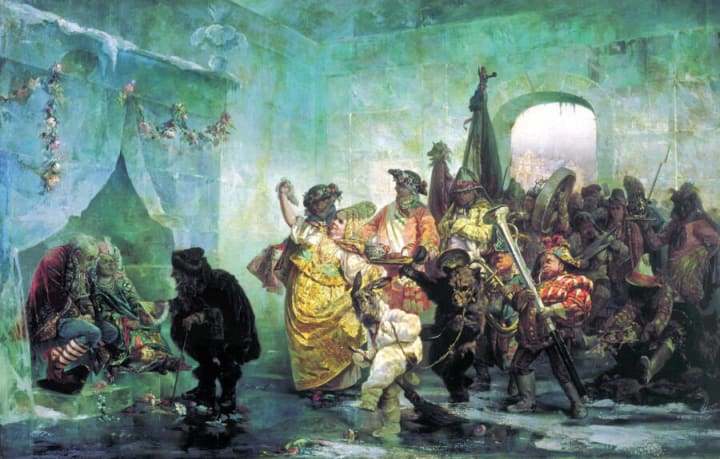
Golitsyn and Avdotya Ivanovna both miraculously survived the night. Avdotya Ivanovna was able to bribe one of the guards in exchange for her pearl necklace for his coat. However, it was insufficient, and she died of pneumonia a few days later.
Taking A Partner And Dying A Slow And Tortured Death
Empress Anna's reign is connected with a "dark age" in Russian history, in part because she deployed such vengeful measures against her court members, such as the ice palace, and in part because she took a violent and powerful lover.
Ernst Johann von Biron was a duke of Latvia who became grand chamberlain of Russia in 1730, when Ivan the Terrible ascended the throne.
Anna granted him immense control, and he was apparently as cruel as she. Until her death in 1740, when he was deprived of his power and put to death by quartering by the new regime, Biron was rumored to have ordered over a thousand killings and exiled between 20,000 and 40,000 dissidents to the Siberian wastelands.
Anna Ivanovna died soon after the show of the ice palace. During her rule, Ivanna the Terrible allegedly ridiculed those with disabilities, imposed punishing taxes on the lower class, and managed a war with Turkey that resulted in the deaths of thousands.
Ivanovna, together with Biron, had instituted brutal punishments for dissidents, such as cutting their nostrils and flogging them with a hefty metal whip. One minister compared her court to "a storm-threatened ship captained by a drunken captain and a slumbering crew... with no significant future."
Perhaps poetically, the Empress suffered a slow and agonizing kidney disease-related death. She had no heirs and failed in her attempt to establish her grandnephew Ivan VII in power before her death.
Instead, Elizabeth Petrovna, one of Anna's former power rivals, rushed into power. Elizabeth was viewed as popular and beloved, whilst Anna was viewed as nasty.
Anna Ivanovna ultimately left a legacy of creative brutality.
About the Creator
Rare Stories
Our goal is to give you stories that will have you hooked.
This is an extension of the Quora space: Rare Stories
X(formerly Twitter): Scarce Stories
Writers:
....xoxo
Keep reading
More stories from Rare Stories and writers in Families and other communities.
Wise~Guys
— Look Behind what's in Front of You ~ Make Good Choices — Hey, So how you Doin'..! Made~Men — Mobster Movies romanticise a distinctive, elegant appearance, impeccable attire style, along with the 'Families' expressive lingo. Making their 'Bones' gave them Panache — with vintage fedoras, tailored pin-striped suits, mirror-polished wing-tip shoes adorned with tassels; with their 'Gun Moll' gorgeous dates on their arms.
By Jay Kantor18 days ago in Families
Kids Beds Suitable for Smaller Bedrooms: Smart Comfort Without Crowding
Not every child has a large bedroom. In many homes, space is shared or limited, which means every piece of furniture needs to be chosen carefully. A bed that is too big or bulky can make a small room feel cramped and uncomfortable.
By Shazad Khan2 days ago in Families




Comments
There are no comments for this story
Be the first to respond and start the conversation.