
The Weight of Unsaid Words
He wrote it a hundred times, and a hundred times, it stayed folded in the drawer.
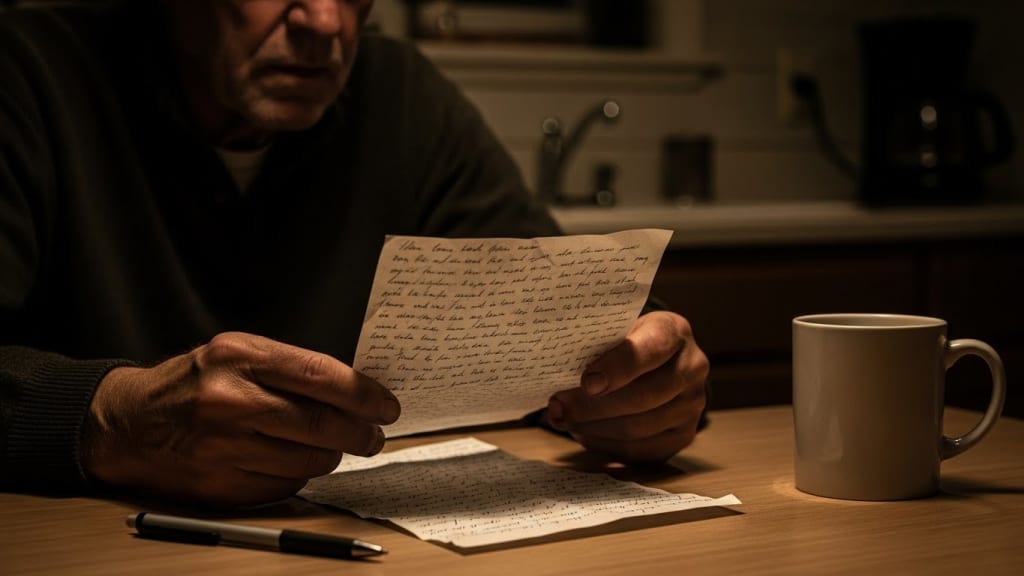
The kitchen light hummed, a flat, sickly yellow against the late-night dark. Michael sat there, like he did most nights, hunched over the Formica table. A cheap ballpoint pen, half-chewed, lay beside a fresh sheet of lined paper. He'd bought a whole ream of it, years ago, thinking he'd write more often. Mostly, it just sat in the cupboard, waiting for these quiet, desperate hours. The house was too big now, too empty. The silence pressed in, a physical thing against his eardrums, broken only by the refrigerator's distant thrum.
He picked up the pen. His fingers, thickened with age and old work, felt clumsy around it. The first line was always the hardest. "Dear Clara," he'd scrawl, then immediately cross it out. Too formal. Too cold. "Clara," just that, standing alone, felt like an accusation, like he was barking her name across a crowded room. He tried again, a little softer in his head, "My dearest Clara." He hated that too. Sounded like some old movie script. He just wanted to talk, really. But how did you talk after all these years of not talking? He pressed the pen to the paper, a faint blue dot blooming on the page, like a bruise.
A flicker, then, a memory. Clara, maybe five years old, on his shoulders at the county fair. Her small hands tangled in his hair, pulling just a little too hard. "Higher, Daddy!" she'd shriek, her laugh bright as a polished bell. He could still feel the warmth of her thighs against his ears, the giddy lightness in her small body. He’d walked for miles that day, feeling invincible, like he could carry the whole world if she asked him to. That was before. Before everything got complicated, before the sharp edges started to cut.
He cleared his throat, a dry rasp. It had been his fault, mostly. He knew it. The way he'd always been gone, chasing the next contract, the next impossible deadline. The way he'd come home, tired and wired, and expected everything to be neat, quiet, just so. He hadn't seen the tremor in her hands when she showed him her report card, hadn't really listened when she talked about her art, her strange, beautiful, messy art. He'd grunted, patted her head, told her to focus on something practical. Practical. God, the word tasted like ash in his mouth now.
He imagined her reading it. Her eyes, sharp like her mother’s, scanning his clumsy sentences. She’d probably snort. "Practical," she'd think. "He still doesn't get it." He could practically hear the resentment in her voice, the way it used to rise when she was a teenager, accusing him of everything and nothing. "You never cared, Dad! You never even saw me!" The words, never actually said to him, but shouted in the slamming of her bedroom door, in the way she’d avoided his gaze for years before she finally just stopped coming home.
What did he want to say? Sorry. That was it, really. Just sorry. For the missed games, the forgotten birthdays, the way he’d let work swallow him whole. For the silence he’d built between them, brick by careful brick. He started to write it. "Clara, I'm sorry for…" He paused. For what? Everything? It felt too big, too hollow. He couldn’t just write "everything." He needed to be specific, but the specific hurts felt too raw, too much like opening old wounds he wasn't sure he could stitch back up. He tried to explain, to offer some context, but it always sounded like excuses, like he was trying to justify himself.
He crumpled that sheet, tossed it onto the growing pile beside the sugar bowl. Another failure. He grabbed a fresh sheet. This time, he decided, he'd just tell her he missed her. Just that. Simple. Honest. "I miss you," he wrote. Then he stared at it. It felt small. Pathetic. Like a child's plea. It didn't account for the years, the anger, the chasms they'd dug. It didn't explain the ache that settled deep in his bones when the holidays came around and the phone never rang. What good was "I miss you" if he couldn't explain *why* he’d let her go in the first place?
He remembered her leaving for college. Not a big goodbye. He’d helped carry boxes, grunted some platitudes about studying hard. She’d hugged her mother tight, a long, drawn-out embrace. For him, it was a quick, awkward pat on the back, a mumbled "take care." He saw the disappointment in her eyes then, a flash of something wounded, before she turned away. He’d told himself it was just how kids were, that she'd come around. She hadn't. Not really. The distance grew, a slow, cancerous thing, until the phone calls became shorter, the visits non-existent.
He needed to tell her he loved her. Not with words, not with that flimsy, inadequate sentence. But with the decades of memories, the pride he’d felt when she graduated, the silent fear he carried for her safety. He wanted to tell her he thought about her every day. That he wondered what she was doing, if she was happy, if she was safe. He wanted to know if she still painted, if she’d found someone good, if she’d forgiven him, even a little bit. He wanted to know everything. But how did you ask for everything, when you’d given so little?
He finished a draft. It was rambling, full of crossed-out words and hesitant explanations. It mentioned the weather, then quickly swerved into an apology for his absence, then an awkward attempt at expressing pride, then back to the weather. It was a mess. His hands trembled as he reread it. It sounded like him, all right. Stilted, a little afraid, trying too hard and not hard enough. He imagined her face as she read it, the critical squint, the sigh. She'd see through it, see all the cowardice, all the unspoken fear of rejection.
He folded the letter. Not perfectly, a little crooked, just like everything else. He didn’t reach for an envelope. He didn’t get a stamp. Instead, he got up, walked to the antique desk in the living room – a piece his wife had loved – and pulled open the top drawer. Inside, beneath a stack of old bills and forgotten photographs, lay a small pile of similar letters. Different dates, different pleas, all written with the same clumsy hope, all folded, all unsent. He placed this new one on top, a fresh layer in his private archive of regret.
The house was silent again. The refrigerator hummed. Michael stood there, the drawer still open, the faint smell of old paper and dust filling his nose. He closed it slowly, the click a soft finality in the quiet dark. Another night, another letter. Tomorrow, maybe. Or not. He just stood there, listening to the silence, and the faint, persistent tick of the clock, marking the time that kept passing, between him and his daughter.
About the Creator
HAADI
Dark Side Of Our Society



Comments
There are no comments for this story
Be the first to respond and start the conversation.