
The Weight of Glass Petals
In the quiet hum of an old house, a mother's silent grief bloomed in a fragile garden of crystal.
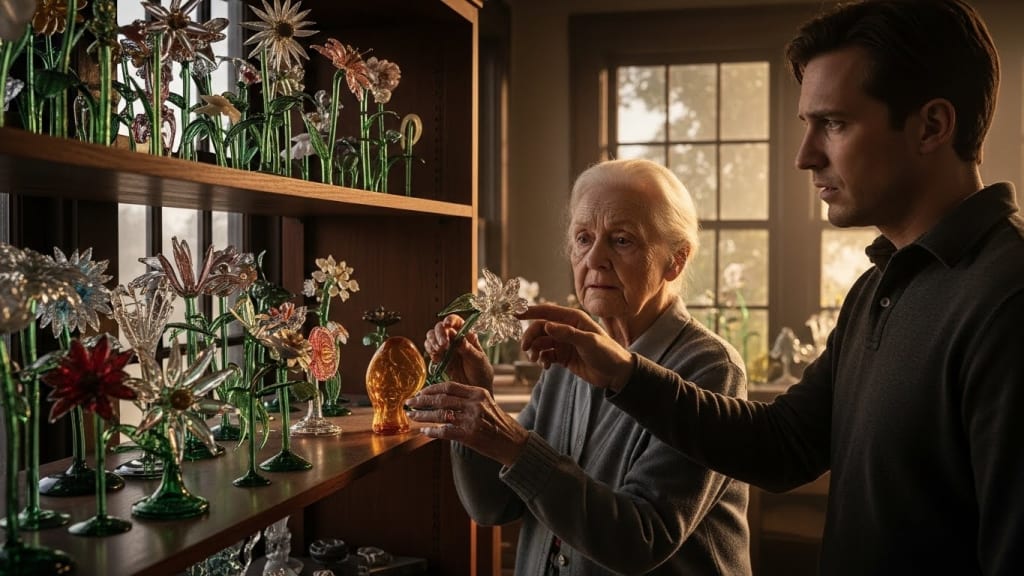
The air in Elara’s sunroom always tasted of dust and something vaguely metallic, like old pennies left too long in a forgotten jar. It wasn’t a sunroom in the cheerful, plant-filled sense, no. This was a sanctuary for her flowers, shelves upon shelves of them, each one painstakingly crafted from glass, catching the weak afternoon light like tiny, frozen moments. A garden of crystal, she called it, though no soil touched these roots, and no bee ever buzzed near their delicate, sharp petals. They were her life, her entire world, balanced precariously on antique mahogany.
Thomas hated coming here. Not his mother, not really, but the house, the quiet, the weight of all those fragile, sparkling things. He stood in the doorway, the back of his neck prickling, hands shoved deep into his pockets. The scent of furniture polish and lavender hit him, a familiar punch to the gut. Elara was already there, a wisp of a woman, her movements slow, deliberate, a soft chamois cloth caressing a glass daffodil. Her back was to him, a familiar, distant posture.
"Ma," he mumbled, his voice too loud in the stillness. She didn't flinch, just paused, her hand hovering over a small, perfect bluebell. Slowly, she turned, her eyes, once bright, now a faded robin's egg, settling on him. A thin, almost imperceptible smile. "Thomas. You're early." She always said that, no matter the time. Always early, always late. Never just, *on time*.
He walked in, careful, as if the floorboards themselves might shatter under his work boots. The flowers shimmered. A deep red rose, its petals curling inward, seemed to pulse. A slender, clear orchid, elegant and cold. And then the ones that twisted, jagged edges catching the light, looking more like broken shards than blossoms. He knew them, these flowers. They’d been accumulating since he was a boy, slowly, steadily, filling every available surface in this room. Each one a memory, he suspected, though he never dared ask what kind.
He remembered his father, a man of booming laughter and calloused hands, trying once, just once, to touch a tiny, intricately blown daisy. Elara had slapped his hand away, a sharp, uncharacteristic snap. His father, startled, had just laughed it off, but Thomas had seen the flicker in his mother's eyes, a desperate fear. A year later, his father was gone, a sudden, brutal car crash. And Elara, she'd retreated further, deeper into her glass garden. The flowers grew, replacing the empty spaces his father had left in the house.
The silence stretched, thick and uncomfortable, broken only by the soft *click* of the chamois against glass. He watched her, this woman who had raised him, who loved him, he supposed, in her own fractured way. But her love always felt like one of these flowers – beautiful, yes, but cold, and if you pressed too hard, it would cut you. He cleared his throat. "Ma, you know, you really ought to get out more. Go to the market, see Mrs. Henderson."
She didn't look at him, her attention already back on a particularly complex fuchsia, its tiny stamens perfect. "I have my work, Thomas. And my memories." Her voice was flat, devoid of emotion, like she was reading from an old book. He wanted to scream. He wanted to shake her, to ask her why she was choosing these fragile, useless things over living, over him. But he never did. He couldn't. Not with her like this, not with the ghosts of a thousand shattered moments watching from the shelves.
"What's this one for?" he found himself asking, pointing to a small, almost formless blob of amber glass, barely recognizable as a flower. It sat nestled between a vibrant blue gladiolus and a pale green snowdrop. It looked like a mistake, a botched attempt. Elara's hand froze. Her breath hitched, just a little, a sound only he could've heard in the oppressive quiet. She finally looked at it, then at him, her eyes clouded.
"That," she whispered, her voice rough now, like gravel, "is for the day your father told me he loved me for the first time. Right after we saw that old amber sunset over the bay. I tried to capture it. But glass… it holds the light, but it can’t hold the warmth, can it?" She finally turned fully to him, her gaze piercing, raw. "And this," she gestured vaguely to a cluster of stark white, skeletal-looking blooms, "this is for every single night after he was gone. The nights I thought I would break apart, just like these. But I didn't. I made them instead. Piece by piece." Her chin trembled.
A dull ache settled in Thomas's chest. All these years, he’d seen them as symbols of her withdrawal, her peculiar, quiet madness. He hadn't seen them as her fight, her desperate, silent struggle to keep from crumbling into dust herself. Each one a shard of her heart, carefully, painfully, reformed. He saw the network of tiny scars on her fingers, too, nicks from the sharp edges of her craft, wounds she never mentioned.
He reached out, his hand hovering over the amber blob, then gently, tentatively, touched the cold, smooth glass. It was surprisingly heavy, substantial. "You never told me, Ma." He didn't know what else to say. The years of silence, the awkward visits, the wall between them – suddenly, it didn't feel so permanent, so unyielding. Just brittle, like everything else in this room.
Elara pulled her hand back from the fuchsia, her gaze fixed on his hand on the amber flower. A small, almost imperceptible tremor ran through her. "No," she murmured. "I suppose I didn't." A beat of silence. Then, with a sudden, jerky movement, she reached for a different flower, a delicate, almost invisible one, perched precariously on a high shelf. Her fingers, usually so precise, fumbled. The flower slipped. It hit the edge of the mahogany shelf with a faint, crystalline *ping*.
A single, minute petal, no bigger than his thumbnail, broke off, falling silently to the polished floor. It lay there, a tiny, perfect fragment, catching the last of the light, before the sun dipped below the horizon, plunging the sunroom into a sudden, deep gloom. Neither of them moved. They just stood there, watching the chipped flower, watching the fallen petal, both equally still, equally broken.
About the Creator
HAADI
Dark Side Of Our Society
The Loneliest People Are the Most Liked
I have 3,842 followers. And no one to call when my chest feels heavy at 11:47 p.m. It sounds dramatic when I say it out loud, which is probably why I don’t say it. Instead, I post. A photo. A joke. A thoughtful caption about growth. A filtered version of a life that looks full. People respond the way they always do — hearts, laughing emojis, “You’re glowing lately,” “Proud of you,” “You’re such a positive soul.” Positive. That word follows me everywhere. I learned early that people like warmth. They like the friend who listens more than they speak. The one who remembers birthdays. The one who shows up smiling, even when they arrived tired. So I became that person. Not because I was fake — but because it worked. Being liked feels a lot like being safe. When you’re liked, people clap for you. They invite you places. They tag you in things. They assume you’re doing well. And assumptions are comfortable. No one looks too closely at someone who seems fine. I seem fine. The loneliest people aren’t the quiet ones in the corner. Sometimes they’re the loudest laugh in the room. The ones who know how to carry a conversation. The ones who can make strangers feel seen. I know how to make people feel seen. I just don’t know how to let them see me. There’s a difference. When you’re the “strong” friend, the “funny” friend, the “put-together” one, you slowly become a role instead of a person. And roles don’t get comforted. They perform. At gatherings, I float between groups like I belong everywhere. I ask questions. I remember details. I make connections. I leave with new followers, new contacts, new proof that I’m socially successful. And then I go home and sit on the edge of my bed in complete silence. No notifications feel the same as conversation. No heart emoji replaces eye contact. No comment section replaces someone noticing that your voice sounded off. Sometimes I scroll through my own profile to understand why I feel so empty. The grid is curated. Balanced. Happy. There’s evidence of friendships, coffee dates, achievements, small adventures. If someone studied my page, they’d think I’m surrounded. Maybe that’s why I don’t reach out when I need help. Who would believe the person who always looks okay? There’s a strange pressure in being well-liked. You don’t want to disappoint the image people hold of you. You don’t want to be “too much.” You don’t want to shift from inspiring to overwhelming. So you swallow the heaviness. You reply, “I’m good!” automatically. You become efficient at redirecting conversations away from yourself. You tell yourself loneliness is dramatic. After all, you’re constantly interacting. Constantly visible. But visibility isn’t intimacy. And being known is not the same as being recognized. I remember one night in particular. I had just posted something vulnerable — but not too vulnerable. Carefully measured honesty. The kind that hints at depth but doesn’t expose the wound. It went viral. Messages poured in. “Thank you for saying this.” “You always articulate things so well.” “You’re so brave.” I stared at the screen and felt nothing. Because bravery would have been telling someone specific, “I’m not okay.” Bravery would have been admitting that I feel invisible even when I’m admired. But admiration is addictive. It fills the surface. It doesn’t reach the center. The loneliest people are often the most liked because they learned how to survive by being agreeable. Being helpful. Being impressive. They built connection skills before they built vulnerability skills. I know how to network. I don’t know how to need. There’s a fear underneath it — what if people like the version of me that doesn’t ask for anything? What if the moment I reveal the mess, the overthinking, the quiet sadness, the confusion… the likes fade? So I maintain. I keep conversations light. I keep problems private. I keep performing stability. And the world rewards me for it. But sometimes, late at night, I wonder what it would feel like to be deeply understood instead of widely appreciated. To have one person notice the pause before I say “I’m fine.” To have someone call without a reason. To sit in silence with another human and not feel the need to entertain. Loneliness isn’t always about physical isolation. It’s about emotional distance. It’s about realizing that many people enjoy you, but very few truly know you. And maybe that’s partly my fault. Being liked gave me control. If I’m useful, funny, inspiring — people stay. If I’m messy, confused, uncertain — that feels risky. But slowly, I’m learning something uncomfortable. Connection requires risk. The kind where you let someone see the unedited version. The kind where you say, “I don’t have it together.” The kind where you admit you don’t want advice — just presence. The first time I told a friend, “I’ve been feeling really alone,” my voice shook. It felt dramatic. Unnecessary. Embarrassing. She didn’t laugh. She didn’t minimize it. She said, “Why didn’t you tell me sooner?” I didn’t have an answer. Maybe because I was too busy being liked. Maybe because I confused applause with affection. Maybe because I thought needing someone would make me less admirable. But something shifted that night. A small crack in the performance. A small step away from being universally appreciated and slightly more personally known. I still have 3,842 followers. But now I also have one person who knows that sometimes, I sit on the edge of my bed and feel the weight of everything. And somehow, that one connection feels louder than all the notifications combined. The loneliest people are often the most liked. Not because they are fake. But because they learned how to shine in public and hide in private. I’m tired of hiding. I don’t want to be everyone’s favorite. I just want to be someone’s real.
By Faizan Malik5 days ago in Families
How Florida Courts Determine a “Substantial Change in Circumstances”
In Florida family law, many court orders are not permanent. Orders related to child support, alimony, time-sharing, and parental responsibility may be modified when circumstances change significantly. However, not every change qualifies. Florida courts apply a specific legal standard known as a substantial change in circumstances before approving most post-judgment modifications. Understanding how courts evaluate this standard can help individuals set realistic expectations when considering whether to pursue a modification.
By Grant Gisondo4 days ago in Families


Comments
There are no comments for this story
Be the first to respond and start the conversation.