
The Unclaimed Dead:
When the State Becomes the Next of Kin.


There is an uncomfortable reality rarely discussed in polite reform conversations: when a person dies unclaimed, their body does not remain neutral—it becomes property of the state. In the absence of family, directives, or advocates, governments and contracted institutions are legally empowered to decide what happens next. Remains may be used for medical training, research, or other sanctioned purposes, often without ceremony, public record, or ethical grounds.
A Humane Reset: Reimagining Body Donation for a Transparent, Sacred Future
Strategy meets stewardship. Science meets soul. Dignity, end to end.
The current body donation system—while indispensable to medicine—operates with blind spots: opacity, quiet commodification, and cultural disconnection. It works, but it doesn’t honor. That gap is where reform belongs.
Here’s a forward-leaning framework that restores trust, safeguards dignity, and closes the loop between human contribution and planetary care.
The Core Vision
A body donation model grounded in public recognition, zero financial incentive, strict temporal limits, and eco-spiritual return of remains. Simple rules. Strong ethics. Long-term legitimacy.
This is not disruption for disruption’s sake—it’s governance with a conscience.
Why This Works?
1. Public Recognition Builds Trust- Donation should not vanish behind institutional curtains. Public acknowledgment reframes the act as a gift to humanity, not a transaction.
- Honors donors beyond academic walls
- Normalizes transparency
- Strengthens social trust in medical science
Recognition isn’t performative—it’s accountability with gratitude.
2. Zero Currency, Clear Boundaries- Money distorts intention. Removing financial incentives eliminates the slippery slope toward commodification. Pair that with strict usage caps—for example, 5–10 years—and you get:
Built-in dignity
- No indefinite storage
- No “freakish overreach”
- A clean beginning and a clean end
Finite use enforces ethical discipline. Period.
The Eco-Spiritual Return: Closing the Circle
Science doesn’t have to sever us from the sacred.
Returning ashes to forests—or ecologically protected regions like the Amazon—reconnects the donor back to the earth, merging:
- Environmental restoration
- Indigenous wisdom
- Psychological and spiritual closure
This isn’t symbolic fluff. It’s regenerative design. Death that gives twice.
Power to the Individual
Embedding these choices into advance directives removes ambiguity—the breeding ground of abuse.
- Clear consent
- Predefined limits
- Nature-based defaults
Autonomy, locked in early. No gray areas. No guessing.
The Path Forward
Policy evolves when ethics mature. Advocating for this framework could influence future updates to the Uniform Anatomical Gift Act, prioritizing:
- Voluntary participation
- Non-commercial structures
- Time-bound use
- Ecological return as the default, not the exception
This isn’t radical. It’s overdue.
Advance directives are not merely expressions of personal preference; they are acts of self-defense in a system that defaults to silence. They function as legal armor against becoming unclaimed, unprotected, and unseen—against having one’s body absorbed into bureaucratic processes where consent is inferred rather than granted. In the absence of explicit directives, the state effectively assumes the role of next of kin, empowered to determine use, duration, and disposition of remains with minimal public accountability. By documenting intent in advance, individuals reclaim agency at the most vulnerable threshold, ensuring their bodies are treated not as surplus resources but as human gifts governed by clear limits, ethical purpose, and dignified return. In this sense, advance directives are less about death planning and more about boundary setting—drawing a firm line between voluntary contribution and institutional entitlement.
Final Thought
We ask donors to give their bodies to science. The least we can do is return the favor—with honor, restraint, and reverence.
A system that educates the living, respects the dead, and heals the planet ?That’s not idealism. That’s good governance—finally aligned with humanity.
Let’s the sun shine light into the shadows. This work deserves daylight bureaucracy—creates a moral vacuum where consent is assumed by default, not explicitly given. Any meaningful reform of body donation must confront this truth head-on, not as an accusation, but as a structural flaw demanding transparent, humane guardrails.
About the Creator
Aja Truth
What feels like mass deception is the collision between buried history and real-time exposure.(INFJ Pattern Recognition with Data Driven Facts)
How Much Does Memory Care Cost in the U.S.? Average Monthly Prices Explained
With the onset of memory loss in a loved one as a result of some conditions such as dementia or Alzheimer disease, families tend to start to seek specialized care services. The first question that one would want to have answered when undergoing this process is very basic, yet significant, and that is how much is the cost of memory care?
By Patrica Overton3 days ago in Families
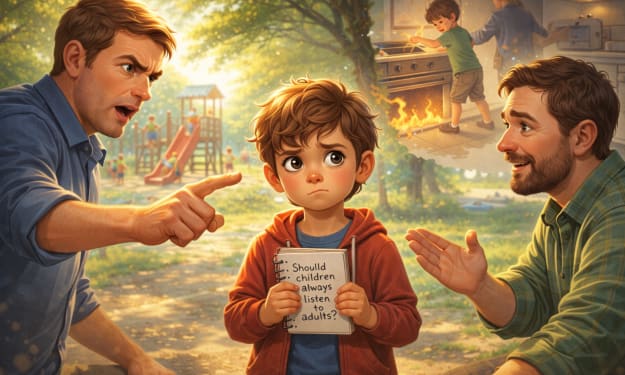
Should Children ALWAYS listen to Adults?
Many people believe children should always listen to adults because adults have more experience and knowledge about life. Adults have faced many situations and learned from their mistakes over time. Because of this, they often try to guide children and help them avoid problems. However, others argue that adults are not always right and that children should also learn to think for themselves. Children are individuals with their own thoughts and ideas, and sometimes they may see things differently from adults. This text will explore both sides of the argument to understand whether children should always listen to adults.
By *+*+*~Teja~*+*+*a day ago in Families



Comments
There are no comments for this story
Be the first to respond and start the conversation.