
The Spirit of Eid ul-Adha
The Day of Sharing and Smiles

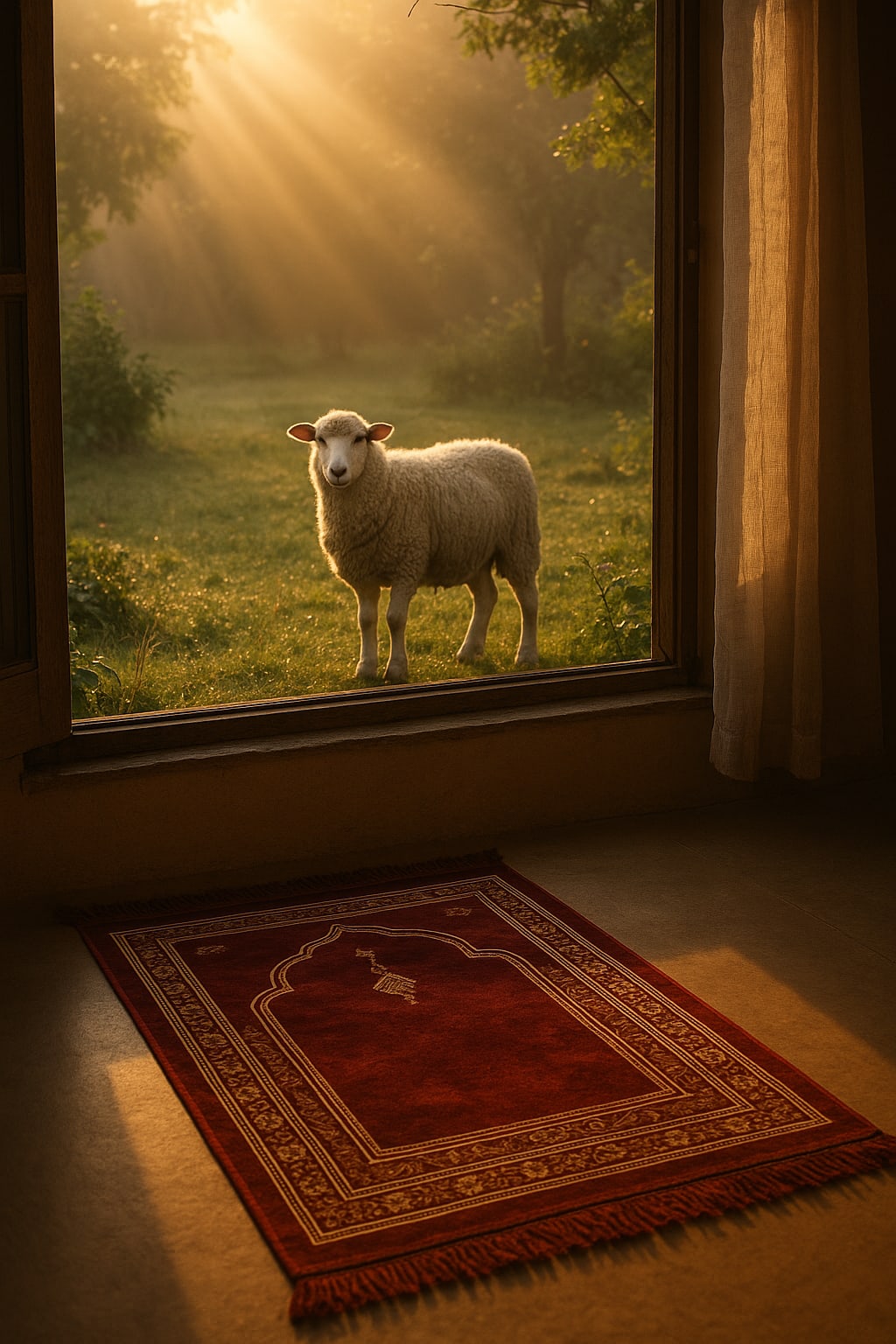
The first light of dawn filtered gently through the curtains, casting a soft glow across the living room floor. In the quiet of the morning, Amina sat near the window, wrapped in her late father’s old shawl. It still carried a faint trace of his scent—oud and rose water. She held a cup of tea close, but her hands trembled slightly, not from the heat—but from the weight of memory.
This Eid ul-Adha would be her first without him.
Outside, the sounds of early Eid preparations drifted through the air—children laughing, elders greeting one another, the distant call of the takbir echoing through the neighborhood. Joy pulsed all around her, but inside Amina, there was only silence and sorrow.
She remembered how Baba would always wake her early on Eid mornings, his voice filled with excitement, like a child’s.
“Amina, wake up! It’s Eid! Let’s feed the animals together!”
He loved Eid ul-Adha—not just for the feast, or the gathering, but for what it stood for. He’d always remind her, as they walked to the prayer ground or prepared the meat for distribution, that the heart of Eid ul-Adha was sacrifice.
“Not just animals, habibti,” he once said, kneeling beside her as she stroked the soft wool of the sheep, “but our pride, our anger, our selfishness. Real sacrifice is giving up something you love—for the sake of something greater.”
She hadn’t understood it then—not really. But she nodded, like she always did, trusting that one day it would make sense.
This year, the sheep stood in the backyard, bleating softly. Her younger brother Yusuf was preparing it, shoulders stiff and hands clumsy. He had taken on Baba’s role, but the shoes were too large, the silence too loud. Their mother busied herself in the kitchen, her grief woven into every movement, every dish. No one spoke of the empty chair at the breakfast table. They didn’t need to.
After the Eid prayer, Amina stood by the garden, watching Yusuf approach the sheep with a hesitant step. She wanted to help, but something held her back—a knot in her chest she hadn’t dared to untangle.
Yusuf paused, knife in hand, and turned to her.
“Do you want to say the prayer, like Baba used to?”
Amina’s throat tightened. She hadn’t spoken a word all morning. But she stepped forward, her voice soft but steady as she recited the Bismillah and whispered the takbir.
Tears welled in her eyes as the act was completed. She turned away, her heart aching not just for her father, but for the purity of the moment—for the reminder of what he had always tried to teach her.
Later that day, as they prepared the meat to distribute to neighbors and those in need, Amina found herself sharing stories of Baba. Each tale brought both laughter and tears, and slowly, the atmosphere in the house shifted. It was as if his spirit filled the rooms—not in ghostly silence, but in the love he left behind.
That evening, they delivered meat to a refugee family that had recently moved into the area. Amina had seen the mother before—often standing alone at the market, her face weary, her child clinging to her skirt.
When Amina handed her the neatly wrapped portion, the woman looked stunned. “For us?”
Amina smiled. “For Eid. For all of us.”
The woman’s eyes filled. “You are like my daughter. We used to do the same, back home.”
They embraced for a long moment, two strangers connected by shared humanity and loss.
As they walked home, the air carried the smells of grilled meat and warm bread, the sounds of laughter spilling into the streets. And for the first time that day, Amina smiled—not out of politeness, but from a place deep within. A place where sorrow and love met, where her father’s teachings lived on.
Eid ul-Adha was not just about the sheep or the feast. It was about surrender. About finding the strength to let go—and the courage to give.
That night, Amina wrote a letter to her father, placing it inside the pages of his old Qur’an.
"Baba, today I understood. Your Eid was never just a celebration. It was a lesson. A prayer. A promise. I will carry it forward—for you, for us, for Him."
And in that moment, surrounded by flickering lanterns and quiet prayers, Amina felt it.
The spirit of Eid.
Alive.
Whole.
Unbroken.
About the Creator
Manatwal Khan
Philosopher, Historian and
Storyteller
Humanitarian
Philanthropist
Social Activist
Keep reading
More stories from Manatwal Khan and writers in Families and other communities.
From Mother… With Love
Minta Jackson was a young girl of sixteen, whose life was tethered to the soft embrace of her mother, Marry Jackson, and the steady, comforting presence of her father, John Jackson. They lived in a small, cozy house by the sea, where the waves would gently crash against the shore, as if singing lullabies to Minta when she was younger. Life had always seemed perfect, simple, and safe.
By Manatwal Khan11 months ago in Families
In the End, Family Is Everything
"Family is not always about blood. It is about the people who choose to stand beside you when life becomes difficult." In a world that moves too fast, where everyone is chasing something — success, money, recognition — there is one place where we can still return without needing to prove anything.
By Zakir Ullah5 days ago in Families
Hottest in the Office
Dear Rafi, You’re very distracting to work around. For the first second I saw you the other day, I thought you were some type of executive. It took a moment to realize no, you were just the new guy, dressed up for the job he wants. Be still, my heart.
By Gabriel Shames5 days ago in Pride



Comments
There are no comments for this story
Be the first to respond and start the conversation.