
The Search to Understand The Human Will To Live
An Exploration of Unknown Grief

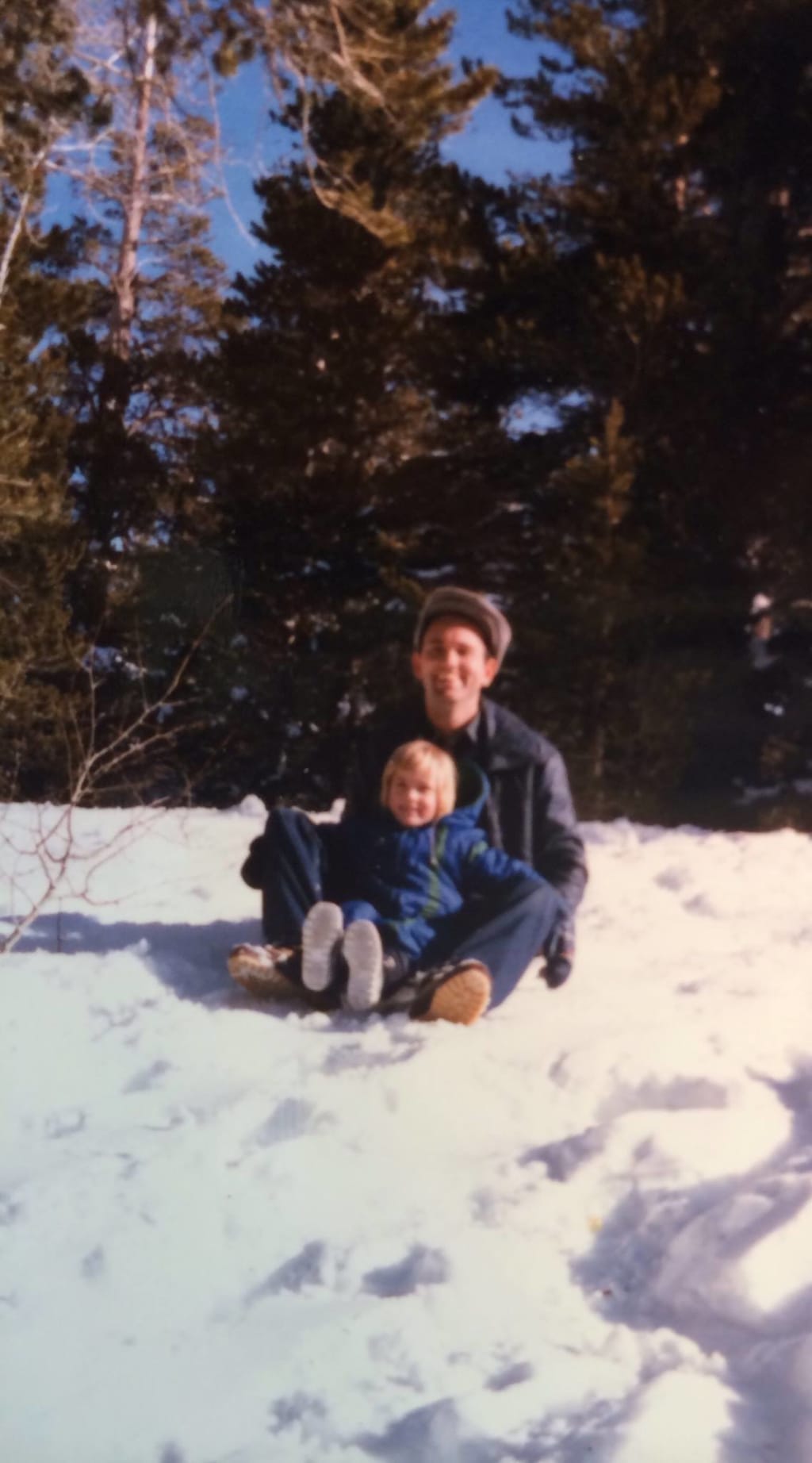
My fascination to understand the human will to live is at the forefront of my searches. To me it is the ultimate quest to understand existence itself, and my own self workings. Although many philosophers have debated what the human will or what the will of power is, many come to the conclusion that it is internal and cannot be measured.
In my more recent years, I have reflected on my life experiences; some good, some bad, some absolutely terrifyingly awful. But it wasn't until my father's passing of inoperable squasmous cell carcinoma lung cancer six years ago, that I felt the sting of my own delicate mortality. And needless to say; the years, the weeks, the days, hours, the minutes, of darkest grief. As a young teen, I flirted with my own mortality before in that "go away Dad, I'm listening to The Cure," kind of way; I even got diagnosed in college with broken heart syndrome also called takotsubo cardiomyopathy after a breakup with my first boyfriend in college. (Tako tsubo, are octopus traps that resemble the pot-like shape of the stricken heart.) But nothing could prepare me for the loss of my father-- so deep, so dulling, and so painful I still don't think I have fully recovered. Also, that same year, I should add, that I lost three other family members, one of whom I was was told about while I was indisposed. When I was told the news all i could do was laugh until I cried. My coping skills were pretty shot by then. During this time, I halfheartedly asked a friend to kill me, and I would pay him, but I was never taken seriously. Instead, he took my picture ... Truth is, I didn't think I was going to survive that year. I just kept waking up when the days felt empty and hopeless. I didn't know what I was doing with my life, and it all felt too much for a lost and grief stricken thirty-two something year old unmotivated asthmatic artist. Looking back, I tend to call this my "Year Of Magical Thinking," borrowed after Joan Didion's memoir where she examines her own life after the passing of her daughter and husband.
As a kind of coping mechanism after the death of my father, I started my journey in gaining information on the "human will" from books and articles on philosophy, psychology, and anatomy-- to further understand my own will to live, especially in the face of hardships.
If you go online and look up the will to live on Google search engine, it would read: 'The desire to live is fundamental to (almost) all humans because humans are a product of millions of years of evolution by natural selection, written in our DNA. But how the first organism on earth got the desire to live is a mystery.' ... (Growing up, it was part of my father's mission to cultivate my sense of direction and assertiveness in order to offset my potential depression from my mother's side of the family whom my father regarded as geniuses at times.) In 1990, The Human Genome Project was launched to decipher the chemical sequence of the complete human genetic material and provide research tools to analyze all genetic information to possibly unlock all the mysteries of human existence. Although The Human Genome Project was a huge success, unlocking hidden aliments and underlining diseases never noticed before, when it came to predicting will or behavior, gene theory failed. Today, the faith in the explanatory power of genes, deciphering individual character , has waned, and few scientists believe that there is a simple “gene for” anything...Mostly, we are merely formed by forces ultimately beyond our control. Maybe to understand the desire to live, we must start with the philosophers and their perception of the human experience.
First, we must first start at the beginning with 19th Century Philosopher, Arthur Schopenhauer, one of the first thinkers in Western Philosophy whom devoted his life's work toward philosophy, science and literature. In Book Two of The World as Will and Representation, Schopenhauer considers that the world as we know it is beyond the aspect of what appears to us; that the world is a mere representation. He believed that as humans, we are led with insatiable impulses, without knowledge, and that these incurable impulses are what drives us striving into existence in which nature itself cannot exist without. That, at the very being in itself of all things, is The Will- the inner essence of everything. It is this unconscious universal striving, a force, that drives our instinctive behaviors. And because the human condition, is to suffer, it is our will that creates it so, creating conflict and constant war against itself and others, in order to remain real. (I'm not sure how my will was able to operate me during this time, but one of my favorite things to do was watch an old documentary film my landlord gave me on Japanese filmmaker Akira Kurosawa. I would listen to the part on repeat where Akira's older brother, Heigo, takes young Akira to witness the aftermath of a nearby earthquake destruction, later called the 1923 Great Kantō earthquake. When Akira wanted to look away from the human corpses and animal carcasses which were scattered everywhere, Heigo told Akira he could not, that he must to face his fears by confronting them directly. Heigo went on to become a silent film narrator for Japanese cinema, but committed suicide years later. It's often thought that Akira's work accredits his bother's spirit by instilling in him the ability to confront unpleasant truths head on... I always liked that part) Schopenhauer also believed that we could transcend our insufferable will by becoming "will-less" through aesthetic contemplation. In short, Schopenhauer believed that aesthetic contemplation, a kind of deep thought meditation, helped alleviate the will so that "we forget our individuality, and continue to exist only as pure subject, as clear mirror of the object, so thus we are no longer able to separate the perceiver from the perception, but the two have become one." One way to meditate is to view art in order to cease to be an individual, by merging with the expressed idea through time, space and rational concept. Schopenhauer called true artists high priests and priestesses in their ability to be free from their slavery to the will. These aesthetic experiences with art such as painting, literature, and music, may transcend the human condition and offer the feeling of the sublime, or inner unity.
(Now, I must add that when my father was alive, we had intense disagreements on the matter of me being an artist. I was an actress foremost. Painter, writer- second. "I didn't raise an artist," he would say in flurry of passion when I talked about a new audition from time to time. And it wasn't until after graduate school that I felt I could prove to my father, that I was indeed a legitimate one. But the pain of being misunderstood most of my life and the struggle to find work, never escaped my thoughts when I was around him, despite my minor successes. There were days I wished that he and I could permanently separate and I could become the artist I desired to be, with all feet in the deep end. To this day, sometimes I feel like I willed his passing into existence.)
Heavily influenced by Schopenhauer's original idea of will to live, Friedrich Nietzsche coined his own idea of the irrational force found in all individuals, and called it "will to power.” Nietzsche's belief that the will to power is nor good or bad, as Schopenhauer attests to; but an arrangement or union of related wills, a negotiable equilibrium in a system of forces relating to one another. "My idea," Nietzche writes, "is that every specific body strives to become master over all space and to extend its force (--its will to power:) and to thrust back all that resists its extension. But it continually encounters similar efforts on the part of other bodies and ends by coming to an arrangement ("union") with those of them that are sufficiently related to it: thus they then conspire together for power. And the process goes on--" ... (In this example, I can't help but dote on my father and I's similar energy and likeness in character, but complete opposite points of view when it came to how to live an authentic life.)... One particular form of the will to power that Nietzsche devotes much attention to in his later work is what he calls “self-overcoming.” Here the will to power is harnessed and directed toward self-mastery and self-transformation, guided by the principle that “your real self lies not deep within you but high above you.” In Nietzche's last unpublished notes he writes, the will to power is “a monster of energy, without beginning, without end..."
It wasn't until shortly after my father's passing, and the passing of my other family members, that I decided to harness my abilities as a storyteller in order to process my trauma. I knew at the time, my brain needed exercising. Certain events and information were becoming harder for me to process. For some, trauma can cause memory processing malfunction, causing memories to be stored improperly called dissociation. And if the body was flooded with constant stress and trauma, a stress response may become a normal state. Structural and functional abnormalities can start to occur in the amygdala, hippocampus, and dorsomedial thalamus when experiencing depression. And, worse case scenario, an increase in cortisol with a decrease of hippocampus size could lead to loosing the will to live, which, lets face it, was at an all-time low. (It's a funny thing: When my father was sick with cancer, I was asked by an elderly Chinese woman what kind of cancer my father had. I told her, "lung cancer." And her reply was, "Oh, well, the lungs are the place where part of the soul resides and it carries the weight of our great emotions." ...For some reason, that stuck with me.)... Deep down inside, I knew I had to start creating a resilience and recovery, but most importantly a willingness to accept and adapt to the circumstances. In reading about trauma, I discovered that trauma represents an existential crisis, casing us to look at our own mortality.
In 1974, Pulitzer Prize winning psychiatrist Ernest Becker said ,"Survivors of traumatic events are brought nose-to nose with reality, and they must find a way to assure themselves that their lives count for something." And Austrian psychiatrist Viktor Frankel, during his internment in Auschwitz and Dachau concentration camps during World War Two, helped his fellow prisoners by getting them to focus on their lives they may lead after the war. He noted that prisoners who lost faith in the future, lost their "spiritual hold." In his book 'Man Searching for Meaning,' Viktor Frankel describes his observations of what it meant to witness the loss the will to live. He writes that in the concentration camps, cigarettes were traded amongst each other as a form of currency. Mostly they were used in exchange for an extra bowl of soup, which could make the difference of living another day. Frankel writes, 'when men would loose their meaning, their will to live, they could be witnessed, sitting in solitary silence, smoking their own cigarettes.' Just sitting, smoking. Therefore, one's meaning in life may hold the secret to personal survival.
When watching my father pass of cancer, it was excruciatingly painful for everyone involved. To bear witness to it was like watching my insides being torn out, and the light softly going out. I knew that there were many things he wanted to do, like, I knew he always wanted to be like an engineer like his father and make him happy instead of an accountant. And I knew he really wanted to spend his last years in retirement, traveling the world with my mother. But, it didn't work out that way. To the very bitter end, my father held on to the idea that he could get better, or at least, he expressed that in his morphine state when they wheeled him home to pass away that day. "These doctors, don't know anything," he muttered. He held onto a sort of future, a sort of diluted fantasy of hope, or at least in that moment he did. He wasn't ready. And fair enough, I wasn't ready either.
Looking up hope online in terms of will to live I stumbled upon an interesting article about false hope or overinflated hope, the kind that some optimistic Vietnam prisoners of war had when they remained focused on outcomes. Instead of focusing on the reality of what was happening, they forged through fantasies of unrealistic expectations, making the stages of grief: denial; anger; bargaining; depression; and acceptance more difficult. I now know this applied to my father and myself as he drew his last breaths. If he couldn't accept it, how could I? If he was going down fighting, so would I. I had to go to war to find my will to live, my meaning, my understanding, my transcendence.
Looking back on the crucial years that followed, I emerged myself in my art in deep search for hope and meaning. (Apparently hopeful people have a higher productivity rate.) I kept a diary. I wrote short films. I directed them. I made new friends. I got a cat I named Kubrick. I directed other people's projects. I took walks. I made new choices. I went swimming in the deep end. I told people, "'I'm an artist. I have many stories to tell. Let's meet up and grab some coffee sometime."
I am thankful in many ways of what I have learned about myself in my search to understand my will to live; to keep pursuing my dreams in what I may become. Sometimes, when I drive home at night from work from a bad day, I'll remind myself of "My Year of Magical Thinking" and remind myself that my father and all the other people whom have departed from this universe, would be proud of the person I have become, and am becoming.
When I asked my friends, and family how they identify the will to live they said, "The ability to see another day with hope and determination." And... "My family, and my God that gives me strength." And... "My desire to make things right." And... "My acceptance of it all; that life is beautiful and meaningful just the way it is." And... "For a future: My unborn children."
At the end of it all, it makes me think of a great quote by Albert Camus, another profound philosopher of his time- "There is no love of life without despair of life..." And I think he might be right. Despair just might be the key to to it all: to self discovery, to unlocking your will, to identifying your meaning towards a unique, authentic, life affirming existence that separates us individually, but unites us all.
And this is where I'll leave off, for now.
About the Creator
Kristen Hansen
Los Angeles native. Filmmaker. Writer. Storyteller. Actor. Director. Lover of truth and all things Universal.
Keep reading
More stories from Kristen Hansen and writers in Families and other communities.
'America'
Tickets for the train were hard to come by, considering the new railcar was a breakthrough in science. As the world was on the brink of war again, and the prices of goods and resources skyrocketed out of control, the train represented a new beacon of hope for humanity.
By Kristen Hansen3 years ago in Fiction
Wise~Guys
— Look Behind what's in Front of You ~ Make Good Choices — Hey, So how you Doin'..! Made~Men — Mobster Movies romanticise a distinctive, elegant appearance, impeccable attire style, along with the 'Families' expressive lingo. Making their 'Bones' gave them Panache — with vintage fedoras, tailored pin-striped suits, mirror-polished wing-tip shoes adorned with tassels; with their 'Gun Moll' gorgeous dates on their arms.
By Jay Kantor19 days ago in Families
Bettijo Hirschi
Introduction Bettijo Hirschi is a multi‑talented creative professional from the United States. She works as a designer, art director, photographer, writer, and event planner. Bettijo has built a long career in creative work and media. People know her for her artistic skills, her work in magazines and television, and her lifestyle blog. She is also known in recent news because of changes in her personal life.
By Farhan Sayed4 days ago in Families



Comments
There are no comments for this story
Be the first to respond and start the conversation.