
The Radiant Power of Goddess Chandraghanta: A Journey of Courage and Spirituality
Unlocking Inner Strength: The Significance and Worship of Goddess Chandraghanta

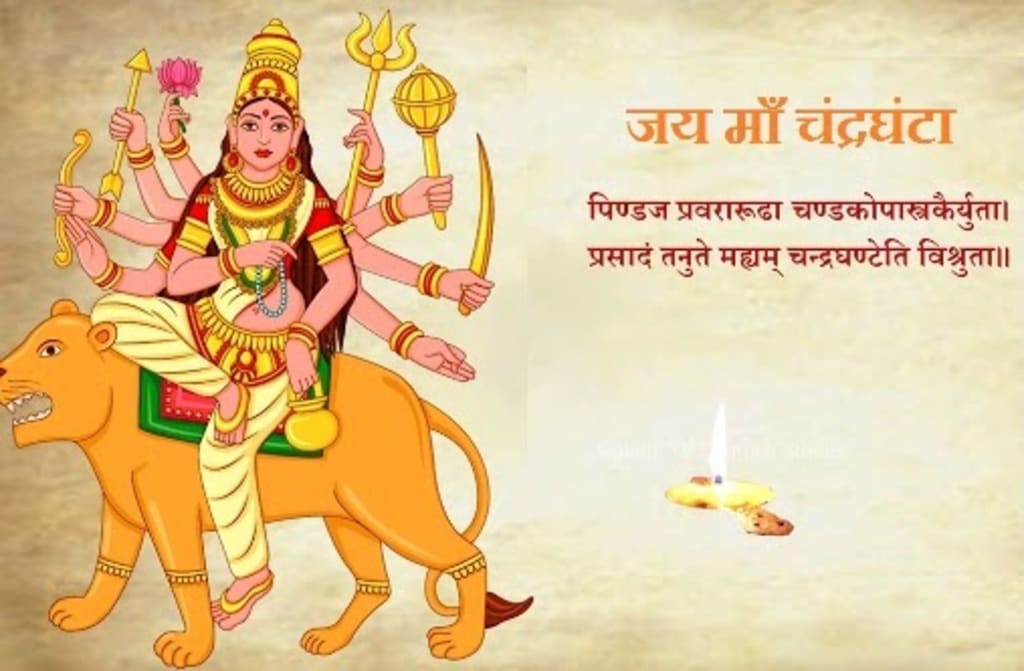
Goddess Chandraghanta is worshipped as the third form of the nine manifestations of Goddess Durga. On the third day of Navratri, devotees worship Goddess Chandraghanta with deep devotion. Her form is considered a symbol of power, courage, and beauty. The name "Chandraghanta" comes from the crescent moon (Chandra) shaped like a bell (Ghanta) adorning her forehead. This form of the goddess reflects both calmness and readiness for battle.
Although fierce and warrior-like, Chandraghanta is known for her benevolence towards her devotees. The worship of Chandraghanta instils courage, fearlessness, and mental peace in devotees, making her a beloved deity during the Navratri festival.
2. The Form and Symbols of Chandraghanta
Goddess Chandraghanta's form is both divine and majestic. She is depicted with a golden complexion, radiating brilliance, and has ten arms, each holding various weapons like a bow, arrows, sword, trident, and mace, symbolising her powerful nature. Additionally, one of her hands is in a blessing gesture, offering protection and grace to her devotees.
Riding on a lion, a symbol of bravery and strength, Chandraghanta’s forehead features a crescent moon shaped like a bell, from which her name is derived. Her warrior stance shows her readiness to fight evil forces, yet her gentle face reflects her compassion towards her devotees.
3. The Origin and Story of Chandraghanta
The story of Goddess Chandraghanta’s origin is closely linked to the battle against the demon Mahishasura. After Mahishasura invaded the heavens and defeated the gods, proclaiming himself the ruler of the celestial realm, the gods sought help from Lord Shiva. Along with Lord Vishnu and Brahma, Lord Shiva invoked Goddess Durga to defeat the demon.
In response, Goddess Durga assumed the fierce form of Chandraghanta and fought a terrifying battle against Mahishasura and his army. With her might and divine power, she destroyed the demon and restored peace in the celestial world. This story illustrates how Chandraghanta is always present to protect her devotees from evil and injustice.
4. Worship Rituals of Chandraghanta
On the third day of Navratri, Goddess Chandraghanta is worshipped with great devotion. The following items are generally used for the puja (worship):
Vermilion, sandalwood, flowers, rice grains (Akshat), coconut, incense sticks, and camphor
Panchamrit (a mixture of milk, yoghourt, ghee, honey, and sugar)
Light a lamp with turmeric and kumkum in front of the goddess
Worship Ritual:
Begin by meditating on Goddess Chandraghanta and offering her holy water.
Offer flowers, incense sticks, and a lamp to the goddess.
Bathe the idol or image of the goddess with Panchamrit and then with clean water.
Apply vermilion, sandalwood, and kumkum to her forehead.
Offer fruits, sweets, and Panchamrit as prasad (holy offering).
Finally, perform the aarti (ritual of light) and chant her praises.
It is believed that sincere worship of Chandraghanta on this day grants fulfilment of all desires, peace of mind, and prosperity in life.
5. Beliefs Associated with Chandraghanta
There are several religious beliefs associated with Goddess Chandraghanta. It is said that those who worship her with devotion are protected from all fears. With her blessings, devotees experience prosperity, good health, and peace in their lives. Her devotees also believe that worshipping her removes all sins and leads them towards the path of righteousness and spirituality.
In addition, the worship of Chandraghanta is believed to bring about mental balance and self-control. Devotees trust that the goddess destroys all their hardships and provides them with divine protection.
6. Spiritual Significance of Chandraghanta Worship
The spiritual significance of worshipping Goddess Chandraghanta is profound. Her form teaches individuals the importance of courage, self-confidence, and self-protection. The sound of the bell (Ghanta) on her forehead is said to repel negative energies and spread positivity in all directions. Chandraghanta is also known as the goddess of inner strength and meditation.
Through her worship, devotees achieve mental calmness and gain the power of meditation. Worshipping her leads to the development of virtuous qualities, helping one grow spiritually and mentally in life.
7. Benefits of Worshipping Chandraghanta
The benefits of worshipping Goddess Chandraghanta are numerous:
Mental Peace: Worshipping the goddess helps remove mental distress and brings inner peace.
Courage and Confidence: Devotees gain courage and self-confidence through her blessings.
Removal of Negativity: The sound of her bell drives away negative energies, creating a positive atmosphere.
Health Benefits: Her blessings are believed to protect devotees from both physical and mental illnesses.
Development of Protective Strengths: Worshipping her awakens one’s inner strength and prepares them to face life's challenges with courage and patience.
8. Religious Sites Associated with Chandraghanta
Several places in India are dedicated to the worship of Goddess Chandraghanta. These temples attract thousands of devotees, especially during Navratri. Some of the prominent temples include:
Vaishno Devi Temple, Jammu and Kashmir: This temple is one of the most famous shrines for Chandraghanta worship, where millions of devotees visit annually for blessings.
Chandi Devi Temple, Haridwar: This temple honours the fierce form of the goddess, and devotees visit to seek peace and spiritual power.
9. Mantra
1. Beej Mantra
Om Aim Hreem Kleem Chamundaye Vichche Om Chandraghantayai Namah।
Chanting this Beej Mantra invokes the blessings of Goddess Chandraghanta and brings positivity and strength into one’s life.
2. Dhyana Mantra (Meditation Mantra)
This mantra is used for meditating on the divine form of Goddess Chandraghanta:
Pindaya Pravara Rudha Chandakopastra Kairyuta |
Prasadam Tante Mayhem Chandraghanteti Vishruta ||
This mantra describes the powerful and divine form of the goddess, helping the devotee focus on her attributes of strength and protection.
3. Stotra Mantra (Hymn)
Ya Devi Sarvabhuteshu Maa Chandraghanta Rupena Samsthita।
Namastasyai Namastasyai Namastasyai Namo Namah।।
This hymn is dedicated to Goddess Chandraghanta, expressing gratitude and devotion towards her powerful and benevolent nature.
4. Kavach Mantra (Protective Shield Mantra)
Rakshansi Yatrogr Vishashcha Naga Yatrarayo Dasyu Balani Yatra।
Davagni Jalourva Maruduttha Vegah Tatra Sthira Tvam Jagatam Madishwari।।
This protective mantra seeks the goddess's blessings to guard against all kinds of dangers, adversaries, and challenges in life.
5. Simple Mantra
Om Devi Chandraghantayai Namah।
This simple mantra can be chanted repeatedly to seek the blessings and protection of Goddess Chandraghanta.
FAQs
1. Who is Goddess Chandraghanta?
Goddess Chandraghanta is the third form of Goddess Durga, worshipped on the third day of Navratri. She is known for her fierce, warrior-like form and is depicted with a crescent moon (Chandra) on her forehead, which resembles a bell (Ghanta). She represents courage, bravery, and peace.
2. What is the significance of the crescent moon on Goddess Chandraghanta's forehead?
The crescent moon on her forehead symbolises emotional balance and control over one's mind. It is also believed to represent time and the cyclical nature of life. The bell-shaped moon signifies the destruction of negative energies with its powerful sound.
3. What does Goddess Chandraghanta symbolise?
She symbolises strength, fearlessness, and serenity. While she has a fierce appearance, she also brings peace and protects her devotees from evil forces. Her form signifies the importance of balance between aggression and calmness.
4. What is the form and appearance of Goddess Chandraghanta?
Goddess Chandraghanta is depicted as having ten arms, each holding weapons like a sword, trident, mace, bow, and arrows. She rides a lion, representing bravery. She has three eyes, symbolising omniscience, and a bell-shaped crescent moon on her forehead. Her posture is one of readiness for battle.
5. On which day of Navratri is Goddess Chandraghanta worshipped?
Goddess Chandraghanta is worshipped on the third day of Navratri, the nine-day Hindu festival dedicated to the worship of Goddess Durga in her various forms.
6. What are the benefits of worshipping Goddess Chandraghanta?
Devotees who worship Goddess Chandraghanta are blessed with courage, confidence, and the strength to overcome challenges. She helps in removing obstacles and protects against evil spirits and negative energies. Her blessings bring peace, prosperity, and inner tranquillity.
7. What is the mantra for Goddess Chandraghanta?
One of the primary mantras dedicated to Goddess Chandraghanta is:
ॐ देवी चंद्रघंटायै नमः।
Om Devi Chandraghantayai Namah।
Chanting this mantra invokes her blessings for courage, protection, and peace of mind.
8. What is the significance of Goddess Chandraghanta’s vehicle, the lion?
The lion symbolises strength, courage, and power. It represents her ability to protect her devotees and defeat evil forces. The lion also signifies her dominance over fear and her readiness to fight for justice and righteousness.
9. Why is Goddess Chandraghanta’s bell significant?
The bell on her forehead symbolises the destruction of evil forces and negative energies. It is believed that the sound of the bell causes demons and wicked entities to flee, bringing peace and positive vibrations to her devotees.
10. How can one please Goddess Chandraghanta?
Goddess Chandraghanta can be pleased through sincere prayers, chanting her mantras, and observing the Navratri fasts with devotion. Worshipping her with red flowers, lighting incense, and offering sweets like kheer or halwa is considered auspicious. Meditating on her image helps invoke her blessings for courage and protection.
The form of Goddess Chandraghanta is both inspiring and uplifting for her devotees. Her worship brings spiritual balance, fills devotees with courage and self-confidence, and offers protection from all forms of evil. The blessings of Goddess Chandraghanta lead to success and happiness in all aspects of life.
About the Creator
DINESH KUMAR SHARMA
i am a writer and a investor
Keep reading
More stories from DINESH KUMAR SHARMA and writers in Families and other communities.
Family and Early Influences on Education
From the very beginning, a person’s attitude toward education is often shaped by the environment in which they grow up. For many, their family plays a crucial role in forming their foundational beliefs, values, and aspirations. The influence of parents, extended family members, and even the wider community sets the stage for how education is perceived—whether as a privilege, a duty, or an essential stepping stone toward a better life. This holds true for the individual at the heart of this story, whose family background not only instilled the importance of education but also influenced his dreams and aspirations.
By DINESH KUMAR SHARMAabout a year ago in Families
A Transparent Look at Vocal Challenges and Top Stories
Almost three years ago, we shared a resource article that served as a place for people to suggest new challenge prompts. We thought it would be a good idea to refresh that thread, and take the opportunity to answer a few common questions about top stories, how challenges are judged and how submissions are reviewed.
By Vocal Curation Team4 days ago in Resources




Comments
There are no comments for this story
Be the first to respond and start the conversation.