
The Painting Day: A Moment of Expression and Connection
A Journey of Expression and Friendship Through Color

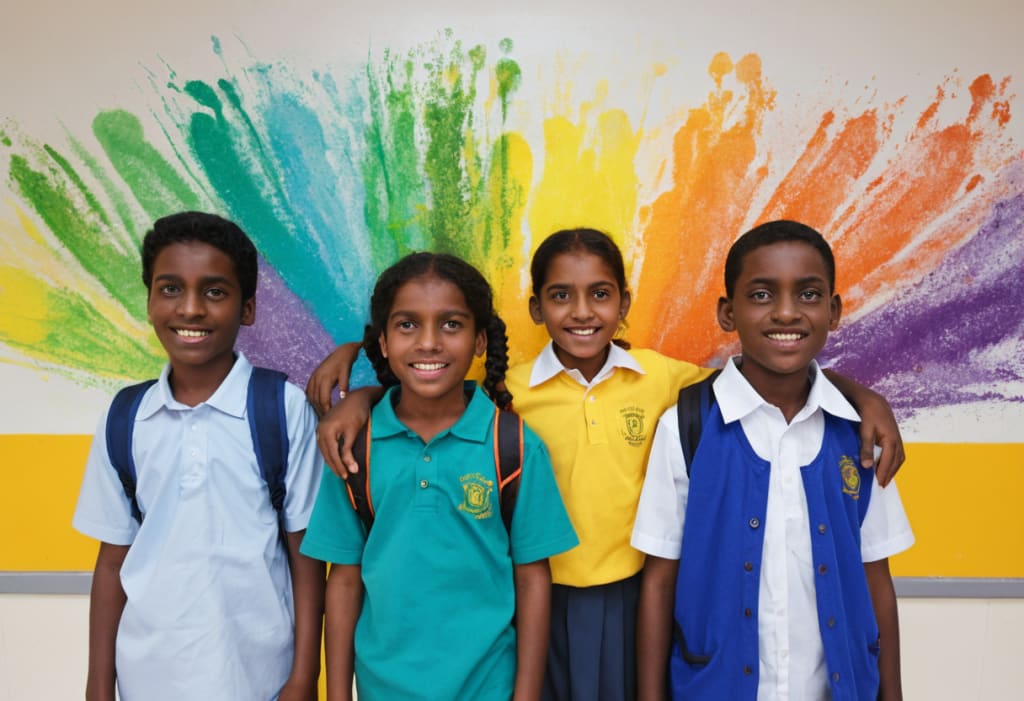
The week had passed slowly, a mixture of small, unfamiliar moments and growing confidence. Each day Kiswa returned home with a new word, a new game, a new song, her mother eagerly awaiting her stories. Though the weight of her initial fears had lifted, they hadn’t disappeared entirely. There were still times when she felt like an outsider, moments when her feet didn’t quite touch the ground. Yet, as the days passed, the sensation of being lost was replaced with the quiet excitement of discovery.
One sunny morning, as Kiswa entered her classroom, she noticed something different. The desks had been rearranged, and there was an air of anticipation. The teacher, Miss Daisy, was busy placing large sheets of paper on each desk, a box of brightly colored paints and brushes next to them. The scent of fresh paper, the faint metallic tang of new paint, and the soft hum of activity filled the air. It was a day that Kiswa could feel even before she fully understood what was happening. It was a day of creativity, of colors, of freedom.
Miss Daisy clapped her hands to gather the children's attention. The classroom, which had felt so chaotic just days before, now seemed to pulse with excitement, a gentle rhythm in every excited murmur. The children sat down, their eyes wide, their hands twitching in anticipation.
“Today, children, we are going to paint,” Miss Daisy announced, her voice bright and warm. She smiled, her kind eyes sweeping over the class. “You can paint whatever you like. There are no rules. Just let your imagination flow.”
Kiswa felt a wave of relief wash over her. There were no rules, no expectations. It was an opportunity to create, to express herself without the fear of making a mistake. The pressure that often weighed on her seemed to lift as she picked up the brush and dipped it into the first color.
Beside her, Lily was already at work. The girl’s hands were covered in paint, her smile wide as she hummed to herself. Her painting was a mess of color—reds, blues, yellows—wild strokes and thick layers of paint. Kiswa glanced at it, fascinated by the freedom with which Lily applied each color, without concern for how the painting was “supposed” to look.
Kiswa took a deep breath, then began with a simple stroke. She dipped her brush into the sky-blue paint and made a long, sweeping line across the paper. The paint felt smooth, cool against the bristles, and as it glided across the page, Kiswa could almost feel the tension in her body begin to dissolve. The act of painting—of simply moving her hand across the paper—was a kind of release. It was a permission to let go.
The other children were absorbed in their work, some lost in the intensity of their brushstrokes, while others were content with the soft blending of colors. Kiswa’s eyes flickered from one child’s painting to another, taking in the varying styles. Some children painted houses and trees, others painted abstract shapes, their thoughts manifested in bursts of color.
Miss Daisy walked between the desks, pausing beside each child to offer encouragement. Her voice was gentle but firm, a constant reminder that there were no wrong choices. When she reached Kiswa’s desk, she leaned down and spoke softly.
“Beautiful,” she said, her eyes bright as they rested on Kiswa’s painting. “I can see the sky you’ve created. It’s so peaceful.”
Kiswa’s heart fluttered at the praise. She had always been afraid of getting it wrong, of not doing it just like everyone else. But here, in this moment, with Miss Daisy’s encouragement and the warmth of the classroom surrounding her, Kiswa realized something: she didn’t need to paint like anyone else. She didn’t need to be perfect. Her painting was her own, and that was enough.
She added more strokes, now with bold strokes of green for grass, yellow for the sun. Her painting began to take form—simple, but full of warmth. Kiswa felt a strange sense of pride rise within her as she added a small, purple flower in the corner. It was nothing grand or complicated, but it felt like a small triumph. She had made something that was hers.
As the minutes ticked by, Kiswa lost track of time. The rhythm of her brush against the paper, the bright colors mixing and blending on the page, filled her mind. It was an escape from everything that worried her—the unknowns of school, the newness of her surroundings. In this moment, she was creating her own world, one color at a time.
Beside her, Lily giggled and dipped her brush into a pot of red paint, splattering it across the paper with abandon. Her painting had no clear lines, no definition—it was a collection of energy, of freedom, of joy. Kiswa smiled at her, and for the first time that day, she felt a deep connection to the girl. They were both creating, both lost in their own worlds of color and imagination. It didn’t matter that their paintings were different; it mattered that they were both theirs.
The room was filled with the sound of soft laughter, the sound of brushes on paper, and the occasional gasp of excitement when someone unveiled a particularly beautiful stroke or color combination. Miss Daisy moved around, checking on the children’s progress, offering words of praise, guiding them when needed. Kiswa noticed that no one was in a hurry. The pace was slow, measured, giving everyone time to focus, to experiment.
By the time the bell rang for lunch, the children’s paintings were spread across the room, drying on the desks. Kiswa’s painting, though still wet in places, was a simple scene: a bright blue sky, a patch of green grass, and a little purple flower in the corner. It wasn’t perfect, but it was hers, and in that moment, that was all that mattered.
As the children gathered their things for lunch, Lily slipped beside Kiswa, her eyes wide with admiration as she looked at the painting.
“Your flower is so pretty,” Lily said, her voice filled with genuine appreciation. “It looks like something from a fairy tale.”
Kiswa’s cheeks flushed with pleasure. She hadn’t expected anyone to notice her flower, much less to praise it. She smiled shyly at Lily.
“Thank you,” she said, her voice barely above a whisper.
Lily grinned and grabbed Kiswa’s hand, pulling her toward the door. “Come on, let’s have lunch together,” she said excitedly.
Kiswa felt a warmth spread through her as she followed Lily out of the classroom. It was a simple gesture, a small act of kindness, but it meant the world to Kiswa. She had made a friend, and she had created something beautiful, something unique. The painting, though just a simple image on paper, had become a symbol for Kiswa—a symbol of her courage, her growth, and her ability to find joy in the most unexpected places.
At lunch, as they sat together on the grass, sharing sandwiches and laughing, Kiswa felt a sense of belonging that she had not felt before. She realized that the world was not as vast and intimidating as it had once seemed. With each new experience, with each new friend, it became a little smaller, a little warmer.
The painting activity had been more than just a chance to create—it had been a chance to express herself, to let go of the fears that had once held her back. And as she sat with Lily, the two of them sharing their stories over lunch, Kiswa felt a sense of contentment she had never known.
The world was still big, still full of unknowns. But for the first time, Kiswa was ready to embrace it, brushstroke by brushstroke.
About the Creator
Syed Ali Shah
Books were my sanctuary, Now, as a dedicated engineer, precision is my realm. But the passion for writing still whispers, like a ghost in the night. Stories never left me; they simply transformed.
Keep reading
More stories from Syed Ali Shah and writers in Families and other communities.
I Want to Find Comfort By The Gate
In the twilight hours before dawn, Kiswa lay in bed, her small frame trembling under the weight of an impending journey. The house was quiet, save for the occasional creak of the wooden floorboards. Outside, the night was calm—too calm, Kiswa thought. The world seemed to hold its breath, as if sensing her unease. She clutched her favorite teddy bear, its fur worn smooth from years of affection. It smelled faintly of her mother’s perfume, a mixture of jasmine and sandalwood, but tonight it brought little comfort.
By Syed Ali Shahabout a year ago in Families
Wise~Guys
— Look Behind what's in Front of You ~ Make Good Choices — Hey, So how you Doin'..! Made~Men — Mobster Movies romanticise a distinctive, elegant appearance, impeccable attire style, along with the 'Families' expressive lingo. Making their 'Bones' gave them Panache — with vintage fedoras, tailored pin-striped suits, mirror-polished wing-tip shoes adorned with tassels; with their 'Gun Moll' gorgeous dates on their arms.
By Jay Kantor19 days ago in Families
Bettijo Hirschi
Introduction Bettijo Hirschi is a multi‑talented creative professional from the United States. She works as a designer, art director, photographer, writer, and event planner. Bettijo has built a long career in creative work and media. People know her for her artistic skills, her work in magazines and television, and her lifestyle blog. She is also known in recent news because of changes in her personal life.
By Farhan Sayed5 days ago in Families
The Devil's Cut
“Comrade, finally you’re awake.” The voice was smooth, sensual. A flickering incandescent bar was all that lit the white, sterile room. All Vladimir remembered was everything going black. He tried to move his arms and found them strapped to the gurney.
By Matthew J. Fromm6 days ago in Fiction




Comments (1)
What a beautifully heartfelt story! Kiswa's journey from fear to creativity is so relatable. The painting activity really symbolizes her growth—starting from hesitation to fully embracing her own unique expression. The connection with her friend Lily is heartwarming, and the way the teacher, Miss Daisy, encourages Kiswa shows the power of nurturing environments in a child's development. It's amazing how such a simple activity can have such a profound impact on a young child's confidence. Excited to see how Kiswa continues to bloom in this new world.