
When her grandmother passed, Casandra Kelly wasn't the only one surprised to learn she'd been included in the will. She had not spent much time with her grandmother since entering adulthood. Holidays, of course, and if other family was visiting. She hated to call anyone on the phone, and her grandmother did not text. She meant to write letters, bought a calligraphy pen and stationery, and was very proud of the idea, a way to reach out to her grandmother in a way the old woman likely felt most comfortable, but there never seemed to be time.
Her life was work and after work there were books to read and shows to watch and online friends with whom to chat. Most of them lived around the world, and she spent her time with them discussing fictional worlds, or places they would visit together someday. Her grandmother lived fifteen minutes down the interstate.
Casandra felt bad. Of course she did. But mostly it was a feeling bad for not feeling as bad as she should have. She was sad for the stories lost, for the conversations she could have had, the ideas and history that could've been passed. But when she sat alone, not reading or watching or chatting, there was a squirming guilt in her chest for feeling mostly relief. One less social burden. One fewer expectation, so she could be free to do as she wished.
Some said it was a very little inheritance, some said surprisingly large. Both sides agreed that Casandra had not deserved it for the amount of effort she'd put in with her grandmother before her death. Casandra didn't think there should be an equation between time spent and money received. Did other people only visit their grandmothers in the interest of someday being paid for it? Did the grandmothers know this? Would she—if she ever decided she did, in fact, want children who then had children of their own—one day arrive at the epiphany that people were only interested in what she could produce for them fiscally?
In the end, it didn't matter what other people thought, because with twenty thousand dollars, Casandra could finally do what she had only talked about. It was not too little or too much but enough. The first chance to leave monotony behind and see the world.
She wanted to travel. It was what she said in every dating profile, to all of her friends, to anyone who asked. She had a list of places, had pictures framed around her apartment. Someday. She lived two miles from a sprawling state park, but preferred to add to her list and dream and insist: Someday. She didn't want children for this. She was an empty vessel for this. For the potentiality of Someday.
In the end, she decided Egypt had to come first. Perhaps the cradle of human life itself, there was so much history, so many ruins and temples, not to mention geographical beauty and one of the official Wonders of the World.
Even with her windfall, she shopped for the best prices, frugal with what was given. She'd always eaten her vegetables first. She hoarded candy until it rotted. She saved money just to have it. When an emergency repair had come up for her car, she cried when she paid for it, despite having enough for the full cost, and still having enough afterward. She'd always had enough.
The plane ticket, the tour fees, accommodations and food barely made a dent in the sum total of her grandmother's money and she was proud. She waited until she'd booked it all before she told her parents over dinner. They asked questions but smiled through them like cardboard cutouts of movie characters.
After dinner, while washing her hands in the bathroom, she heard them discussing it softly, perhaps thinking the water ran loud enough to cover their voices.
“It's not normal,” said her mother.
“Everybody grieves differently.”
“It's not right.”
She looked at herself in the mirror and tried to make herself cry. She squinted and leaned hard over the sink and tried to force it. She tried until her mother knocked on the door and asked if she was alright. Then she shut off the light and opened the door and her mother looked hard into her eyes, searching. When she looked away, she shook her head.
Back in the sanctuary of her apartment, Casandra dug under her bed for a stack of blank notebooks. She always bought the most beautiful journals from bookstores, then organized them from her least favorite to most, and always grabbed for the worst of them when it was time for a fresh one, in order to save the best for last. Now she pulled a little black book from the stack, from the bottom of the stack, the most satisfying of the bunch. She had resigned herself to never write in it, to watch the stack keep growing atop this little black root. But now she held it like some ancient treasure, a pleasant sturdy weight with deep black covers, smooth as the skin of her inner wrist, and filled with ivory-toned weighted pages covered in perfectly-spaced lines.
She fanned open the pages and—after some struggle with ink cartridges—loaded up one of the calligraphy pens and wrote inside the front cover her name and address. On the first page, she wrote “Journal of Journeys” and then underneath that: EGYPT. She felt a little thrill looking at the wet ink cooling on the page, marked, branded, tattooed with words. A line crossed. No more talking and hoarding and waiting.
She couldn't cry at the funeral either.
The Nile was beautiful. The cities were stunning. The summer heat was excruciating and the tour groups were sparse. But she was doing it. She was in Egypt and living her life at last and everything would change now. She made no friends among the tour groups. Sometimes she traded smiles or answered a question, but she never found anyone to sit near or point at things and say over and over: “Isn't that amazing?”
She stood awestruck before the Pyramids at Giza. She paid the extra fee to enter the tombs at the Valley of the Kings. She peered into their empty resting places in silence and wondered what it would be like to be laid to rest in the cool stone dark with all your worldly goods. She wrote everything down, filling the cream pages of the forbidden best journal.
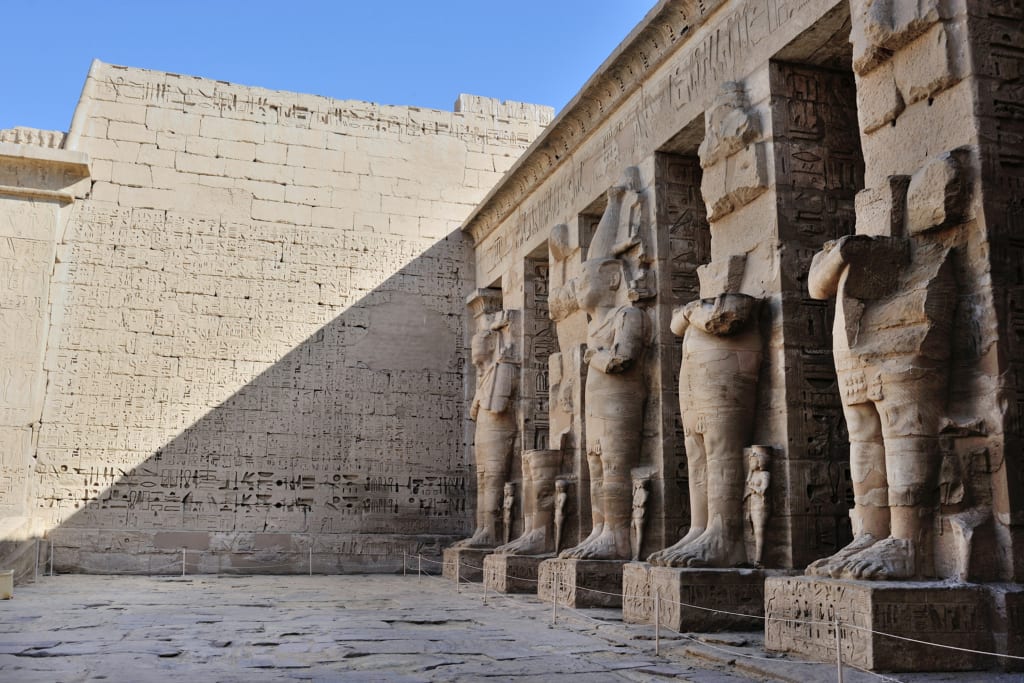
It was at Medinet Habu Temple in Luxor that the heat began to seep into her bones and she was tired and perhaps had not drank enough water. She stood in a courtyard, surrounded by the sameness of sand-colored walls and worn-down statuary and impressively aligned brickwork and inscriptions and carvings that ran all the way up the walls and onto the ceilings. The only sound was the whine of insects in the oppressive summer heat and the murmuring of tourists as they shuffled past her in either direction like highway traffic. There were no clouds and the sun was cruel.
A tour guide's voice echoed against the stone from a few dozen feet away in the relative cool of the interior. A tour group clustered around in the shade, but Casandra stood out in the sun and listened without looking. She held her little black book without writing.
“The temple was likely built almost three thousand years ago, under the rule of Ramesses the Third.”
She stared up at the towering statues flanking the courtyard, all of Ramesses, in varying states of erosion. Lifting her Journal of Journeys to shield her eyes against the glare of the sun, she fixated on one of the pharaohs without a face, the composing blocks either missing or worn away.
“Notice, there remains some color on the artwork of the ceiling and interior pillars, where it was shielded from the elements,” the distant tour guide went on. “Even at our most careful, we fight a losing battle against nature. One day, this will all return to the desert. Please touch nothing, and perhaps someday your grandchildren will be able to stand where you stand and see what you see.”
Casandra stared at the featureless head of Ramesses III, unmoving, as if she would become a statue, too. Her eyes were shaded, but something was building behind them, a weight and pressure and sting that made her want to blink.
She was thirty years old. Her grandmother was dead, turned to ash by fire, earthly treasures split among her descendants. The people who had built this place were all dead, bodies looted along with their graves, their belongings and bones turned to dust or divvied among museums. This, here, a monument too large to yet be swallowed whole by sand and time, was all that remained.
And it was just a place, and it was just a place, and it was just a place.
About the Creator
Wise~Guys
— Look Behind what's in Front of You ~ Make Good Choices — Hey, So how you Doin'..! Made~Men — Mobster Movies romanticise a distinctive, elegant appearance, impeccable attire style, along with the 'Families' expressive lingo. Making their 'Bones' gave them Panache — with vintage fedoras, tailored pin-striped suits, mirror-polished wing-tip shoes adorned with tassels; with their 'Gun Moll' gorgeous dates on their arms.
By Jay Kantor24 days ago in Families
How Parents Can Find a Child’s Location on Facebook Messenger
In today’s digital world, Facebook Messenger has become one of the most popular ways for children and teenagers to communicate with friends. While messaging apps help kids stay connected, they also raise safety concerns for parents—especially when it comes to knowing where their child is and who they are talking to. Understanding how location works on Facebook Messenger can help parents protect their children while still respecting their privacy.
By Ahmad Hassan3 days ago in Families




Comments
There are no comments for this story
Be the first to respond and start the conversation.