
The Man Who Returned Too Late
A father left his family to chase the American dream he returned twenty years later to find a home he no longer recognized.

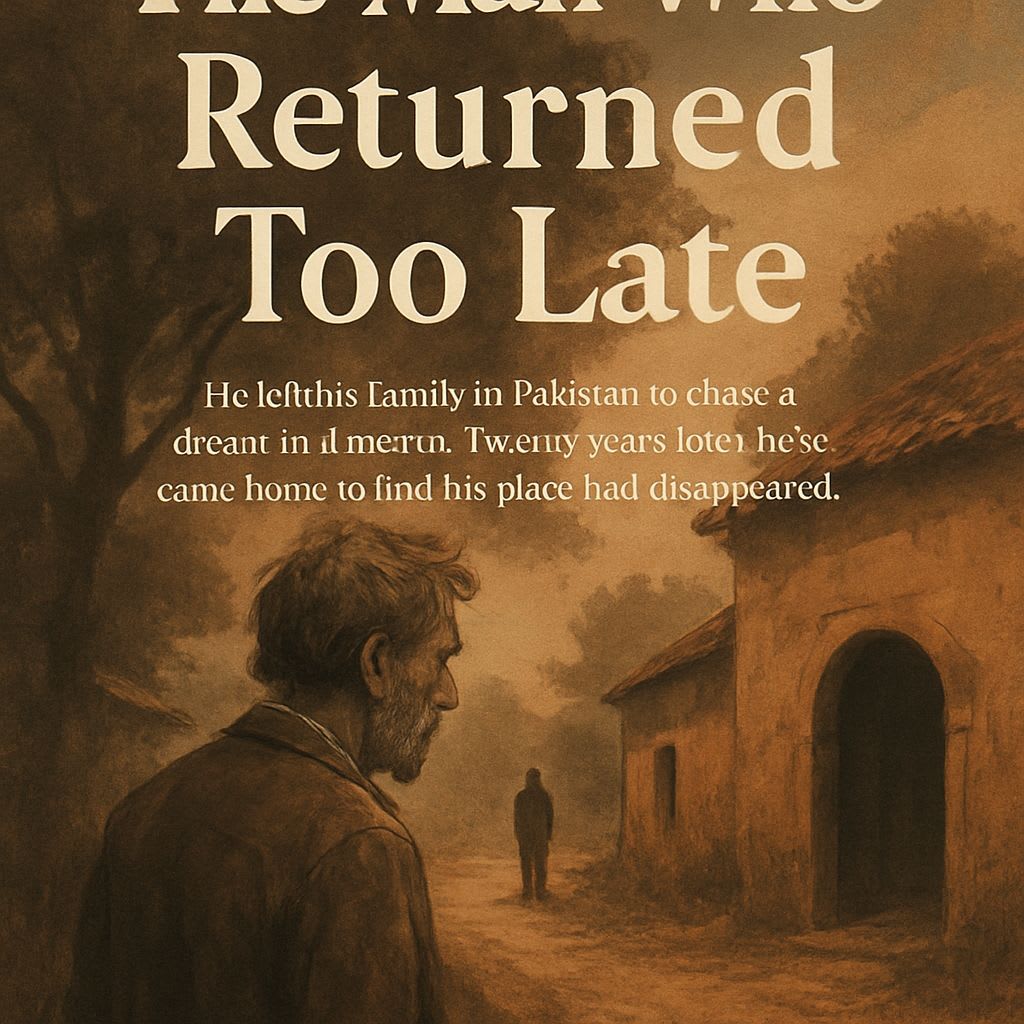
He was young, handsome, and full of dreams.
Born and raised in a peaceful village in Pakistan, Arif had always been different from other boys. While his friends were content playing cricket and helping in their family fields, Arif would often sit under the old banyan tree, sketching out fantasies of a life beyond the borders of his land.
He fell in love with Mehwish—his childhood friend, a girl whose laughter echoed like wind chimes in summer. She had no ambitions beyond the village, no desires beyond the small home they built with borrowed wood and honest hands. She loved him, fiercely and completely. And he, at least in the beginning, loved her back just as much.
Their life was simple but full of love. In the span of three years, they were blessed with two sons. Their tiny home echoed with baby cries and lullabies. Arif tried to work hard, but the income from the fields was barely enough. The walls of the village began to feel like a cage.
He heard stories—of Lahore, of Dubai, of America. Men from neighboring villages had gone abroad and returned with riches: new homes, motorbikes, shiny clothes, and pride in their voices. Arif began to imagine what life would be like if he too could step into that world.
So, one morning, he made a decision. He would go to America.
Mehwish wept. “Don’t go,” she pleaded. “We have enough. We have each other.”
But he couldn’t be persuaded. “It’s only for a little while,” he promised. “I’ll come back rich. Our sons will go to school. You’ll wear gold bangles, and our house will be made of brick, not mud.”
So, he left.
For the first year, he kept his promise. Letters arrived every two weeks. Short phone calls from strange numbers. Parcels filled with chocolate, toys, and photographs of tall buildings.
Then slowly… everything stopped.
The letters became rare. Phone calls turned into excuses. The money stopped coming. Mehwish began to hear rumors—that Arif had married another woman abroad, that he had changed his name, that he didn’t plan to return.
She waited.
His parents waited.
His sons—still toddlers—grew into boys without ever knowing the sound of their father’s voice.
His mother fell ill. Cancer, they said. She whispered his name in her final breath. His father sat silently in the corner for weeks after her funeral, staring at the gate until one morning, he never got up again.
Mehwish buried them both.
She wore white from then on. Not the white of a widow, for she didn’t know if she was one—but the white of loss, of waiting, of absence.
Every Eid, she bought new clothes for her sons.
Every Friday, she cleaned the gate and lit a lamp.
“Your father might come today,” she’d say.
The boys nodded. They stopped believing by the time they turned ten.
---
Twenty years passed.
And then, one afternoon, a man stepped off a bus. His beard was grey, his hands weathered, and his eyes carried the fatigue of a thousand lonely nights. Arif had returned.
He walked slowly down the village path. The banyan tree still stood, but the village was no longer the one he left. The homes had grown taller, painted in fresh colors. Children laughed in school uniforms. Roads were paved. Time had not waited for him.
He arrived at his old street. The house still stood—but stronger, cleaner, alive.
A tall boy stood near the well. His face… it looked familiar.
“Son,” Arif asked softly, “who lives here?”
“That’s our home,” the boy replied.
“What’s your name?”
“Hamza.”
Arif’s voice trembled. “And your father?”
Hamza hesitated. “He left us when I was small. Mom says he got angry. She says he’ll come back one day. Every Friday, she makes us wear our best clothes. But he never came.”
Arif looked away quickly, hiding his tears.
The boy tilted his head. “Uncle, are you alright?”
“Yes… just some dust,” Arif murmured.
A younger boy came running up, laughing, chasing a butterfly.
“That’s my little brother,” Hamza smiled.
Arif nodded. The two boys were his flesh and blood. They didn’t know him. They didn’t hate him—because they didn’t even know to hate him. To them, he was just… gone.
As the boys played, a scuffle broke out. Another kid shouted, “You don’t even have a father! He abandoned you!”
The words struck Arif like a bullet.
He walked to the gate. It was slightly ajar.
Inside, Mehwish was sweeping the floor. Her hair now streaked with silver, her shoulders tired, her eyes blank and focused only on the rhythm of survival. She paused and looked toward the gate, as if sensing something. But he didn’t move.
His feet were frozen.
His voice lost.
His courage shattered.
He wanted to step inside. To say, “I’m sorry.”
But how could he?
How do you apologize for twenty years?
For missing birthdays, funerals, illnesses, heartbreak?
He saw the laundry line where once his son's baby clothes hung. Now, grown-up shirts danced in the wind. He saw the tree where he once carved his name with Mehwish. It still stood, but weathered. Just like her. Just like him.
He stepped back.
Hamza walked to him again, offering water. “Uncle, do you need anything?”
Arif looked into his son's eyes. So kind. So innocent.
“Nothing,” he whispered. “You’ve already given me enough.”
He turned away.
With each step, the weight grew heavier.
He reached the main road, stood silently, and looked back once more.
A part of him wanted to run back, fall at their feet, cry, beg.
But another part of him knew—some wounds don’t heal with words. Some absences can’t be filled with regret.
Sometimes, you don't get to return.
Sometimes… it's just too late.
About the Creator
Keep reading
More stories from Qutbi Alam and writers in Families and other communities.
The Family That Time Forgot But Love Remembered
in a small village where the river whispered to the wind and evenings fell gently like a soft sheet across the fields there was a modest home not rich in wealth but overflowing with love the kind of love that asked for nothing and gave everything
By Qutbi Alam 8 months ago in Families
My Body Found the Red Flags Before My Brain Did
The Weight of the Interior: An Unfinished Map of a Marriage The stiff blue cotton of my nursing scrubs still smells like the clinical lab, a scent that shouldn’t feel like a relief, but it does. There is a brown cardboard box sitting on the laminate counter, its tape shredded open by a house key because he couldn't wait the ten minutes I asked for while I was finishing a call.
By Brooks Ghost Max 3 days ago in Families
WHEN SILENCE SPEAKS.
There is a kind of silence in children that does not feel peaceful. It feels heavy, almost charged, as if something unspoken is filling the space between their small bodies and the world around them. As adults, we are trained to listen for words, to expect explanations, to believe that if something is wrong, it will be said aloud. But children do not always work that way. Many of them do not have the vocabulary for what they are feeling, and some of them, especially when something truly painful has happened, do not feel safe enough to try.
By Yolanda Cristobal 5 days ago in Families
Review of 'Man on the Run'
My wife and I saw Man on the Run, a nearly 2-hour documentary on Amazon Prime, about Wings, Paul McCartney's group that flew around the world from shortly after The Beatles broke up in early 1970 to shortly after John Lennon was murdered at the end of 1980, making a Beatles reunion forever impossible.
By Paul Levinson6 days ago in Beat


Comments
There are no comments for this story
Be the first to respond and start the conversation.