
The Love Languages of Oldest Siblings
Is their a correlation between the status of oldest sibling and type of love language of oldest siblings in romantic relationships?


The epiphany came to me one night after my fiancée and I adopted our 4-year-old rescue dog, Ace (bear with me). Due to his reactive nature towards our cat, Pesto, the living/kitchen of my small apartment become a space for Ace while my bedroom was for Pesto. The first few weeks, Ace’s vocal need for attention knew no boundary, certainly not at night. Therefore, I spent those first few weeks sleeping on the couch with Ace, working with his separation anxiety until I could finally return to my bed. During those weeks, Pesto unfortunately received less attention then the time B.A. (Before Ace) and was less than pleased about that.
That first night back in my bed, in Pesto’s space, his whole demeanor changed and returned to his normal in-your-face nosing kissing and purring and sleeping against me. Then I remembered something my mom had told me a few years prior when I had told her about love languages and revealed that mine was touch and quality time. She had said that whenever emotions where flying high, my parents would spend some one-on-one time with me and we’d have a lot of fun. That’s when it hit me: both Pesto and I were essentially oldest/first born children of our houses, beginning our years with significantly more one-on-one quality time with our parents. Following that realization, a bigger question arose about whether or not this was something of sleep-induced delusion or actual correlation. Do oldest siblings share love languages because of their status as older sibling/first born?
I began asking friends and acquaintances that I knew were oldest of their siblings and were easy to contact. This research study was very short and informal, however as each person answered my question, a relatively strong pattern began to emerge (see figure 1). The responses varied from just one acknowledged love language to having a two and nearly all included quality time. This trend would make sense from my initial working hypothesis that, due to some time spent with individual attention as an only child only to then have to share that with younger siblings, older siblings would value quality time as a love language.
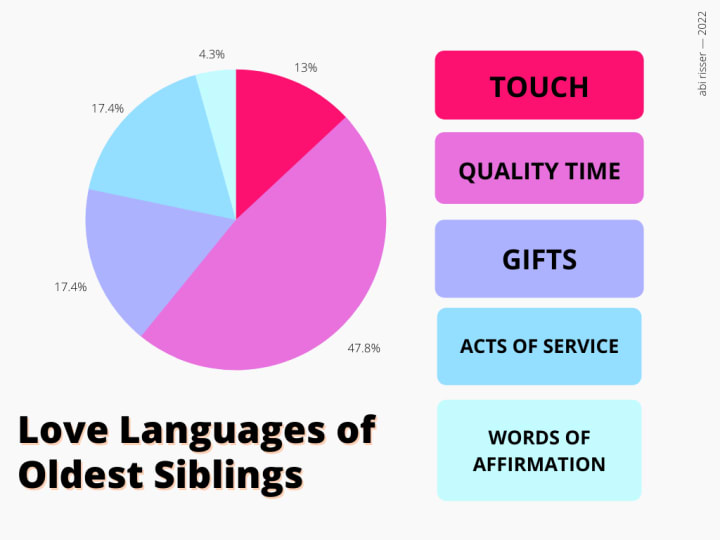
So, what does this all mean?
There are obviously more factors that should be looked at to grasper a fuller view of this trend (in addition to expanding the sample size), especially since I did get varying answers from everyone. These factors could include the typical demographics—age, sex, gender, race or ethnicity, socioeconomic status—in addition to age gap between the first and second born siblings, total number of siblings a first born child has, presense of disabilities, and so on. For now, however, I will be keeping this as a “limited” study, so to speak, but will also continue collecting data in the mean-time.
In terms of other research, it is worth noting that birth order’s effect on relationships has been studied and does make an impact. According to Denise Schipani from Women’s Day, ”[firstborns] tend to be conscientious, ambitious, organized and—in relationships—dominant. Says Cane, "Firstborns like to be in control." As with all birth-order positions, gender plays a role, too. In the case of firsts, oldest sons tend to be take-charge types, leaders. Oldest females, on the other hand, are more likely to be bossy, confident and aggressive than their younger sisters”.
Interestingly enough, in another article from Scientific American, Corinna Hartmann and Sara Goudarzi explain the findings from a study conducted by psychotherapist Alfred Adler supporting birth order affecting the personalities of siblings. “Adler considered firstborns to be neurotic, because they don’t have to share their parents for years and are essentially dethroned once a sibling comes along”. While their article continues to debate the legitimacy of this type of pattern from many different studies, they do admit that there are still significant findings in support of these theorized personality differences.
With research showing that oldest siblings desire more control in their lives and relationships, I believe that the tendency to value quality time the most out of other love languages makes a lot of sense. As someone who is an oldest sibling and shares this commonnality, one-on-one quality time does create some sense of control while enjoying the presence of my fiancee.
Are you an oldest sibling and agree? Or are my brief findings way off for you? Regardless of where you fall, share your love language and add to my research! If you don’t know your love language, you can complete a short quiz here to find out.
About the Creator
Abi Risser
MU English major
Creative Writer
LGBT
Musician
Avid reader
Longboarder
Radio DJ
Keep reading
More stories from Abi Risser and writers in Families and other communities.
Dear Mr. President...
Dear Mr. President, Although I do not enjoy using this title for you, Donald, it is important to do so; after all, you did win the race for this job you sought after. As President of our country, you're role is to not only act as a chief executive of the federal government and Commander in Chief, but it is also to help great progression and change. To care. Over your reign as leader for the United States you've flaunted your wealth and power for the world to see. Can you not use use your influence to lead efforts to preserve the world around us?
By Abi Risser6 years ago in The Swamp
Carlton Jama Adams: Building Stronger Families Through Healthy Parenting Strategies
Professor Carlton Jama Adams is a licensed clinical psychologist and a professor of psychology who has dedicated much of his professional life to understanding how families grow, communicate, and overcome challenges together. His work focuses on healthy parenting strategies and the ways in which emotional awareness can strengthen relationships within the home. As an educator, he teaches courses on masculinities, human services and community justice, Africana intellectual thought, and the psychology of oppression and liberation. He has also worked extensively with individuals involved in the criminal justice system and has consulted with international, national, and community based organizations on leadership strategy and executive coaching. Through both his teaching and consulting work, Carlton Jama Adams has developed a perspective on family life that highlights the importance of communication, emotional safety, and consistent guidance in raising resilient children.
By Carlton Adams3 days ago in Families
TUS NUA - ch 53
TUS NUA – ch 53 New Beginnings – Mia and Midnight (*)(*)(*) Finola knew Ali’s brother-in-law needed to put his mind at rest. She fed her arm through his and led him outside. “We’ll sit here. If you like, I can put a block around us so our conversation will be private.”
By Margaret Brennan7 days ago in Fiction




Comments
There are no comments for this story
Be the first to respond and start the conversation.