
The Letters Beneath the Fig Tree
In the city of blue walls and quiet hills... Lina searched for something more than words.”


“The Letters Beneath the Fig Tree”
Written by SOPHIA ROSE
It was in the Moroccan town of Chefchaouen, a city washed in hues of soft blue, where Lina first met Youssef. She had come from Casablanca, a language student spending a quiet summer in the Rif Mountains, looking for more than just fluency in dialects—she needed peace, maybe even reinvention. Youssef was a native, a quiet soul who ran a tiny bookshop tucked beneath a fig tree whose branches sprawled out like an open hand to the street.
Their first conversation wasn’t about love. It was about Pablo Neruda.
Lina pulled a well-worn volume of his poems from the highest shelf, triggering a mini avalanche of books. Youssef caught the one she wanted before it hit the floor, handed it to her, and said simply, “He saves the best lines for those who are aching.”
She laughed, genuinely. “That means all of us meeting under the fig tree. Sometimes they spoke about books, other times about the way time moved differently in Chefchaouen—how the fog didn’t settle, but draped itself softly over buildings like a silk scarf. Each day, he gave her a paper bag with dried figs and a handwritten quote tucked inside. One day it read, “Love is the longing for the half of ourselves we lost at birth.”
Two months passed like breath in a cold window.
On her final evening, she left a note tucked into the tree's bark: “If words brought us together, maybe silence will bring you to me. One day. Somewhere.” She didn’t tell him goodbye. She didn’t know how.
Lina returned to the rush of Casablanca, then to Madrid, London, and later Tokyo. She became a translator—turning words into bridges for people who didn't speak the same language. She kept a small jar of dried figs on her shelf, and every time one shriveled, she whispered a line from Neruda like an invocation.
Years passed.
Then, while attending a literary conference in Marrakech, Lina wandered off the schedule. Habit, perhaps. She found herself in a small library in the Medina quarter, looking for a translation of Moroccan folk tales. There, pressed between two ancient volumes, was a handwritten note: “The fig tree is gone, but I’m still reading the leaves.” Signed: Y.
She turned, but no one stood behind her. Nothing to explain it. She could have dismissed it—a prank, a coincidence—but she knew.
One week later, she was back in Chefchaouen. The blue walls hadn’t faded, but the bookshop had changed. A young woman behind the counter smiled. “You’re Lina, right?”
Lina nodded.
The woman handed her a thin envelope. Inside was a plane ticket, one-way, to Istanbul, and a short note: “Sometimes silence does bring someone back. If you're still listening.”
And so she went.
At a café overlooking the Bosphorus, among call to prayer and sea wind, she found Youssef. Older. Wiser eyes. A little gray in his beard.
“I was afraid you wouldn’t come,” he said.
She smiled. “I was afraid I’d been imagining you all this time.”
He reached into his bag and handed her a fig. Fresh.
“I figured if the tree’s gone, I should bring something sweeter.”
---
Youssef and Lina lingered in Istanbul like two verses of the same poem finally reunited. They walked along narrow alleys echoing with life—vendors calling out in Turkish, oud music drifting from the cafés. They didn’t speak much that first day. Some emotions, like certain spices, need simmering.
Later that evening, they sat by the Bosphorus, sipping tea from tulip-shaped glasses.
“Did you really keep writing those notes all this time?” Lina asked.
“I never stopped. Every time someone walked into the shop, I hoped it would be you. When it wasn’t, I wrote anyway.”
She reached into her bag and pulled out a folded paper, yellowed at the edges—one of his fig quotes from years ago.
“I kept them too.”
That night, they spoke of all the nearlys: the almost-calls, the missed trips, the people they met and nearly fell for, but something always held them back. Neither called it fate aloud. But it sat between them like a third companion, nodding.
The next morning, Youssef brought her to a small rooftop with an easel facing east.
“This is where I paint now.”
A canvas sat unfinished—brushstrokes tracing a blue city under a tree that no longer stood. She picked up a brush.
“Let’s finish it together.”
For weeks, they painted side by side. Lina rented a small flat, translated by day, painted by twilight. Youssef taught art classes at a local school. Life didn’t explode with fireworks. It unfurled like a scroll.
They rebuilt love not on longing, but on shared rituals: fig jam on toast, reading aloud under rain-streaked windows, dancing to scratchy vinyls from Youssef’s youth. It was soft, honest, and earned.
One winter evening, he gave her a ring—not flashy or grand, but engraved inside were the coordinates of the fig tree.
“Not to bind,” he said. “But to remind you where this story began. And that it still matters.”
Lina smiled, slipping it on. “And if ever we lose the words again?”
He tapped her heart gently. “That’s where I keep the quiet ones.”
---
About the Creator
Sofia Richie
Sofia is a storyteller who weaves emotion into every word. With a deep love for connection, language, and cultural depth, his stories illuminate unseen beauty and inspire reflection across borders—both real and imagine.
Keep reading
More stories from Sofia Richie and writers in Families and other communities.
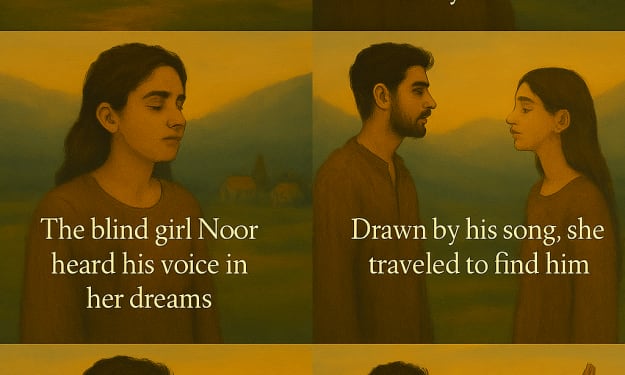
The Voice Beyond the Hills
The Voice Beyond the Hills In a forgotten valley cradled by snow-veiled peaks, there lived a boy named Ayaan. Each night, as the sky spilled indigo ink across the land, he climbed the jagged path to a lonely cliff and sang. His voice—clear as mountain water and warm as firelight—rose into the wind, woven with melodies born not from books or notes, but from the depths of longing. Ayaan had no audience. No one saw the boy with stars in his throat. But still, he sang.
By Sofia Richie 8 months ago in Motivation
St. Patrick's Day
When I was a child, I really thought our family was Irish. We always celebrated St. Patrick's Day with a chocolate cake with green frosting, and it was pretty common to wear green and to have corned beef, cabbage, and boiled potatoes for dinner that day.
By Denise E Lindquistabout 22 hours ago in Families
We Grew Up as “Siblings”… Then Fell in Love—What Happened Next Changed Everything
When my parents decided to adopt a child, I was old enough to understand what it meant—but too young to grasp how much it would change my life. I remember the day they brought them home. Everything felt different overnight. Suddenly, I wasn’t an only child anymore. I had someone to share my space, my routines, and eventually, my life with.
By Lukáš Hrdlička6 days ago in Families


Comments
There are no comments for this story
Be the first to respond and start the conversation.