
The Last Door on Maple Street
"Some doors are meant to stay shut."
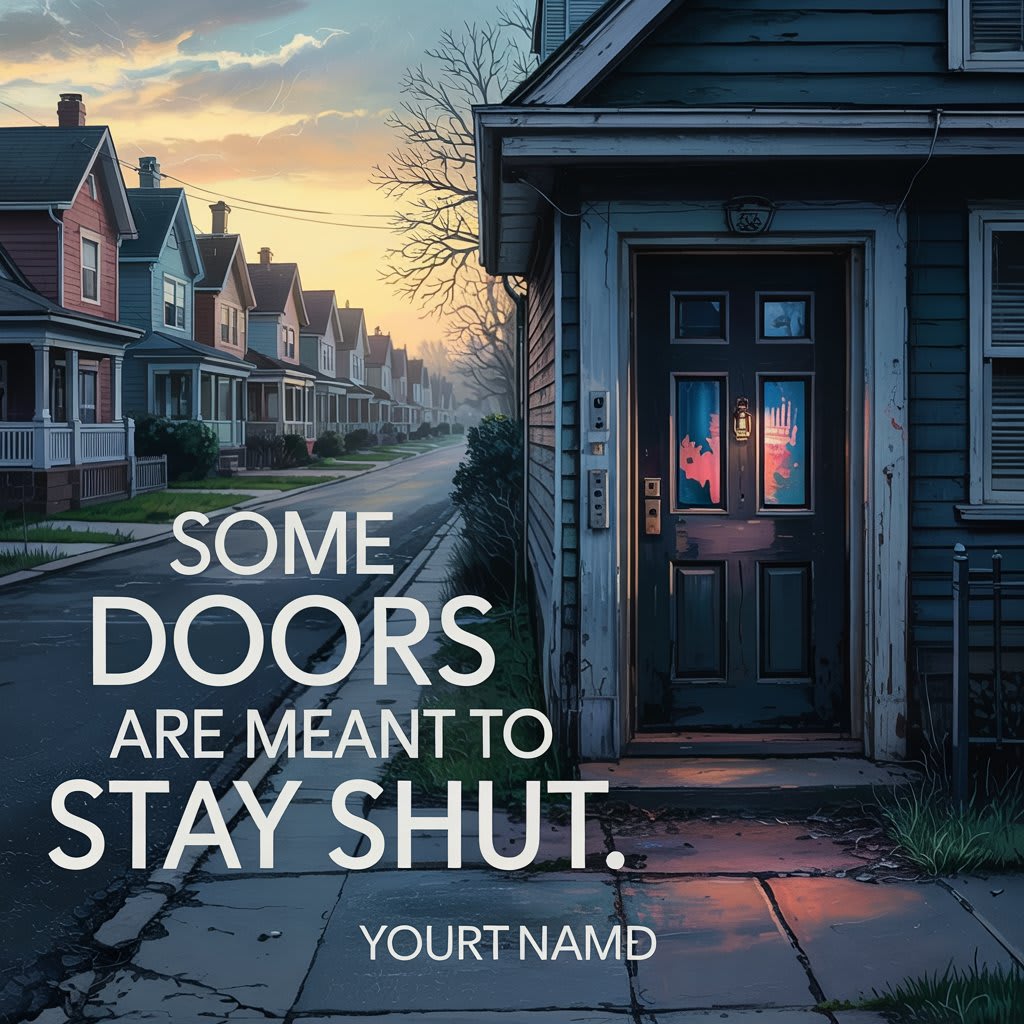
Everyone knew about the house at the end of Maple Street.
It wasn’t haunted—not exactly. There were no recorded deaths there. No ghosts in white sheets, no blood stains, no cold drafts or flickering lights. Just a single house with a door that no one ever opened. Not the family who lived there for 40 years. Not the kids who moved in afterward. And not even the mailman, who swore the mailbox was always empty.
No one ever saw anyone go in or come out of that door.
It was always locked. Always sealed.
And then, one day, it wasn’t.
I moved to Maple Street when I was fifteen, right after Dad disappeared. Mom said we needed “a fresh start,” which was her way of pretending things weren’t falling apart. She bought a tiny house two doors down from the infamous property and never mentioned Dad again.
I asked the neighbors once about the house at the end. Mrs. Grant from across the street just shook her head. “Stay away from it, honey,” she said. “It’s not meant for you.”
But that made it worse. You tell a teenager not to look behind the curtain, and that’s the first place they’ll go.
The house was dull gray with faded green shutters. Everything about it looked slightly out of sync, like a photograph printed just slightly out of frame. But the front door—that last door on Maple Street—was pristine. Jet black. No scratches. No dust. A brass doorknob that gleamed in the sun like it was polished daily.
And yet no one touched it.
Not until Halloween night.
It was my first Halloween in the neighborhood, and I’d roped my new friend, Milo, into going door to door with me. By the time we got to the end of the street, our plastic pumpkins were half full, and the cold October air was starting to sting.
I pointed to the last house.
“We skipping it?”
Milo shook his head fast. “Nobody ever goes there.”
“Why not?”
He hesitated. “Because someone always answers… but nobody sees them.”
I grinned. “Sounds like a challenge.”
Before he could stop me, I was already walking toward it.
The porch creaked under my feet. The wind suddenly died, and everything felt... too quiet. The kind of silence that presses against your ears.
I knocked once.
No answer.
Then, just as I turned to go, I heard it—click.
The door swung open.
There was no one there.
Just a hallway stretching far too long for a house that size. Wallpaper peeled in soft curls, and the lights inside buzzed faintly, flickering like they were struggling to stay alive.
“Milo,” I called, my voice shaking.
But when I looked back, Milo was gone.
Not just hiding or running.
Gone.
The street, the other houses, the orange glow of jack-o'-lanterns—all of it had vanished.
And in its place, only the house remained.
I should’ve run.
I stepped inside.
The door slammed shut behind me, plunging the house into near-darkness.
I turned the knob. Locked.
The hallway in front of me shifted—walls bending inward like ribs, the floor warping beneath my feet. The door at the end was the only thing that looked solid.
Black. Just like the one I had entered.
There were whispers in the walls now. Not words—just sounds, like breathing in reverse. I felt them crawl over my skin like invisible spiders.
I walked.
The further I went, the more the hallway stretched. Time slowed. I passed rooms filled with impossible things—a dining room where the chandelier spun like a clock, a nursery with a crib that rocked itself, a mirror that reflected someone else standing where I should be.
And always, at the end, that final door.
It looked exactly like the one I had entered through, but something told me it wasn’t.
Not exactly.
When I finally reached it, the whispers had grown louder. They formed words now:
"Do you want to know?"
"Do you want to remember?"
I touched the doorknob.
And memories I didn’t know I had surged through me.
Dad, standing in front of a door just like this one. Telling me not to follow. Telling me that once you open the last door, you don’t come back the same. That the house remembers you. That it wants you.
He’d opened it.
He never came back.
I turned the knob.
On the other side wasn’t another hallway. It was our living room.
Mom on the couch, asleep. Milo sitting on the floor, looking dazed. A moment frozen in time.
I stepped through.
The whispers stopped.
The door closed behind me with a whisper of its own—and this time, it vanished.
No black frame. No brass knob. Just drywall where the door had been.
I was home.
But things didn’t go back to normal.
Every mirror in the house showed me standing just a second too late. I woke up at 3:03 a.m. each night to the sound of footsteps in the hallway. And when I passed the end of Maple Street…
There was no house there anymore.
Just an empty lot.
People say it was torn down years ago. That there’s never been a house at the end.
But I remember.
I remember the door.
The way it whispered my name.
And I know—one day soon—it will open again.
About the Creator
Wise~Guys
— Look Behind what's in Front of You ~ Make Good Choices — Hey, So how you Doin'..! Made~Men — Mobster Movies romanticise a distinctive, elegant appearance, impeccable attire style, along with the 'Families' expressive lingo. Making their 'Bones' gave them Panache — with vintage fedoras, tailored pin-striped suits, mirror-polished wing-tip shoes adorned with tassels; with their 'Gun Moll' gorgeous dates on their arms.
By Jay Kantor21 days ago in Families
Blue Room 🛏️
Loneliness has never been about being alone. I have felt it in crowds, in homes full of family, in rooms buzzing with voices. It is not the silence of solitude I know—it is something older, deeper, stitched into my chest. It is a weight in my stomach, a tightness around my heart, a companion that clings when I try to laugh or speak or reach for someone. It has been with me since I was a child, a shadow from the very beginning.
By Saiydaa Hayes3 days ago in Families
Smart phones, Humans and Aliens.
WARNING. I will be tapping into one of your favorite creative tensions: The absurdity of humans worshipping their glowing rectangles as if they were tiny oracles. There’s something deliciously poetic about that contradiction, and it lends itself beautifully to an instructive proviso.
By Novel Allen5 days ago in Poets



Comments
There are no comments for this story
Be the first to respond and start the conversation.