
The Forgotten Art of Being Present: Why Family Time Became a Casualty of the Clock
In Our Obsession with Productivity, We Lost the One Thing Children Actually Need
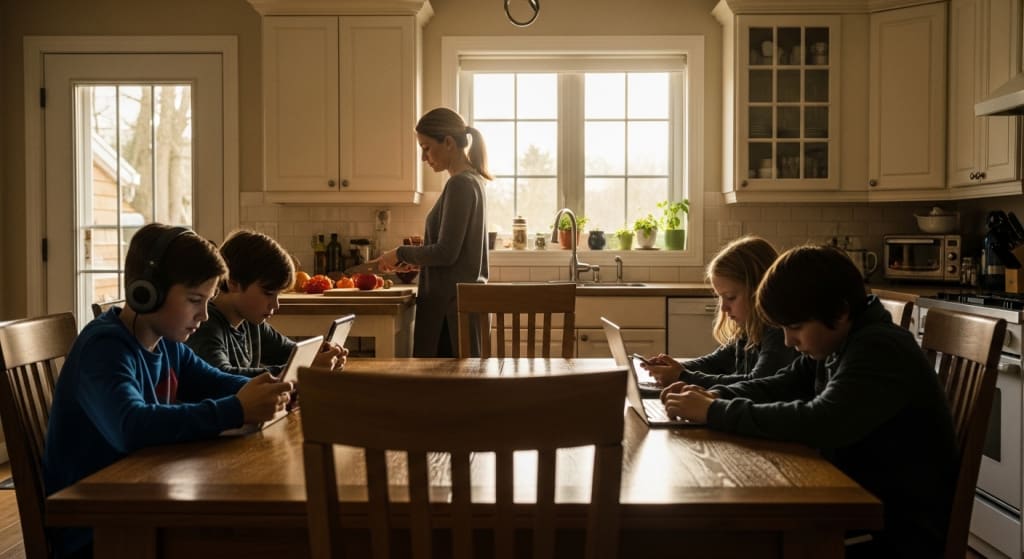
The dinner table was never just a piece of furniture. It was an altar, a staging ground for the small dramas and quiet revelations that woven together form the tapestry of family life. It was where you learned that your father had a funny story about his boss, that your sister was nervous about her math test, that your grandmother once had a different name, in a different country, in a different life. It was where you were seen, not as a student, a teammate, or a future adult, but simply as a member of a small, flawed, stubborn tribe called family.
Today, in millions of homes, that table sits empty—or worse, occupied by bodies whose minds are elsewhere. We have not abandoned the family; we have simply outsourced its emotional labor to screens, schedules, and the relentless machinery of modern life. In doing so, we have lost something irreplaceable: the art of being present for one another in the unscripted, unhurried moments that once bound generations together.
The narrative we tell ourselves is one of necessity. We are busy, we insist, because we are building futures, providing opportunities, ensuring our children have every advantage. The afternoons packed with piano lessons, soccer practice, tutoring sessions, and coding camps are not neglect; they are investment. The evenings spent answering emails while children do homework nearby is not absence; it is multitasking. The weekends consumed by errands, chores, and catching up on rest is not disconnection; it is survival.
But children do not measure love in opportunities provided. They measure it in attention received. They do not remember the extracurricular activities as much as they remember who showed up to watch. They do not value the device purchased as much as they value the device ignored when they have something to say. The math of childhood is simple and unforgiving: presence equals worth. When we are perpetually elsewhere—even when our bodies remain in the room—we communicate, with devastating clarity, that they are not enough to hold our focus.
This epidemic of distracted parenting has a name, though we rarely speak it aloud: the privatization of family life. We have convinced ourselves that raising children is a project to be managed efficiently, a checklist of developmental milestones and enrichment activities, rather than a relationship to be nurtured messily over time. We treat quality time as though it were a commodity that can be compressed into scheduled intervals, ignoring the truth that the deepest connections form in the margins—in the car ride when no one is in a hurry, in the fifteen minutes before bed when guards are down, in the lazy Sunday morning when nothing at all is planned.
The consequences are seeping into the souls of our children, visible in the rising rates of anxiety, the epidemic of loneliness among teenagers, the hollow eyes of young people who have been given everything except the one thing they actually needed: witnesses to their lives. A child who grows up without the consistent, undistracted presence of loving adults learns a terrible lesson: that they must perform to be seen, achieve to be valued, or disappear entirely. They carry this wound into adulthood, into their own relationships, into the next generation of families, perpetuating the very distance they once longed to bridge.
Technology, of course, is the convenient villain. And it is true that the average American parent now spends more time on screens than engaged in direct conversation with their children. It is true that family dinners have declined by 33% over the past two decades, replaced by meals eaten in separate rooms, at separate times, absorbed in separate worlds. It is true that the average child now receives their parents' full, undivided attention for less than thirty minutes per day.
But technology is not the root; it is the amplifier. The root is a culture that has forgotten what cannot be quantified—that has elevated productivity above presence, efficiency above connection, achievement above love. We have built our lives around the measurable and are surprised when the immeasurable withers. We have optimized for everything except the one thing that actually matters: showing up, again and again, with nothing to prove and nowhere else to be.
The families that resist this tide are not necessarily those with more time, but those with clearer priorities. They are the families that protect dinner not as a meal but as a ritual—phones in a basket, television off, everyone required to share one thing about their day, even when the teenagers roll their eyes. They are the families that choose the local park over the distant theme park, that value the walk around the block over the scheduled playdate, that understand that boredom, left to breathe, often gives birth to the most intimate conversations.
They are also the families that have learned to apologize. Because no parent gets this right all the time. The distracted evenings accumulate, the missed moments multiply, and at some point, every parent looks at their child and realizes they have not truly seen them in days. The repair is not in perfection but in acknowledgment: "I'm sorry I was on my phone. Tell me again. I'm listening now." Children are astonishingly forgiving of imperfection; they are not forgiving of absence dressed as presence.
What would it mean to reclaim family time in an age that conspires against it? It would mean rejecting the tyranny of the urgent in favor of the important. It would mean letting some balls drop—the immaculate house, the impressive resume of activities, the constant connectivity—so that the one that matters most stays aloft. It would mean recognizing that the hours between 5 and 8 p.m. are not a gauntlet to be survived but an opportunity to be seized, a daily chance to remind the people under your roof that they are more than roommates sharing a Wi-Fi network.
It would mean, above all, remembering what we knew before we forgot: that children do not need perfect parents. They need present ones. They need adults who look up when they walk in the room, who listen without glancing at watches, who choose them, again and again, over the endless demands of a world that will always want more than it gives. They need to know, deep in their bones, that in a universe of seven billion people, there are a few for whom they are not an interruption but the point.
The family dinner will not save the world. But it might save one child, in one house, on one ordinary Tuesday night, from the quiet despair of growing up unseen. And that child, years later, might sit at a table of their own, phone silenced, heart open, passing forward the gift they once received: the gift of being chosen, moment by ordinary moment, over everything else the world had to offer. In the end, that is all any of us really want. That is all any of us should need
About the Creator
HAADI
Dark Side Of Our Society




Comments
There are no comments for this story
Be the first to respond and start the conversation.