
"The Comfort of Denial"
Where Truth Fades, and the Soul Finds Solace in Shadows
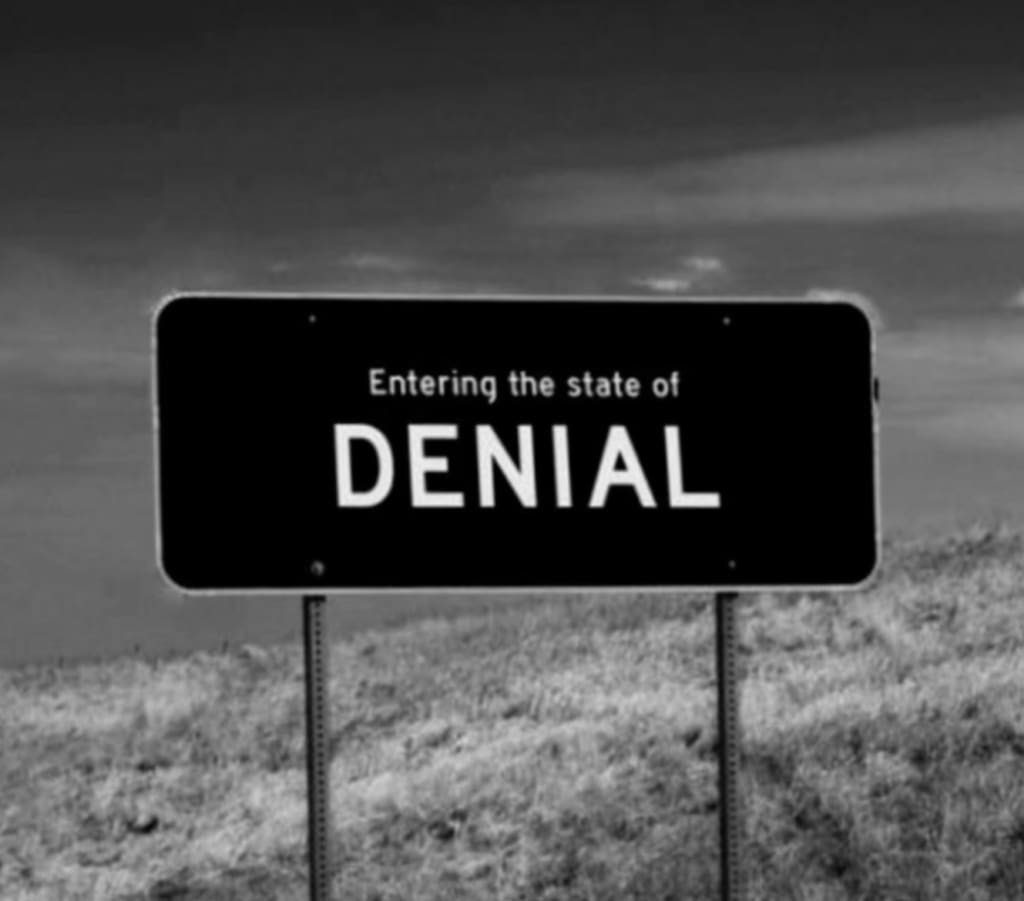
Denial is a shadowed sanctuary, a refuge carved from the marrow of the mind where truths, dreadful and unrelenting, are banished to languish in obscurity. It is the fortress we erect against the storms of reality, its walls woven from whispers of what if and not yet, its gates sealed by the trembling hand of fear. Yet, as with all fortresses, denial is not impenetrable—it is a fragile edifice, and within its hollow halls, echoes of the forsaken truth grow louder with each passing moment, a dirge for the inevitable reckoning to come. To dwell within denial is to inhabit a house built upon shifting sands, where each grain is a fragment of the reality we refuse to confront, accumulating beneath our feet until the weight of avoidance collapses the structure entirely.
There is a certain comfort in denial, a seductive allure that tempts us to turn our gaze from the mirror of truth and instead cast our eyes into the void of forgetfulness. This comfort, however, is a cruel jest, for it offers not peace but reprieve—a fleeting respite from the inexorable march of time and consequence. Like the ticking of a clock muffled by a silken shroud, denial does not halt the passage of events but merely obscures their sound, lulling us into a false sense of serenity. And yet, within the silence, there is a pulse, a rhythmic reminder that the truth, though buried, still lives, still breathes, still waits.
Philosophers and poets alike have wrestled with the nature of denial, each seeking to unravel its mysteries and lay bare its paradoxes. Friedrich Nietzsche, that prophet of chaos and will, spoke of the peril of avoidance, declaring that “What we deny gains power over us.” To deny, he argued, is to relinquish our agency, to cede control to the very forces we seek to escape. In the act of denial, we become prisoners of our own fear, bound by chains forged from the truths we refuse to bear. And yet, Nietzsche’s philosophy does not despair—it beckons us to confront the abyss, to embrace the totality of existence, for it is in the acceptance of life’s darkness that we discover its light.
Jean-Paul Sartre, too, peered into the labyrinth of denial, naming it an act of mauvaise foi, or bad faith. For Sartre, denial is a betrayal of the self, a refusal to acknowledge the freedom and responsibility that define human existence. To deny is to flee from authenticity, to construct a façade of falsehoods that shield us from the weight of our choices. Yet, this façade is not without cost, for in denying the truth, we deny ourselves, severing the connection between who we are and who we might become. Sartre’s existentialism demands that we cast aside the veil of denial and step boldly into the light of our freedom, no matter how blinding or terrifying it may be.
But perhaps it is Albert Camus who offers the most poignant meditation on denial, framing it as a response to the absurdity of existence. Life, Camus tells us, is a riddle without an answer, a dance upon the precipice of meaninglessness. Denial, then, becomes a retreat from this absurdity, a desperate attempt to impose order upon chaos. Yet, Camus does not condemn this retreat—he understands it, even sympathizes with it. For whom among us has not sought shelter from the storm? Who has not, at one time or another, clung to the illusion of control in a world that defies comprehension? And yet, Camus urges us to resist this impulse, to confront the absurd with defiance and courage, for it is in this confrontation that we find our freedom.
Psychologically, denial is no less enigmatic, a mechanism of the mind as ancient and primal as fear itself. Sigmund Freud, that cartographer of the unconscious, described denial as a defense of the ego, a bulwark against the tidal waves of trauma and despair. To deny is to protect, to shield the self from the unbearable weight of reality. And yet, this protection is not without peril, for the truths we bury do not rest—they fester, they grow, they rise. Repressed emotions seep into the cracks of the psyche, manifesting as anxiety, anger, or sorrow. The mind, like a haunted house, echoes with the footsteps of the unresolved, each creak and groan a reminder that the ghosts of denial cannot be exorcised through avoidance alone.
Why, then, do we cling so desperately to denial, knowing its cost? Perhaps it is because denial offers something reality cannot: the illusion of control. To deny a problem is to declare mastery over it, to assert that it holds no power over us. Yet this mastery is a mirage, a cruel trick played by the mind upon itself. The crack in the dam does not vanish when ignored—it widens, it deepens, it waits. Denial, then, is not a solution but a postponement, a wager against inevitability that we are doomed to lose.
And yet, there is beauty in this folly, a tragic splendor that speaks to the resilience of the human spirit. For denial, though flawed, is born of hope—the hope that tomorrow will be kinder, that the storm will pass, that the truths we fear will fade into nothingness. This hope, though misplaced, is a testament to our capacity for endurance, our refusal to surrender to despair. To deny is to dream, however fleetingly, of a world without pain.
But dreams, like all things, must end, and when they do, we are left to face the dawn of reality. What, then, does it mean to awaken from denial? It means to confront the truths we have buried, to unearth the fears we have hidden, to stand before the mirror and see ourselves as we truly are. It is a painful process, to be sure, but it is also a liberating one, for in the act of confrontation, we reclaim our power. As Rumi wrote, “Try not to resist the changes that come your way. Instead, let life live through you.” To break free from denial is to embrace life in its entirety, with all its beauty and pain, its light and shadow.
And so, we return to the question: why do we deny? Perhaps it is because we are human, and to be human is to long for comfort, even when it comes at a cost. But in seeking this comfort, we must not forget the price we pay, nor the freedom that awaits us when we choose to face the truths we fear. For in the end, denial is not an escape—it is a detour, a winding path that leads us, inevitably, back to ourselves.
For denial is not the absence of truth, but the shadow it casts—and to step into the light is to reclaim the power we once surrendered to the dark!
About the Creator
Nazia Syed
A quiet observer, lost in thought, weaving the threads of life into stories that capture the unspoken truths we all share.
Keep reading
More stories from Nazia Syed and writers in Families and other communities.
“Conspiracy Theories: Labyrinths of Shadows and the Poetry of Paranoia”
There is something profoundly human about the allure of conspiracy theories. They arise not simply as explanations for chaos, but as manifestations of our deepest anxieties and desires. They speak to a part of us that is both terrified of the unknown and irresistibly drawn to it, yearning to impose meaning on an existence that often seems incomprehensible.
By Nazia Syedabout a year ago in Critique
The Man with the Jacket Haunts My Childhood Memory
We were in a hurry. Mother always walked fast, but I struggled more than usual to keep up with her as we sped through the train station with her suitcase. She held my hand and dragged me along behind her, her oversized purse swinging from her shoulder, clunking into my head with every step.
By Georgia Kreigerabout 14 hours ago in Families




Comments
There are no comments for this story
Be the first to respond and start the conversation.