

The first thing he noticed was the carpets in the room: blood-red fabric laced with a hectic array of beige and black lines that didn’t seem to follow any pattern. The air felt heavy as he took a seat in the guest chair. A wiry man with circular glasses and a mismatched suit sat opposite him at a large oak desk, behind which were dozens of bookshelves ranging from law encyclopedias to directories of funeral services. If someone had asked him to describe what he expected to see today, he would have described this down to the last detail.
“Glenn Harrington, is that correct?” the wiry man rigidly inquired.
Glenn nodded without speaking. He wanted to maintain a stoic appearance in the face of this meeting, but the call had come as a shock. For years he had all but forgotten the name Jack Harrington, and given the choice he would forget again. Yet here he sat before the arbitrator of his father’s will, waiting to find out what had been left to him by a man he hadn’t seen in more than thirty years.
“Very well, Mr. Harrington,” he continued. “And you’re aware of why you are here today, is that correct?”
He nodded once more.
“Before we begin, one of the terms of your inheritance is that you first receive and read a piece of correspondence from your father. The original copy was damaged, and the late Mr. Harrington consented to have it retyped and printed for your convenience.” He opened a folder on his desk and removed a large manila envelope, sliding it across the polished wood to Glenn’s side.
His heart raced as he gazed at the yellow paper, the only barrier between him and the first – and last – words he would hear from his father in decades. He closed his eyes so tightly that, for a moment, a thin wrinkle formed between them, crossing over the bridge of his nose. He inhaled deeply, opened his eyes and answered, “I don’t want it.”
“Mr. Harrington, I realize that this is a very difficult time for you. However, I am legally required to honor the last wishes of your father, within all appropriate legal boundaries, of course. A contingency of this inheritance is that you read his parting words, and I may not continue these proceedings until this has been done. Please, take your time.” He gestured at the envelope with an open palm.
How could this man possibly know how difficult this was? Had the arbitrator known who Jack Harrington really was, known the full extent of what he had done, he never would have picked up the phone. Glenn considered walking out of the meeting right then, even to the extent of sliding the legs of this barely comfortable chair a few inches away from the desk. What could Jack possibly have to say to him? He supposed a dying man could be beyond shame, unaccountable to any actions he made at the end of his life. But then, he thought, Jack had never been accountable for anything in the first place, so why should this be any different? Finally, overcome with a morbid curiosity for what the man who was only his father in name had to say, he clasped the metal clip of the envelope in his fingers, and slowly removed a few sheets of paper from inside. The first words assaulted his eyes as he began to read:
“My Son,
As I write these words, I know that it’s very likely you will never read them, just as I know that I will take my last breath without ever laying eyes on you again. I have contemplated for too long exactly what I would say to you if I ever had the chance. Would I apologize for all the things I have done and try to beg your forgiveness, or make an attempt to explain why I made the choices I did and hope you would understand?
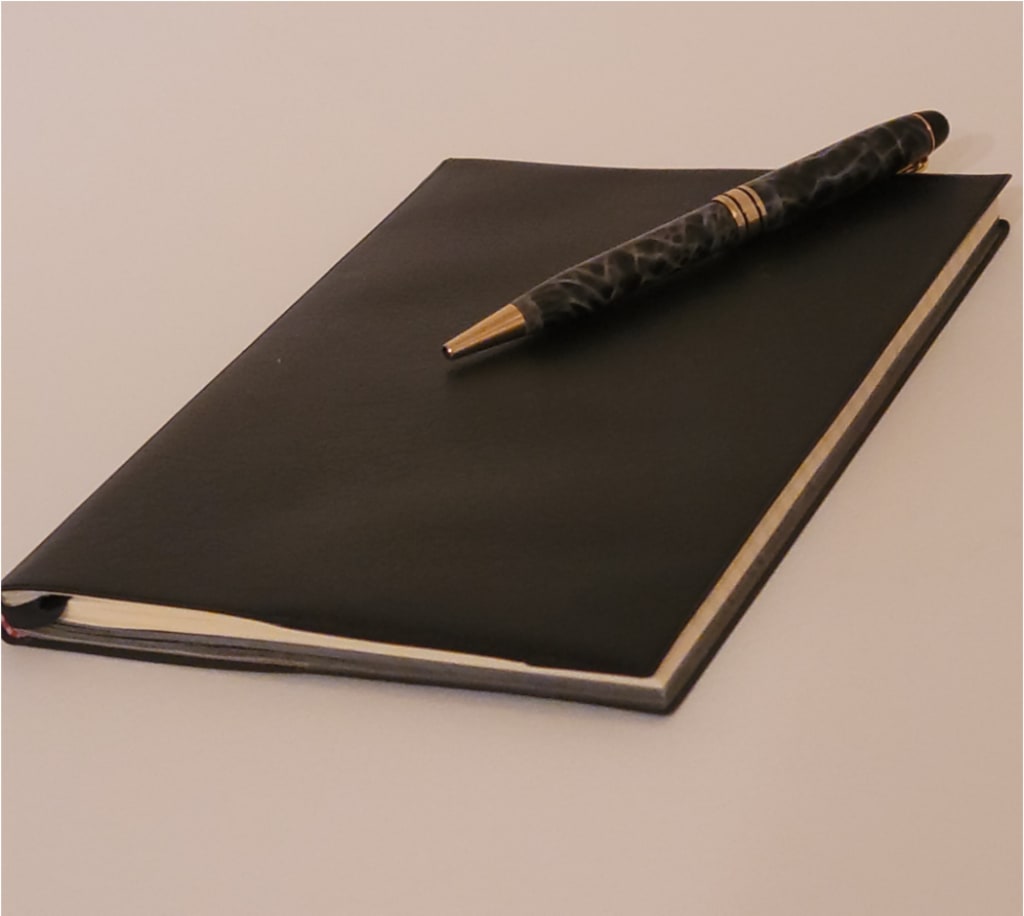
The logical conclusion is that the only chance that remains is to leave the last of my sane thoughts scribbled across the pages of this tiny black notebook gifted to me by nurses who, up until recently, did not want to look in my direction. The fact that they are all suddenly so attentive only serves to verify what I have known for months: I am soon to die. My body may live for a short time longer, but the man I used to be – the man who remembers your name, and who can still smell the baby powder and shampoo on your skin from when you were just an infant – will soon be gone, replaced by an empty, belligerent shell who doesn’t even comprehend where he is, or know the current year.
Of all the ways I would have imagined that my life would end, this fate never occurred to me. An awful odor like bleach and old milk surrounds me as I wander in these halls, listening to those who have progressed to the final stages of this terrible condition, screaming at those who try to help them and searching for loved ones who died long ago, and I know that very soon I will be among them. Before I forget who you are, I want you to know the things I can still recall.
The day you were born, while your mother held you in that hospital bed, you reached your little hand up and gripped my pinky so tightly I thought you would break it. I couldn’t imagine how someone so tiny could be so strong. I said a prayer to god that day that after all the love I felt for you, there would still be enough left in me to share with anyone else.
When you were two years old, we took you to your cousin Miranda’s wedding. I imagine you were too young to remember being the ring bearer that day. We had you fitted for a tiny black zoot suit and searched everywhere for a matching fedora. You looked like a little gangster, and you ran up to every aisle in that church to show everyone the pillow and ring you were carrying. When you finally made it to the altar, everyone thought you started dancing, until your cousin realized you just needed to use the bathroom. I’ll never forget the smiles and laughs as I escorted you to the back of the church while the wedding continued. At least, I always told myself I wouldn’t forget, but I’m sure the days of that memory are numbered as well.
The day I got my sentence handed down to me, you sat with your guardian ad litem in the courthouse. I had always imagined that someone being sent to prison would be fixated on thinking about themselves and what the coming years had in store, but the only person with whose future I was concerned that day was you. I can still hear your little voice yelling ‘I want candy!’ as the judge declared that I would be spending the next fifteen years in prison. Fifteen years of no baseball games, no girls, and no teaching you how to drive or shave. If I could relive that day, I would jump over the seats and push past the bailiff just to try to make it to a vending machine, to buy you a piece of candy… to be your father one last time.
I spent every day inside thinking about you and your mother, imagining what it would be like to finally see you again. When you were a teenager, your foster parents brought you to see me inside. I looked at you through that plated glass, and your hair had grown into your face and you had pimples on your chin. Trevor and Jen were very cordial with me; I could tell that they cared a great deal about you. But I’ll never forget (I say again) the look in your eyes that day. You looked down at the floor the whole time you sat in front of me. Was it hatred in your eyes? Disappointment? Boredom? All I know is that on that day, I realized that I was no longer your father.
Jen sent me photos from your high school graduation while I was inside. I kept them taped on the wall over my bed, and said good night to you every day, filled with pride at how much you had grown. I had hoped that with good behavior, I might be out in time to be there for the ceremony. Even as I write this, it seems a terrible excuse to say that good behavior is a tall order for someone locked in a building with dozens of killers. As it happened, you were old enough to drink by the time I walked out the penitentiary doors, and high school was already a fading memory.
I almost dare not write about your mother. No apology or explanation could possibly be enough to deserve your forgiveness for what I did. I know that now. You grew up without a mother because I killed her, and I realize that’s all you will ever remember about me. If I told you that I did it to protect you, would it make a difference? Your mother loved you just as much as I do, and she was a good mother. I have thought about her every day since she died and imagined so many scenarios where I saved both of you from that crash. I imagined myself being dead, and you growing up with her. In truth, I wish that had been the outcome. And more than anything else, I imagined that for just one night, just that one night, that I had set down the drink menu and stayed sober, or at least handed your mother the keys. I imagine the last memory I will lose is of her, locked in that car as it sunk into the water, kept prisoner by a warped safety belt. But in that moment, son, looking back at you in that seat, I knew I had to make a choice. I let your mother drown to save you, and I have lived with that knowledge for nearly forty years.
No matter who you are today, I am proud of you. I imagine all the things you will accomplish in your life, and this gives me a bit of hope that in spite of my mistakes, you will be okay. I know I am no longer your father, but you will always be my son.
With love,
Jack Harrington”
As he held the last of his father’s words in shaky hands, pools of water collected in the corners of his eyes, turning to salty red streaks down his cheeks. He set the papers down in front of him, composing himself for a moment before returning his eyes to the man across from him.
“Very well, Mr. Harrington. Your section of your father’s last will and testament reads, ‘On the day of my death, twenty thousand dollars and zero cents shall be left to my son, Glenn Harrington.’ All I need from you is a signature.” He slid another piece of paper across the table, clipped with a ball point pen. The top of the page read AFFIDAVIT OF INHERITANCE.
Standing from his chair, Glenn took the pen in his fingers, breathing deeply to suppress any further emotion. Searching for the signature line at the bottom of the page, he scribbled quickly and handed the paper back to the arbitrator. “Thank you,” he said in a weak voice, and promptly left the office.
The man at the desk adjusted his glasses and scanned the page for anything he may have missed. On the signature line at the bottom of the page read only one word: REFUSED.
About the Creator
Wen Parker
I'm a Maine man with a passion for fitness and nutrition, and an active imagination. Thanks for reading!
Keep reading
More stories from Wen Parker and writers in Families and other communities.
The Internet
It’s been said that most poor white Americans don’t view themselves as poor, but rather as “temporarily embarrassed millionaires”. They aren’t real poor people, because real poor people just haven’t had the work ethic or discipline to realize their American dream: they’re too cowardly to embrace their entrepreneurial spirit, to open their small business and watch it grow into an international corporation; they’re too lazy or incompetent at their jobs to climb the company ladder and collect the kind of money that’s up there waiting for them; or they’re simply too stupid to do it. And most poor white Americans view themselves as one of the special few who are only impoverished because of a string of bad luck that’s sure to end, just as soon as they get that promotion that’s right around the corner or go long enough without car trouble to save up and start the business they’ve always wanted. Of course, this is evidence enough of their misunderstanding of what a millionaire really is, and what it takes to become one.
By Wen Parker5 years ago in Journal
Wise~Guys
— Look Behind what's in Front of You ~ Make Good Choices — Hey, So how you Doin'..! Made~Men — Mobster Movies romanticise a distinctive, elegant appearance, impeccable attire style, along with the 'Families' expressive lingo. Making their 'Bones' gave them Panache — with vintage fedoras, tailored pin-striped suits, mirror-polished wing-tip shoes adorned with tassels; with their 'Gun Moll' gorgeous dates on their arms.
By Jay Kantor23 days ago in Families



Comments
There are no comments for this story
Be the first to respond and start the conversation.